Robot half marathon lifts related Chinese stocks as manufacturing strength and improving business climate drive sector growth
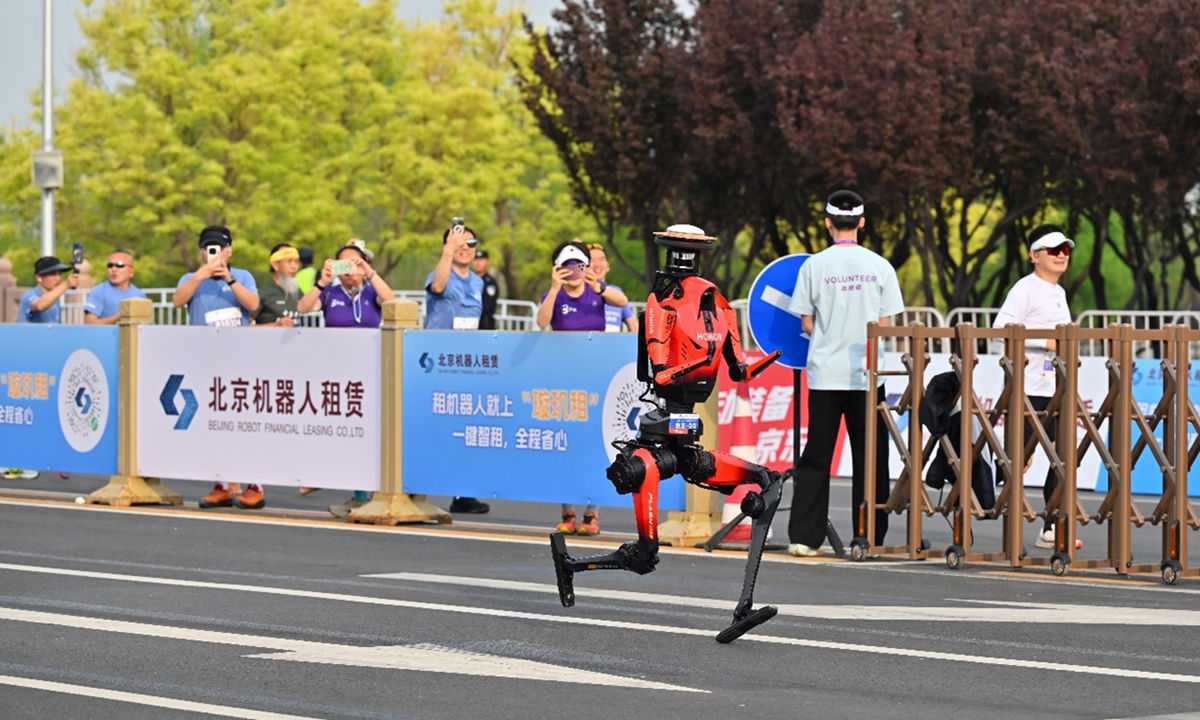
An HONOR Robotics D1 humanoid robot, dubbed "Lightning," runs at the 2nd Humanoid Robot Half Marathon held in Beijing on April 19, 2026. Photo: Tao Mingyang/GT
Shares of Chinese robot-related firms rallied sharply at the close on Monday, buoyed by the strong performances of robot runners at the 2nd Humanoid Robot Half Marathon in Beijing on Sunday, with several stocks hitting their daily limit-up. Multiple component suppliers related to the championship robot runner said that their products have already entered mass delivery.
Shenzhen Stock Exchange-listed Jirfine Intelligent Equipment Co saw its shares rise by more than 15 percent on Monday morning. Beijing Dahao Technology Co hit its daily limit-up of 10.03 percent. Other related companies, including Ningbo Shenglong Group Co and Tellhow Sci-tech Co, had also reached their daily limit-up as of press time.
Six Robotics' D1 humanoid robots, dubbed "Lightning," from Chinese smartphone maker HONOR — three autonomous navigation units and three remotely controlled units — swept the top six positions of the 2nd Humanoid Robot Half Marathon, according to the company.
The championship team slashed last year's winning time of about 2 hours and 40 minutes, set by Tiangong Robot, to 50 minutes 26 seconds, also outpacing the man's half marathon world record of 57 minutes 20 seconds recorded by Ugandan runner Jacob Kiplimo in 2026 at the Lisbon Half Marathon.
Domestic LiDAR manufacturer Hesai said in a statement to the Global Times on Monday that all six HONOR "Lightning" robots were equipped with its JT128 mini 360 degree lidar. The company noted that cumulative deliveries of the JT series have exceeded 300,000 units, with successful deployment across multiple embodied intelligent robot products, and future expansion into industrial, agricultural and service robotics.
LY iTECH said on its WeChat account on Monday that 159 core structural components of the HONOR "Lightning" robots were produced at its factory in Dongguan, South China's Guangdong Province, covering key motion units including hips, legs, feet and torso, achieving zero faults and zero failures throughout the race. As one of the first suppliers to support Honor's robot research and development (R&D) and manufacturing, the company said that related products have already been delivered at scale.
Precision manufacturing provider Lens Technology said via its official WeChat account on Sunday that 132 core metal structural components used in two of HONOR's competing robots—covering the head, arms, hips and legs—provided key support for flexible movement and stable race performance.
The company said that it has transferred quality control and delivery models from the consumer electronics sector to HONOR's robot project. In terms of materials, high-strength steel was adopted, with specialized vacuum heat treatment significantly enhancing hardness and tensile performance. This decision enabled lightweight design while significantly enhancing durability to support long-duration, high-intensity operation, said the company.
A total of 102 teams participated in this year's event, with 47 successfully finishing the race. Among them, 18 teams completed the race using autonomous navigation, while 29 relied on remote control, bringing the overall completion rate to more than 45 percent. In comparison, only six out of 20 teams finished in the inaugural race. Analysts said that the sharp increases in participation and completion reflected leapfrog development in China's humanoid robotics industry within just one year.
Compared with last year, the significant progress of humanoid robots in this year's event reflected China's advances in technological innovation and new quality productive forces. In the field of artificial intelligence, China has consistently upheld openness, inclusiveness, and development for all. China will continue to promote international cooperation, enabling technological innovation to drive shared development and benefit people around the world, Foreign Ministry spokesperson Guo Jiakun said on Monday, in response to a question regarding the 2026 Beijing E-Town Humanoid Robot Half Marathon held on April 19.
After watching the race on-site, Liu Dingding, a veteran industry observer, told the Global Times that the winning robot reflected collaboration among multiple suppliers and partners, underscoring the rise of China's manufacturing, industry and intelligent capabilities.
"Such results are closely tied to the strengths of a mature and comprehensive manufacturing ecosystem, such as that seen in China," Liu said.
An article published by International Data Corp (IDC) via its official WeChat account on Monday said that the event showed significant improvement over 2025 in terms of scale, technological complexity and industry participation, demonstrating the sector's progress toward commercial adoption.
IDC predicted that global humanoid robot shipments will exceed 510,000 units by 2030, with a compound annual growth rate of nearly 95 percent, according to the report.
RELATED ARTICLES