Three sports events reflect the surging 'new' wave of China's economy: Global Times editorial
Listen
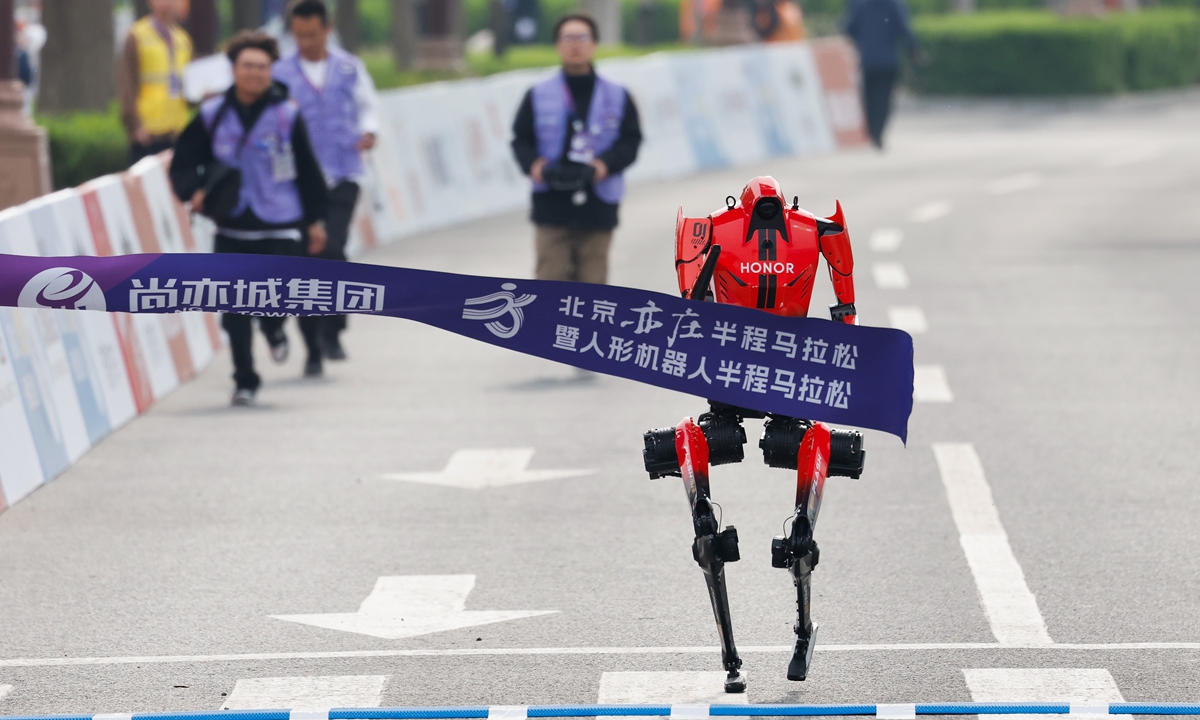
The Robotics D1 humanoid robot, developed by Chinese smartphone maker HONOR and nicknamed "Lightning," crosses the finish line in 48 minutes and 19 seconds in the remote-control category at the second Humanoid Robot Half Marathon in Beijing on April 19, 2026. Photo: VCG
Chinese society has been quite lively these past few days. In Beijing, at the second edition of a humanoid robot half-marathon, a robot broke the human half-marathon world record for the first time, dazzling the international media. In Jiangsu Province, the 2026 Jiangsu Football City League - "Su Super League," also known as Suchao in China - which kicked off in mid-April, has ignited a frenzy of online and offline celebrations with each match. In Shanghai, the 2026 China GT Championship has attracted a record number of participants, evolving from an event for a "niche group of enthusiasts" into a cultural phenomenon to which everyone is flocking to experience. Held in close succession and generating overlapping buzz, these three sports events are like three vibrant forces surging across the Chinese landscape, reflecting the most real and vivid aspects of Chinese modernization from different perspectives."Humanoid robots outperforming human competitors demonstrate rapid progress," and "China's technological prowess has been fully showcased"… As foreign media marvel at the leap from "tentative first steps" to "steadier and stronger" in China's robotics sector, it signifies that one technological "hard nut" after another has been cracked. Following ZXMOTO's championship victory and the F1 Chinese Grand Prix's "breakout success," a new Chinese "consumer trend" is simultaneously gaining momentum - the "motor racing economy" - which has also been directly validated in the China GT races. Estimates suggest that by 2029, the total scale of China's auto and motorcycle sports industry is expected to reach 500 billion yuan ($73.34 billion). It is foreseeable that, through continuous refinement in this vast market, an increasing number of Chinese drivers will take to international circuits, and more brands like ZXMOTO will lead the way.
At the same time, the "Su Super League" has not only taken the lead in converting sports engagement into economic growth but has also conveyed a sense of "human warmth" - no wonder foreign media have dubbed it China's "grassroots World Cup." Whether it's inviting a Chinese actor, who recently went viral for his portrayal of a legendary general in Chinese history Xiang Yu, to support the event or ensuring that "even small and micro firms can secure a spot on the billboards," this down-to-earth approach remains the core driving force behind why people watch and love "Su Super League."
With events including the "Chu Super League," "Guangdong Super League," and "Qilu Super League" all kicking off in full swing this year, they collectively paint a picture of China's economy that is both innovative and vibrant, yet also warm and welcoming.
Three sports events, spanning the north and south of the country and encompassing diverse content, together reflect the immense scale, rich layers, and development potential of China's super-sized market, as well as the people's growing aspirations for a better life. While there may be some coincidental factors in these events going viral, there is an inevitability behind that coincidence. From tech arenas to sports stadiums, from high-end manufacturing to popular culture, China continues to unleash astonishing breakthroughs in various fields and at different levels. These bursts of progress are not accidental, isolated achievements but the inevitable result of China's long-term accumulation and sustained efforts - a genuine release of the society's innovation and creative vitality.
This serves as a vivid illustration of Chinese modernization. It not only has scientific theoretical explanations and a futuristic vision of technology, but it also has vivid and tangible practices that are deeply rooted in the people. From technological iteration in science parks to smart infrastructure embedded in streets and neighborhoods, innovation is steadily moving out of laboratories and into ordinary households, making convenience and efficiency the norm in daily life. Today, "Intelligent Manufacturing in China" is no longer content with merely producing or selling well; it aims to excel across tracks, brands, technologies, and aesthetics - striving to move faster, speak louder, and go further. At the same time, the diversification and upgrading of consumption have turned many once-niche demands into mainstream trends, reflecting not only rising purchasing power but also growing cultural confidence.
This kind of development, marked by high quality and a human touch, translates at the international level into a compelling appeal that is hard to resist, especially among younger generations. When "becoming Chinese" trends on overseas social media, Chinese-style security brings great peace of mind to overseas bloggers and even "Chinglish" enters popular culture, even those Western voices most reluctant to acknowledge China's achievements have had to concede that it may signal "young people in the West beginning to envy the Chinese way of life." As China continues to make breakthroughs in high-end manufacturing and intelligent technologies, and as the quality of life for its people steadily improves, more and more foreigners, particularly the young, are recognizing the vast possibilities inherent in China's development.
China's foreign trade grew 15 percent year-on-year in the first quarter of 2026, with GDP growth reaching an "unexpected" 5 percent, achieving a strong start for the first quarter of the 15th Five-Year Plan. This impressive report card resonates with these three major events, together outlining the strong pulse of the Chinese economy. Amid increasing uncertainty in the external environment, China has demonstrated through practical actions that it is steadily moving forward and continuously injecting positive energy into the world. This stability is reflected in every technological breakthrough, in the efforts of each sports event, and in the striving endeavors of every Chinese person.
The running of robots, the cheers on the green fields, and the roar of the tracks - the progress, vitality, and breakthroughs showcased by these three events - are a microcosm of China's development.
In the future, as Chinese modernization continues to advance, China will undoubtedly shine in more fields, consistently providing the world with stable development expectations and strong development momentum. Such a vibrant, steadily advancing, open, and inclusive China is worth looking forward to by the world.
RELATED ARTICLES