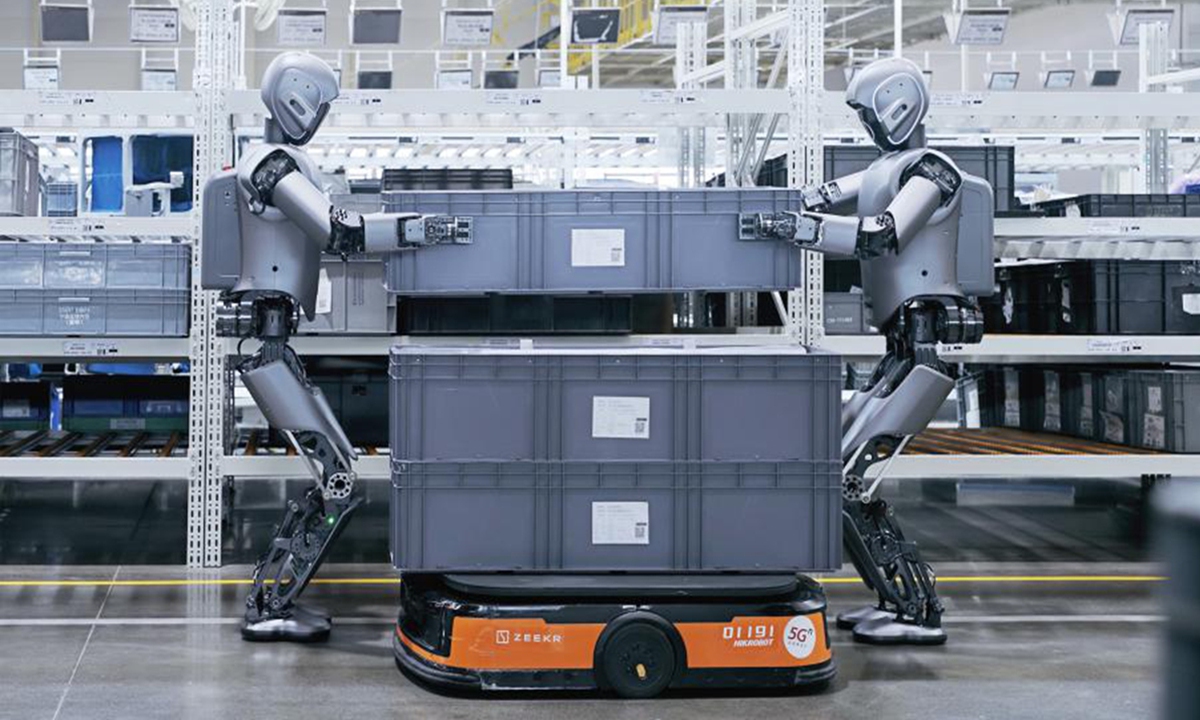
Dozens of UBTECH industrial humanoid robots, Walker S1, are collaboratively handling large and heavy payload bins. Photo:UBTECH
Editor's Note:
Currently, China's economy is steadily advancing along the path of high-quality development, even as domestic and international circumstances become increasingly complex. Some Western media, due to misunderstanding or bias, have repeatedly questioned or even distorted China's economic development. Accordingly, the Global Times launches the "Q&A on China's Economy" column to publish opinion pieces to present facts and clarify perceptions.
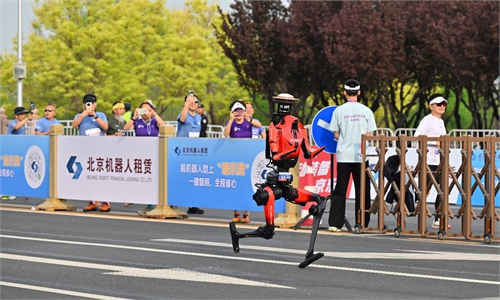
Are Chinese robots "only able to dance and run"? This has become a recurring question raised by some Western media outlets in recent months. A British outlet recently commented on robot performances in China, claiming that what these robots do is the "result of being trained for a routine hundreds or thousands of times" and that "stage performance does not equate to industrial robustness." Some European media have even gone so far as to ask in their headlines: "China's robots can dance. What else can they do?"
The problem with this line of thinking begins with a conceptual sleight of hand: equating "being able to dance and run" with "being only able to dance and run." The difference between the two is obvious. What the public sees as robots "dancing" or "running" is, in fact, a visual demonstration of technological breakthroughs. For a robot to synchronize precisely with musical rhythms, execute smooth and natural movements, and maintain balance during complex routines, it must rely on high-precision servo control systems, efficient algorithmic coordination, and the stable support of core components. This represents an extreme test of core technologies such as balance perception and motion control.
In other words, the very technologies that enable robots to "dance" are fundamentally the same as those required for practical applications such as industrial production, household services, disaster response and gentle support tasks. Stage performances are, in essence, a visible showcase of advanced coordination and the maturity of underlying technologies. They also serve as a stepping stone toward broader diversified applications and the ability to undertake complex tasks. If a robot can dance well, it is precisely because it has already overcome multiple key technical challenges and developed the foundational capabilities needed for diverse practical operations.
Another common argument suggests that AI chip computing power matters more and that China still lags behind the global cutting edge in this area. This view is equally one-sided. While AI chips - the "brain" - are undoubtedly important, without breakthroughs in motion control, core components and application scenarios, the large-scale deployment and practical use of robotics would be significantly hindered. Chips and robots are not in opposition; rather, they are interdependent and co-evolving. From deep-sea exploration to outer space missions, from smart factories to smart cities, and from precision medicine to inclusive elderly care, the future evolution of robotics will depend on the coordinated advancement of both "brains" and "limbs," as well as the deep integration of hardware and software.
In fact, robots have already been widely deployed in many industries across China, and dancing and running are actually the very few tasks they perform. In industrial workshops, robots precisely carry out high-intensity tasks such as welding, assembly and transportation, replacing human workers in high-risk and repetitive processes to support the transformation and upgrading of the manufacturing sector. In the medical field, surgical robots, with their millimeter-level precision, assist doctors in performing complex minimally invasive surgeries, reducing surgical risks and improving treatment outcomes. At disaster sites, specialized robots venture into areas inaccessible to humans - such as rubble, high-temperature zones and toxic environments - to carry out search-and-rescue, detection and hazard mitigation tasks, buying precious time for life-saving efforts. In household settings, robotic vacuum cleaners and elderly care robots have entered millions of homes, streamlining daily life and alleviating the burden of elderly care. These application scenarios across various sectors have long dispelled the one-sided perception that robots "can only" dance or run.
After years of technological breakthroughs and deep industry cultivation, China's embodied intelligence industry has gradually achieved full-chain coverage - from core components and whole-machine manufacturing to scenario applications and system integration. It has made globally acclaimed achievements across multiple dimensions, including core technologies, market scale and application breadth, with some sectors ranking among the world's best. At the same time, Chinese companies have become deeply embedded in and supportive of the world's top robotics supply chains. Numerous overseas humanoid robot startups, including Germany's Neura Robotics and the US' Figure AI, widely use Chinese components and even choose to complete full-scale integration and small-batch pilot production in China. According to estimates by Morgan Stanley, by leveraging a comprehensive supply chain, China can reduce the manufacturing costs of humanoid robots by as much as two-thirds.
To simplistically equate Chinese robot technologies with "being only able to dance and run" is, at its core, a one-sided view of the development of China's robotics industry, overlooking the underlying breakthroughs in core technologies and their extensive application value. The development of China's robotics industry has never been about mere "aesthetics." It is grounded in technology and application-oriented, steadily advancing along the path of independent innovation. This approach not only addresses domestic shortcomings but also contributes Chinese strength to the global robotics industry. In the future, as technologies across the entire supply chain continue to evolve, Chinese robots are bound to shine in more uncharted fields, dispelling further prejudices and misconceptions.
RELATED ARTICLES