ARTS / CULTURE & LEISURE
Citizens unite to protect and share stories of Nanjing’s 660-year-old wall
Brick by brick
By Published: Apr 22, 2026 10:06 PM

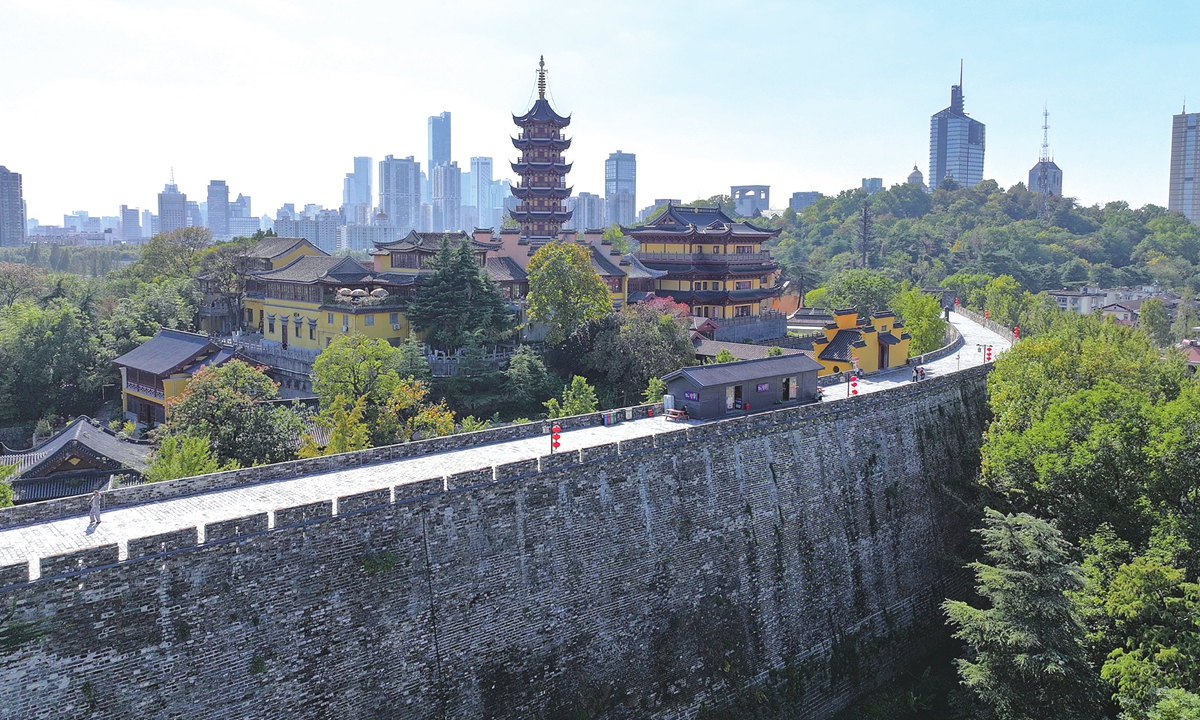
The Ming Dynasty Nanjing City Wall Photo: VCG
Six hundred and sixty years ago, under the order of Zhu Yuanzhang, the founding emperor of the Ming Dynasty (1368-1644), an ancient city wall began rising brick by brick in Nanjing, East China's Jiangsu Province. Each brick was engraved with the names of the craftsman and the supervising official, forming China's largest existing "open-air library of brick inscriptions." Over the centuries, many bricks have become scattered among the local people due to the passage of time. Today, a public initiative called "Bring Each Brick Home" has been gathering these scattered bricks from streets, neighborhoods, and construction sites, returning them to their original posts, and pioneering a new trail for public participation in heritage conservation.Recently, one brick engraved with the name "Liu Dehua" - the exact same characters as the Chinese name of Hong Kong superstar Andy Lau - captured widespread public attention, sparking renewed interest in Nanjing's ancient wall.
The original four-layered wall stretched around 35 kilometers around the capital, with 25 kilometers still standing today. To protect this valuable heritage, the Nanjing City Wall Protection and Management Center launched the campaign, seeking public clues to report and donate scattered bricks, sparking a citywide movement to find, save, and restore the city's lost history.
Zhao Mengwei, director of the Academic Research Department at the Nanjing City Wall Protection and Management Center, told the Global Times that, in the process of collecting the bricks, many residents shared their own stories and family connections to the wall.
"People tell us about their ties to the wall or their family histories, and often move themselves to tears. For those who have left Nanjing, the city wall also stands for their hometown. This emotional connection ensures cultural heritage is no longer cold and distant," she said.
This sense of connection, Zhao noted, is not only a direct display of the relationship between people and heritage, but also a motivation for the city wall's application to become a part of the World Cultural Heritage site.
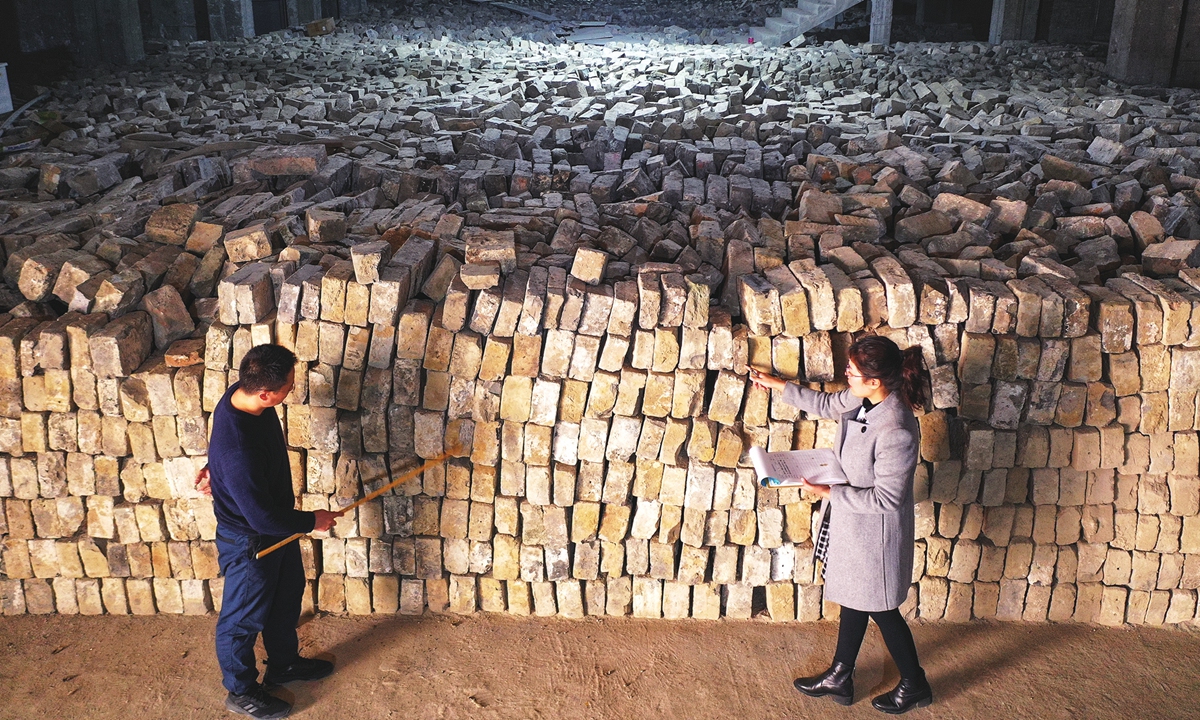
Experts examine bricks from the city wall. Photo: Courtesy of the Nanjing City Wall Protection and Management Center
Bringing bricks 'home'After the "Bring Each Brick Home" project was launched, many Nanjing residents took it upon themselves to search for and return city wall bricks. There are many moving stories. Xie Zhuru, now in her 90s and the widow of a Nanjing University professor, had long cared about the wall's protection. She and her husband had collected scattered bricks, strapping them to their bicycle and storing them at home. When Xie heard about the project, she immediately contacted the project staff and donated all 12 bricks from her personal collection.
In 2017, city wall protection volunteer Dong Yueming began to patrol a factory wall built from ancient city bricks. For over seven years, he urged residents to protect the bricks and wait for the time to return them. He brought a water bottle on each visit to wash away dust so inscriptions would be clear to read and photograph. After the factory was finally abandoned, experts recovered about 20,000 bricks for preservation.
The recovery of the bricks follows a strict process. Once a clue is received, experts from the Nanjing City Wall Protection and Management Center hurry to the site to carry out a survey, especially at demolition sites where actions must be swift. After confirming the bricks' authenticity, all sides coordinate and trained professionals use hand tools to dismantle the bricks, avoiding large machines to prevent damage. The bricks are then packed on wooden pallets and stored in a dedicated warehouse.
So far, more than 600,000 city wall bricks have been recovered, and hundreds of useful clues have been submitted by the public over the past 10 years.
International interest has also been sparked by this call for public involvement. In November 2025, mayoral representatives from Brunei, Egypt, Germany, Italy, and other countries visited the Nanjing City Wall, studying the campaign and praising it as a good example, according to the People's Daily. Zhao noted that the project has also been awarded the Star of Discovery of 2023 Global Awards for World Heritage Education Innovative Cases, which was initiated during the 45th Session of the World Heritage Committee in 2023 by the World Heritage Institute of Training and Research for the Asia and the Pacific Region under the auspices of UNESCO.
Preserving digital 'life'
After entering storage, the precious brick inscriptions are carefully studied. To ensure these historic records are never lost, Xiao Fahua, a deputy director of basic operations at the Nanjing City Wall Museum, told the Global Times that a professional team has used digital technology to collect and organize the inscriptions. Tens of thousands of bricks and their inscriptions are now part of a large database - a vital asset for Ming history research.
"Brick inscriptions are important physical evidence of the construction history of the city wall. Through them, we can know the origin of each brick, the organization that made it, and even view the evolution of rural labor groups making bricks during the Ming Dynasty," Xiao said.
To prevent the loss of information from damage or decay, the protection center has also developed the "One Map" resource management platform. Using 3D laser scanning to record the city wall in detail.
For day-to-day protection, both technology and people's experience are essential. An expert at the protection center told the Global Times that staff regularly patrol different wall sections with handheld devices, using years of experience to identify and upload problems like weathering or plant growth, ensuring prompt care.
Currently, efforts are underway to build an even larger integrated digital platform. By combining information from many sources, this will eventually create a "digital city wall," thus preserving the spirit and knowledge of the wall forever.
RELATED ARTICLES