AmCham report shows US firms in China demonstrate resilience, confidence in the market; expert attributes it to complementarity in industries and technology in trade ties
China-US Photo: VCG
Despite global economic headwinds and heightened geopolitical risks, American companies in China continue to demonstrate remarkable resilience and confidence in the market. Half of the surveyed US companies still rank China among their top three global investment destinations, while 79 percent of respondents hold a positive or neutral outlook on the future of China-US relations in 2026, up 30 percentage points from last year, according to a latest report by the American Chamber of Commerce in China (AmCham China).
Chinese experts said that the report sent a clear message: US businesses remain deeply committed to the Chinese market and are optimistic about their long-term development in China.
Findings from the 2026 China Business Climate Survey Report released by AmCham China on Thursday showed that China remains a cornerstone for foreign investment, with 50 percent of respondents still ranking it among their top three global destinations, a testament to the market's strategic value and resilience. The rise of the Chinese consumer and continued market-opening reforms remain the most compelling opportunities for long-term growth.
The report also pointed out that China's continuous efforts to expand high-level opening-up and optimize the business environment have been well received. Companies particularly appreciate China's robust innovation environment, abundant artificial intelligence (AI) research talent and strong patent reserves, demonstrating strong resilience in high-tech fields, per the report.
"China has very developed competitive market. Every time China's market access expands, we appreciate that," AmCham China President Michael Hart told the Global Times on Thursday at a press briefing for the report release.
"For most of our companies, China continues to be very important part of their manufacturing supply chain," said Hart, adding that China going global has created new opportunities for US service sector firms.
AmCham China Chairman James Zimmerman also said at the press briefing that "overall, we've seen significant progress (in China's opening-up). Over the last three decades, market access has improved."
"China and the US enjoy strong complementary advantages in industries and technology. China's super-large market, complete industrial supply chain, and innovation ecosystem offer unique value that cannot be replaced," Li Yong, an executive council member of the China Society for WTO Studies, told the Global Times on Thursday.
"China's stable and predictable policy environment, combined with its ever-expanding market, provides a solid foundation for the steady development of US companies," Zhou Mi, a senior research fellow at the Chinese Academy of International Trade and Economic Cooperation, told the Global Times on Thursday.
China has continued to shorten its negative list for foreign investment, reduce tariffs, and improve the business climate, offering foreign investors a favorable environment for long-term growth, said Zhou.
On various occasions, Chinese officials have expressed willingness of the country to welcome foreign companies, as part of its efforts and commitment to high-level opening-up.
In terms of China-US ties, the vast majority of US companies view a positive and stable bilateral relationship as crucial to their operations in China, the report said.
Some 83 percent of member companies regard positive US-China relations as crucial to their China operations, rising to 86 percent in the technology and R&D sector. Despite ongoing tensions, 79 percent hold a positive or neutral outlook for 2026, reflecting the stabilizing effect of the Busan summit and high-level engagement between the two countries, per the report.
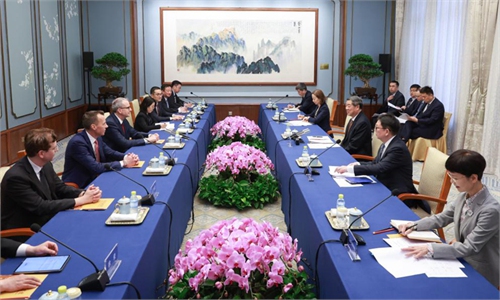
As one of the latest bilateral exchanges, China's International Trade Representative and Vice Minister of Commerce Li Chenggang met with Ford Motor Company Executive Vice President and Chief Policy Officer Steven Croley in Beijing on April 13, exchanging views on China-US economic and trade relations and Ford's development in China.
The Vice Commerce Minister said since last year, under the strategic guidance of the important consensus reached by the two heads of state, the two sides have held six rounds of economic and trade consultations and achieved a series of outcomes, injecting greater certainty and stability into bilateral economic ties and the global economy.
Hart also said at the Thursday press briefing that AmCham China called for more people-to-people exchanges and the APEC meeting, with China as the host, is a great opportunity.
"It's a little bit more urgent for members of the US administration and businesses to get back to the table and conversations with China," Hart noted.
However, Li Yong also pointed out that opportunities for China-US economic and trade cooperation lie in rebuilding communication mechanisms, leveraging complementary strengths in industrial chains, and pursuing collaboration under multilateral frameworks.
The report also pointed out that tariff escalation, expanding export controls, and policy unpredictability on both sides remain the top concern for AmCham China member companies across all sectors. And US-China tensions remain significant and rank well ahead of other concerns.
"The current main challenges stem from the US side: persistent tariff threats, the politicization of economic and trade issues that encourages supply chain relocation, a domestic hardline atmosphere that constrains corporate decision-making, and the US' full-chain suppression of Chinese companies operating in the US," Li Yong noted.
The US should stop ideologizing economic and trade relations, incorporate the chamber's appeals into negotiation agendas, and work with China to strengthen practical cooperation in the field of intellectual property, Li Yong stressed.
"China-US economic and trade cooperation has huge potential, and mutual benefit and win-win outcomes are the only correct path forward," Zhou said.
RELATED ARTICLES