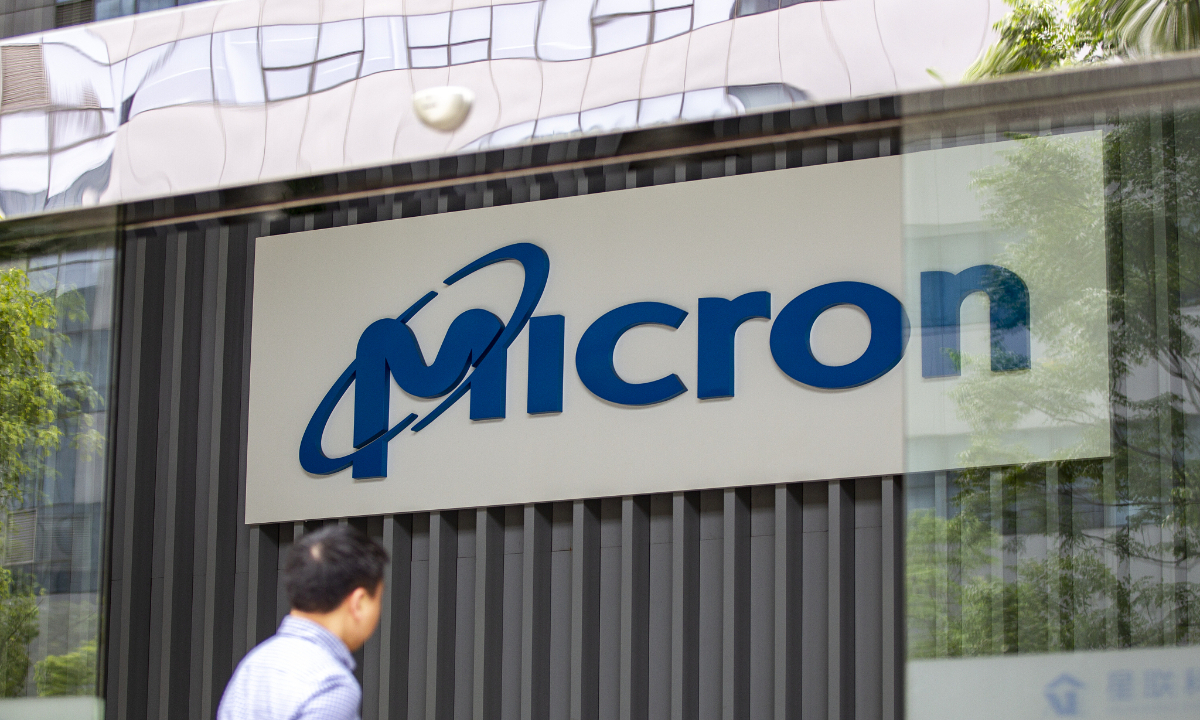
US-based semiconductor firm Micron Photo:VCG
A US House committee on Wednesday voted to advance the Multilateral Alignment of Technology Controls on Hardware (MATCH) Act, and US chipmaker Micron Technology is reportedly a driving force pushing the US Congress to pass the legislation that would impose new export restrictions on chipmaking equipment used by Chinese semiconductor firms, Reuters reported. Chinese experts said that hindering competitors does not serve to enhance one's own competitiveness, and Washington's attempts to impose restrictions over the years have already proven ineffective in curbing China's technological progress.
After passing the House committee, the bill must be approved by both the House of Representatives and the Senate before being sent to the White House to be signed into law or vetoed.
The bill specifically cited several Chinese integrated circuit companies, including ChangXin Memory Technologies, Hua Hong Semiconductor Ltd, Huawei Technologies Co, Semiconductor Manufacturing International Corp, and Yangtze Memory Technologies Corp. It claims that comprehensive export controls are necessary to prevent the Chinese firms from accessing products made with US technologies.
The Global Times sought comment from Micron, ChangXin Memory Technologies, and Yangtze Memory Technologies, but had received no response as of press time.
The unilateral US controls have severely disrupted the normal functioning of the global semiconductor supply chain and affected the international economic and trade order, Gao Lingyun, a research fellow at the Chinese Academy of Social Sciences, told the Global Times on Thursday. He stressed that Washington's long-standing attempts, including the erection of barriers, have already been proven ineffective in restraining China's technological advancements in such areas as artificial intelligence (AI), robotics and semiconductors.
Washington's chip export controls against China are increasingly triggering a backlash within the US domestic industry. US Commerce Secretary Howard Lutnick told a Senate hearing on Wednesday (US time) that "we have not sold them chips as of yet," referring to what he claimed hurdles Chinese firms face in securing government approvals, as well as China's policy focus on bolstering its domestic semiconductor ecosystem, according to a Reuters report.
In January, the US government gave a formal green light to exports of Nvidia's second-most advanced AI chips to China, but subject to stringent licensing requirements, third-party vetting and end-use restrictions, according to media reports.
Shipments have been stymied by disagreements over the terms of the sales on both the Chinese and US sides, Reuters reported on Wednesday, citing sources. In February, Reuters reported that sales of the chips to China were still pending a US national security review.
"Backed by a complete industrial system and a vast market, China's industrial development is difficult to contain," Gao said. Besides, "slowing others down does not make oneself run faster," he said.
The bill stipulates that within 180 days of enactment, and annually thereafter, suppliers based in US allied countries must submit lists of all covered semiconductor manufacturing equipment and entities owning or operating covered facilities, and must require licenses from both the US and the supplier country for exports of relevant items.
Gao noted that economic and trade exchanges between China and relevant countries had been stable and healthy, but the US goes all out to maintain its global dominance at the expense of undermining the actual economic interests of its allies, adding that as a result, some US allies may not fully comply, as doing so would directly harm their own interests.
China is the world's largest buyer of semiconductor manufacturing equipment and a major production base for mature-node chips. Forcing US allies to tighten export controls on semiconductor equipment destined for China would inevitably cause economic losses for countries that rely on the Chinese market, it could also disrupt global semiconductor supply chains, expert said.
Regarding US' restriction on chip exports to China, Chinese Foreign Ministry has previously stated China's position on opposing the politicization and weaponization of tech and trade issues, as well as malicious blockade and suppression against China, is consistent and clear, stressing that such practices disrupt the stability of global industrial and supply chains and are in no one's interests.
RELATED ARTICLES