ARTS / CULTURE & LEISURE
Hollywood blockbuster ‘The Devil Wears Prada 2’ raises controversy in China over Asian character’s name
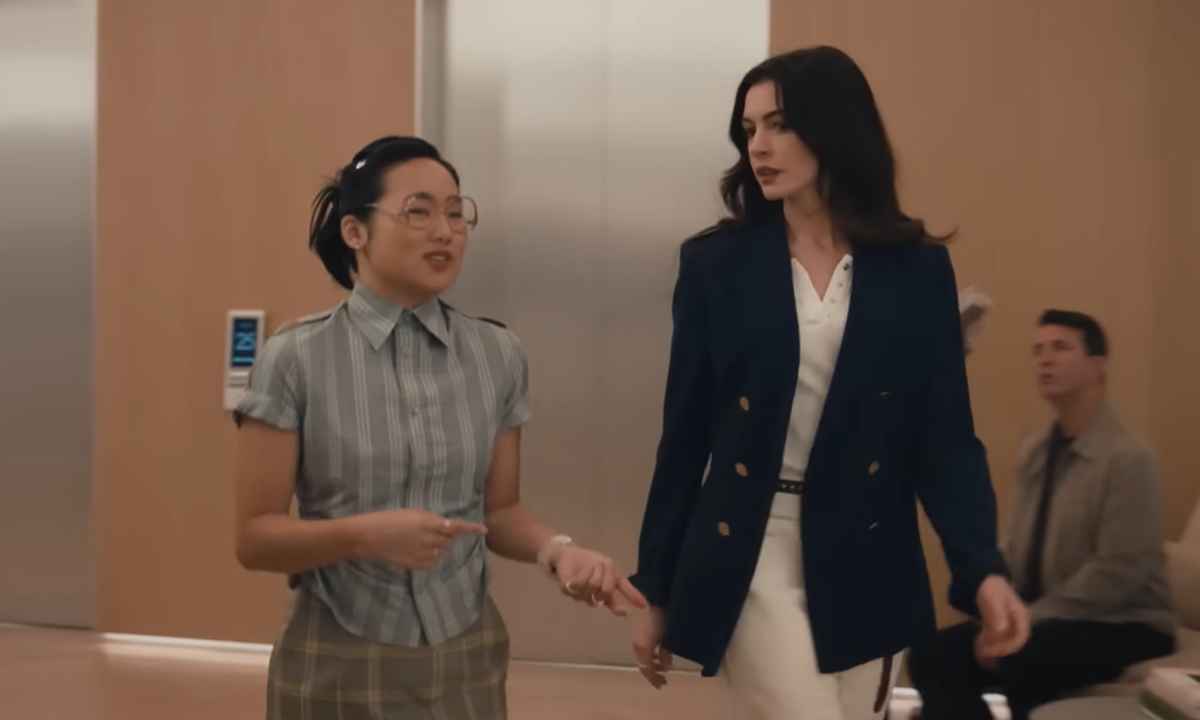
A screenshot of the official trailer featuring Helen Shen as Jin Chao (left) and Anne Hathaway as Andrea Sachs Photo: 20th Century Studios
Nearly two decades after the original film became a global fashion-culture phenomenon, the upcoming sequel The Devil Wears Prada 2 has raised controversy in China over the name and the portrayal of an Asian character.The discussion began after a promotional segment circulated online, introducing a supporting character who appears as an assistant to Anne Hathaway's character, journalist Andy Sachs. In the clip, the Asian assistant is shown introducing herself and listing her academic credentials, including graduating from Yale with a high grade point average.
Posts online from some Chinese and Korean viewers on X argued that the character's name Jin Chao sounds similar to "Ching Chong," a term historically used in Western societies to mock Asian languages.
The resemblance has fueled criticism across Chinese social media platforms. On Sina Weibo, the related topic rapidly gained traction, with the hashtag accumulating tens of millions of reads as netizens debated whether the naming choice was insensitive.
"If a Black character's name resembled a racial slur, would Hollywood still release the film like this?" Others questioned whether the similarity was accidental or a sign of insufficient cultural awareness in the scriptwriting process.
Beyond the name, some viewers have also criticized the character's appearance and personality traits.
The assistant is depicted wearing thick-framed glasses and relatively plain clothing that contrasts sharply with the glamorous fashion-industry environment surrounding the film's main characters.
The movie is set to premier in China on April 30.
While some netizens focused on the specific details of the character's name and appearance, the broader debate soon turned to deeper questions about long-standing portrayals of Asians in Hollywood and the cultural context behind them.
But Beijing-based internet analyst Liu Dingding argued that the online reaction over the Asian characte's name is "exaggerated," as Liu said that the rapid spread of online discussions can amplify controversy before audiences see the full context of the film.
"Social media tends to magnify fragments," Liu told the Global Times. "Sometimes people form strong conclusions based on short clips or trailers rather than the complete story."
But Shi Wenxue, a Beijing-based film critic, said the debate cannot easily be dismissed as a coincidence.
"This controversy touches many deeply rooted sensitivities," Shi told the Global Times on Thursday. "If we examine it more closely, it is tied to complex historical issues and the question of who holds narrative power in global cinema."
Shi argued that the situation reflects a continuation of what scholars often describe as Orientalist tendencies in Hollywood storytelling.
"From early film villains such as Fu Manchu to submissive or exoticized female characters like Madame Butterfly, Asians have long been portrayed as the 'other,'" Shi said.
"As times change, these stereotypes evolve. The old 'Yellow Peril' narratives produced villainous figures, while newer labels such as the 'model minority' stereotype portray Asians as high-achieving but socially awkward."
RELATED ARTICLES