ARTS / CULTURE & LEISURE
When AI can write too, do we still need to read word by word?
A conversation with China’s celebrated authors Mo Yan and Yu Hua
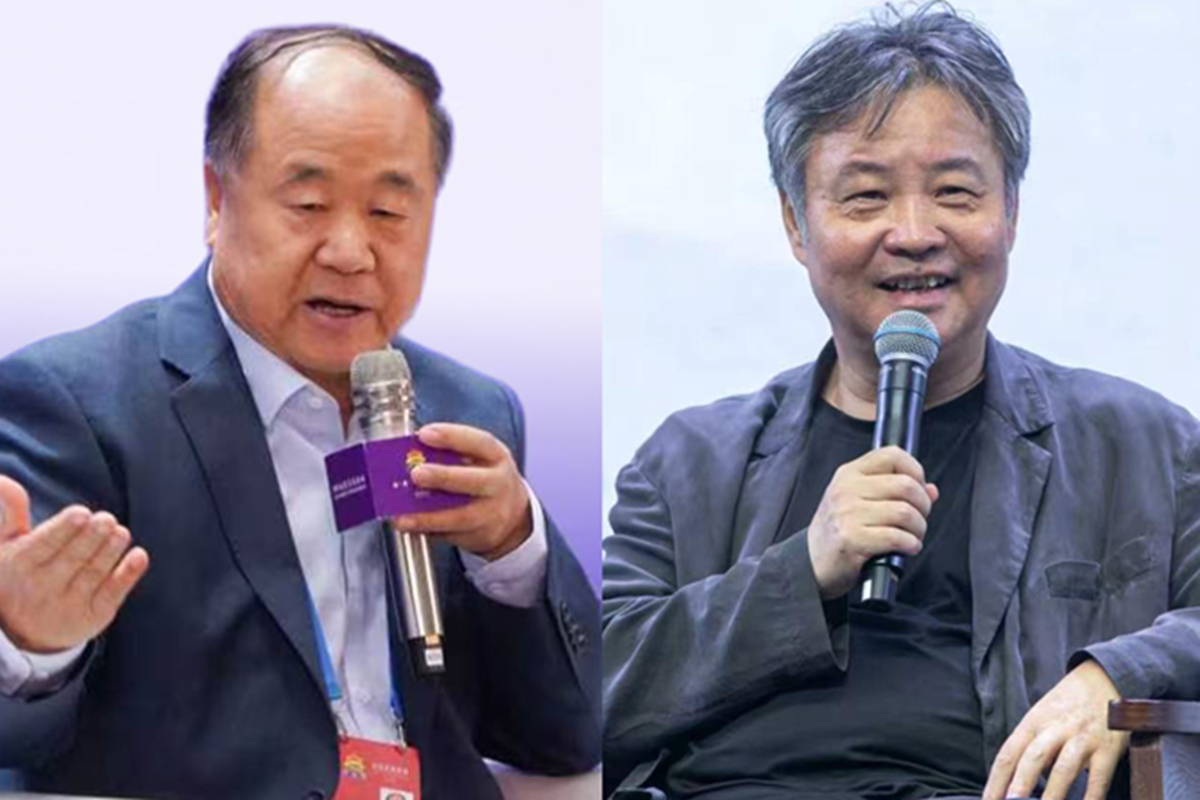
Chinese authors Mo Yan (left) and Yu Hua Photos: VCG
As the 31st World Book and Copyright Day fell on Thursday, coinciding with China's first national reading week, the People's Daily invited two of China's most celebrated authors, Mo Yan and Yu Hua, to discuss reading and literary creation in the age of artificial intelligence (AI) as well as youth development.
The conversation explored why people read, how eclectic books in one's youth can shape a lifetime, how young graduates can find direction amid uncertainty, and whether close, careful reading still matters now that AI can produce written works.
For Nobel laureate Mo Yan, the journey to becoming a writer began not with writing, but with an intense love of reading. Growing up in a rural area with limited access to books, he often had only a single day to borrow and finish them.
Despite reading quickly, he noted that the stories remained vivid in his memory. His experience, he suggested, highlights the importance of reading during youth, when absorption and imagination are at their peak.
Mo Yan explained that reading gradually awakened his desire to write. Alongside practical ambitions for a better life, he also developed a deeper aspiration "to use my pen to express inner emotions and portray real life."
Writer Yu Hua offered a different perspective. Unlike Mo Yan, his early reading experiences were often incomplete and missing pages forced him to imagine how stories might begin or end.
"My imagination was cultivated at that time," he said. For him, the impulse to write did not come from a single moment, but from a series of small accumulations.
As AI technologies advance, there are concerns about the future of writers. Could machines one day replace human authors? Yu Hua remains skeptical. He once saw a list of the 50 professions most likely to be replaced by AI, with writers ranked in the 20s. In his view, in the face of AI, those with stronger originality are more likely to "survive."
"Writing is not just a technical skill," he said, noting that emotions, subtle details and lived experience that shape it are still beyond what AI can do. Yu Hua recalled that he once enjoyed watching "a few minutes to understand a film" videos, sometimes finishing seven or eight in one night. But he later found it hurt his viewing experience. Once he knew the plot, watching the full film felt oddly hollow, as if he had already seen it.
He used this as an example to conclude that, like films, what truly moves people in novels is not the story itself, but the "saturation" created by details, emotions, and dialogue.
Mo Yan echoed this view, adding that while AI may excel at highly structured forms, such as classical poetry, it lacks genuine thought. "Without ideas, the writing is hollow," he argued.
He noted that "AI can serve as a valuable tool, but truly great works still require human thought." In the age of AI, writers may feel both anxious and uncertain, yet they must remain convinced they cannot give up, and this great inner tension will become the soil from which their work grows.
At the same time, they expressed concerns about the misuse of AI, particularly in generating misleading content. Mo Yan suggested that AI-generated content should carry clear, permanent markers to help audiences identify it.
Beyond technology, the discussion also turned to everyday reading habits. Many young people, exhausted from work, prefer light, entertaining fiction over serious literature. Both of them agree that reading should be diverse, with varied tastes.
Mo Yan noted that there is no strict boundary between light, entertaining fiction and serious literature. When young people are tired after work, it's totally understandable to unwind with light fiction. But when there's time and energy, it can be good to change things up and read something different.
Yu Hua added that enjoyment and depth are not mutually exclusive: a compelling story can also be profound.
In his view, reading should be as varied as one's diet, constantly refreshed to maintain interest and growth.
Many young graduates enter a phase of uncertainty and searching as they begin their careers, often described as an "Odyssey period," a word borrowed from Homer's epic story of Odysseus, who spent 10 years wandering after the war trying to return home, to describe the period between roughly ages 20 and 35, a time when people move from school to society and from dependence to independence.
Both authors acknowledged that they also experienced periods of confusion and anxiety. Mo Yan said that even in his 70s, he continues to face challenges in writing. "No stage of life is free from uncertainty."
Yu Hua described his own "Odyssey period" during his years as a dentist. He noted that what matters is learning from life and gaining experience, so that one can better face confusion, anxiety, and setbacks.
The article was originally published by the People's Daily on April 23, 2026.
RELATED ARTICLES