ARTS / CULTURE & LEISURE
‘Spring Reading’ event in first National Reading Week contributes to book-loving society
Reading changes life
By Wu Jie, and Sun Langchen Published: Apr 21, 2026 12:52 AM

Photos: Chen Tao, Cui Meng, Li Hao/GT
Spring breeze flips the pages, and reading changes life. On April 20, the first day of China's first National Reading Week, the Global Times "Spring Reading" event was held at the Guangcheng Academy in Beijing. Taking literature as the medium and making friends through reading, the event has built a bridge for exchanging insights on reading and promoting the National Reading initiative. This marks the sixth session of the Global Times' reading-themed events since their launch in 2023.Bai Long, deputy editor-in-chief of the Global Times; Tian Qing, member of the China Central Institute for Culture and History, honorary director of the Institute of Music Research at the Chinese National Academy of Arts; and Liu Yi, board member of the China Taofen Foundation, attended the event and delivered addresses. Xu Bo, general manager of the Global Times, and Zhao Gang, secretary of the Commission for Discipline Inspection of the Global Times, also attended the event.
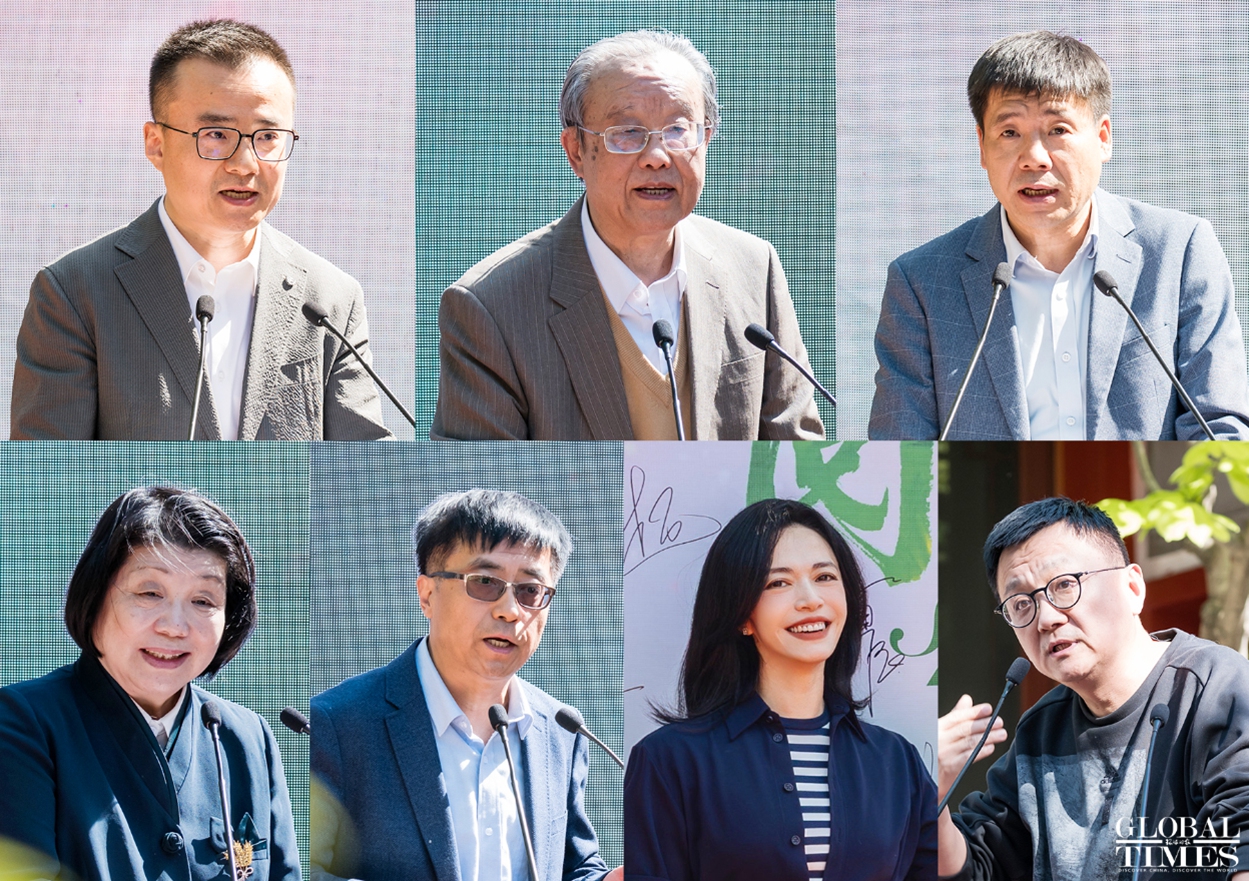
A host of guests, including renowned writer Bi Shumin, professor in the Department of Chinese Language and Literature at Tsinghua University and former chief editor of the Zhonghua Book Company Zhou Xuanlong, director and screenwriter Yu Baimei, and actress Yao Chen, drew on their personal life experiences to offer incisive insights into the profound significance of National Reading, interpret the power of reading, and share their personal gains and reflections from reading.
At the roundtable discussion, Wu Yuxia, president of the China Nationalities Orchestra Society and a doctoral supervisor at the Chinese National Academy of Arts; He Hui, director of the School of Chinese Language and Literature at Beijing Foreign Studies University; Jiang Haoshu, deputy director of the international department of the China Writers Association; Li Nianzu, deputy director of the Capital Library of China; Ma Chao, founder of Innokids Band; Huang Ying, founder of the Qingtian Academy in Jiangxi Province; and Zhang Sai, delivery worker and writer from Wuhan, held a lively discussion centered on the theme of "Reading Changes Life." They offered multi-dimensional interpretations of the profound significance of reading for personal growth and social development from diverse perspectives.
The Global Times held a launch ceremony for the "100 Avid Readers" column at the event. As an innovative initiative by the Global Times to promote reading, the column aims to echo the National Reading initiative and fulfill its cultural mission by telling vivid stories of reading.
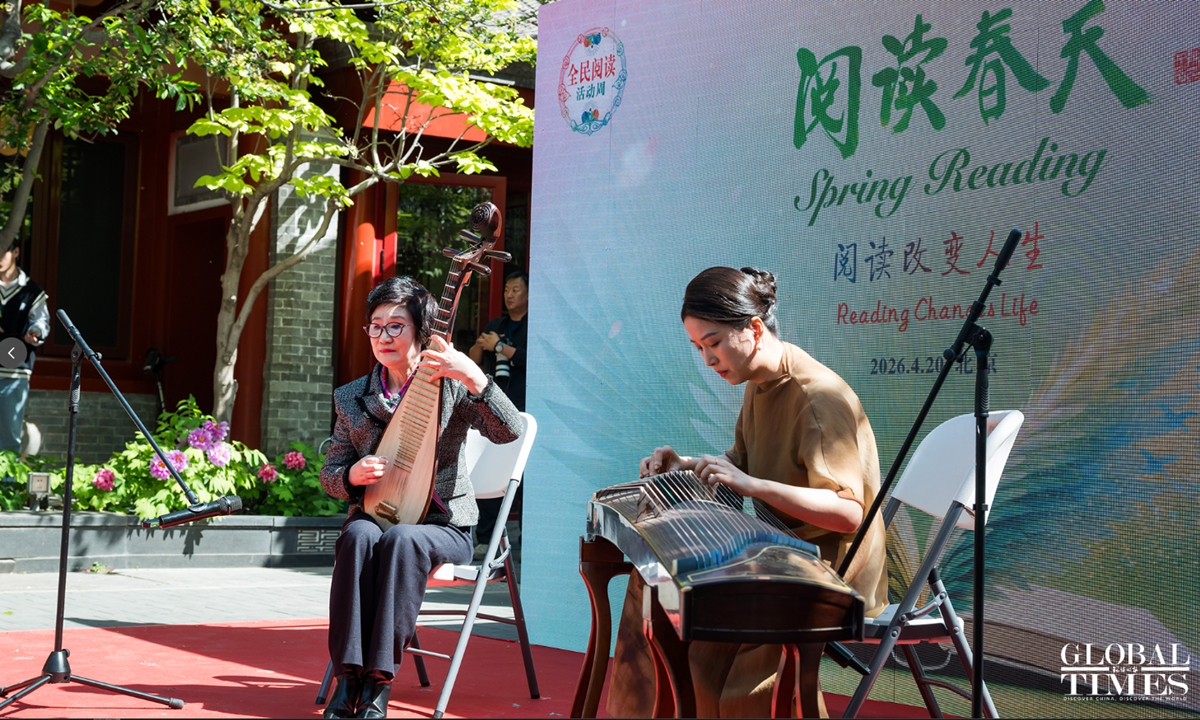
Wu Yuxia (left) and Yang Xinyue play the pipa and the guzheng as the event begins. Photo: Chen Tao/GT
Bai Long, deputy editor-in-chief of the Global Times
Every seed of reading will eventually break through the soil and sprout, and as more of these seeds take root, they will grow into a lush canopy of a book-loving society. The encounter between a person and a book is often a matter of chance, but also a process of mutual choosing. The right reader and the right book are always in search of one another. Reading not only transforms individual lives, but also shapes the future of a society and a nation.
Tian Qing, member of the China Central Institute for Culture and History
Today, reading is no longer just about acquiring knowledge; it is about carrying forward one of humanity's most remarkable traditions. As artificial intelligence (AI) reshapes this era and the world, and as people debate how humanity can continue to develop without being replaced, I believe that reading represents one of the last bastions of human dignity in the age of AI.
Liu Yi, board member of the China Taofen Foundation
The power of reading may not immediately change our circumstances, but it slowly nourishes our inner world. It helps us stay clear-minded and fulfilled amid life's hustle and toil, and preserve poetry and passion within the routines of daily life. Little by little, it makes us better versions of ourselves. This is the simplest yet most precious significance of reading.
A nation that loves reading is a nation full of hope and strength; a society rich in the fragrance of books is one that is civilized and harmonious.
Bi Shumin, writer
Reading has been the greatest nourishment in my life, nurturing my soul even in places without spring or books. During my military life in the Ngari prefecture, the Xizang Autonomous Region, at age of 16, I exchanged a single book for other books and eventually read almost every privately owned book there. While digital and AI writing are advancing rapidly, I, now in my 70s, firmly believe that AI could never write with the depth of personal experience or emotion found in my works. Reading shapes our spirit and destiny, guiding us through challenges and illuminating our way forward.
Zhou Xuanlong, professor in the Department of Chinese Language and Literature at Tsinghua University and former chief editor of the Zhonghua Book Company
I believe the core values of reading have never changed, from ancient times to today. First, we have the dissemination and acquisition of knowledge; second, the cultivation of values; third, the enhancement of aesthetic appreciation; and fourth, the improvement of expressive ability. No matter how technology develops in the future, if humanity cannot play a leading role within the system of civilization, we will lose our sense of purpose. Books will always be a vital vessel for the inheritance of the human spirit.
Yao Chen, actress, reading promotion ambassador for the Global Times
In childhood, reading was my shield against loneliness. As I grew older, it became a light that illuminated my inner world. Today, it is a path through which I explore human nature. Reading helps me understand others and see myself more clearly.
Across countless ordinary moments, it has shaped who I am, little by little. In the future, reading will continue to guide me, across time and space, into conversations with countless souls as I seek the deeper truths of life.
Yu Baimei, director, screenwriter
For me, finding useful material from different fields is a fundamental part of the job. However, in recent years, my reliance on books for writing has dropped sharply because the age of AI has truly arrived. Now the real question is: "With AI here, what should humans do?" The answer is simple - read, and keep reading. In this era, what matters most is drawing wisdom and experience from the vast library of human thought. Books may mean less pure knowledge, but books of ideas are more vital than ever. Reading will be humanity's strongest weapon in the era reshaped by AI.
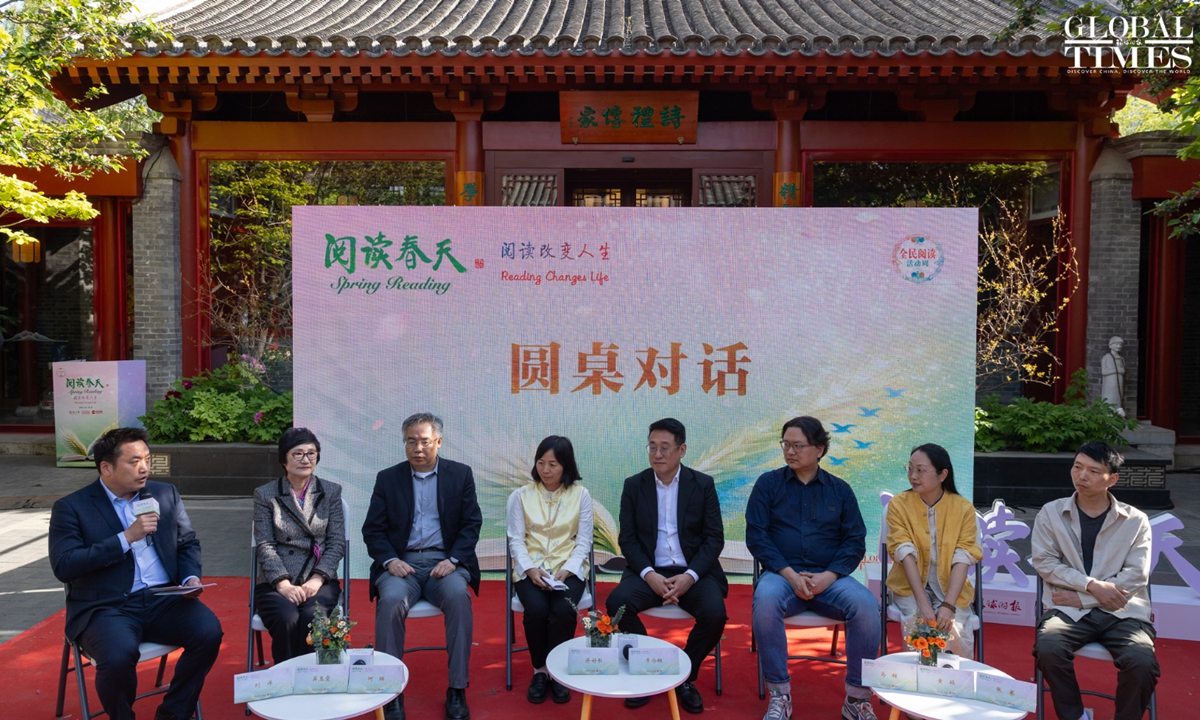
Guests talk about the power of reading during a roundtable at the Global Times Spring Reading Literature Salon at the Guangcheng Academy in Beijing on April 20, 2026. Photo: Chen Tao/GT
Roundtable discussionsWu Yuxia, president of the China Nationalities Orchestra Society and doctoral supervisor at the Chinese National Academy of Arts
In the course of my own artistic growth, there is one book that left an unforgettable impact on me: Home Letters by Fu Lei. It can be said to have influenced my entire life. In doing anything, one must be rigorous - whether in academic work, in art, in performing a piece, or in interpreting it ourselves, even in the smallest matters. I have always believed that rigor and discipline are extremely important. Reading has given us a lifelong pursuit, one that we continue to uphold.
He Hui, dean of the School of Chinese Language and Literature at Beijing Foreign Studies University
Books allow me to view the world, including our universe, from another perspective. Humans are very small within the universe, but why do we seek to understand the universe? Because we are human, and we possess initiative. Books enabled me to understand the world from different angles.
If we were to say which one book changed our lives, I think it is truly difficult to single out just one. Personally, I believe that every good book you read subtly influences your life.
Jiang Haoshu, deputy director of the international department of the China Writers Association
We are deeply encouraged to find that Chinese literature has a broad readership worldwide. More and more readers across the globe are paying attention to Chinese literature. There is still a significant market overseas for physical reading materials. I think the most important point is that Chinese literature possesses the power to connect with the world. Reading Chinese works enables the world to better understand China.
Li Nianzu, deputy director of the Capital Library of China
How should we read? As a librarian, I hope everyone reads a complete book, finishes one book. In a lifetime, a person may only read about 1,000 books, just 1,000. We have specially compiled a reading list called a "lifelong reading list." We look forward to everyone coming to the library and turning the next page of your reading journey.
Ma Chao, founder of Innokids Band
As a creative team, our methods, including AI music, AI virtual idols, and various forms of creation, are very diverse. They require a great deal of inspiration, and much of that inspiration comes from reading, from books. We often draw inspiration from a particular story. Much of the content in our music and videos relates to feelings of home and country. How do we shape our view of history? How do we develop logical thinking about society? Reading drives us to create more vital and enduring works in the future.
Huang Ying, founder of the Qingtian Academy in Jiangxi
Promoting reading in rural areas is very difficult. We segment our audiences and aim to make culture visible. We want people to read the culture of this place. This is what reading means to us. Through our storytelling, our expression, and various forms of organization, we enable culture to be seen.
Zhang Sai, delivery worker and writer
What I write is not literature, but the silent daily lives of countless workers. By day I work; by night I am a writer. It may sound like a fantasy story, but it is not. More than 20 years ago, when I first entered a factory, my life was already like this.
People often say that reading changes a person. Once, when I was delivering food to a residential complex, the buildings were labeled with names instead of numbers. For example, one was called "Xiaoxiang Pavilion." For a delivery worker, that can be inconvenient. But because I read, I immediately thought of Dream of the Red Chamber (Xiaoxiang Pavilion is the famous dwelling place of Lin Daiyu, a leading character in the classic novel). This is the kind of experience and change that reading has brought me.
RELATED ARTICLES