From quiet campus to cruise voyages, E.China’s Qingdao embraces silver economy by leveraging local resources
How the silver economy and coastal resources converge in Qingdao
By By , Tao Mingyang and Zhang Yashu in Qingdao Published: Apr 23, 2026 09:43 PM

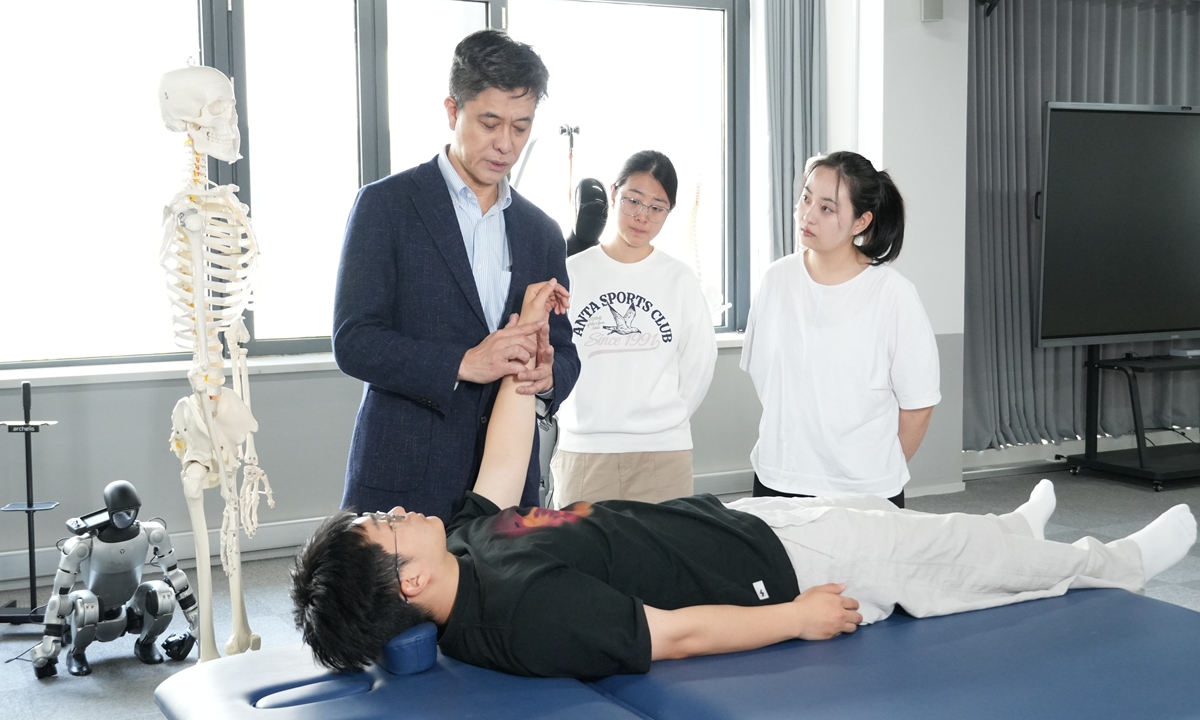
Professor Huo Ming demonstrates to his students how to perform rehabilitation therapy on a "patient's" arm joint inside a classroom at the University of Health and Rehabilitation Sciences on April 15, 2025. Photo: Chu Daye/GT
On the northern shore of Jiaozhou Bay in East China's Shandong Province, just three kilometers from the magnificent Hongdao High‑Speed Railway Station, stands a university with an "extraordinary" background. Located in Qingdao, Shandong, the University of Health and Rehabilitation Sciences (UHRS) is China's only new‑model research university dedicated to health promotion, and has been included in three consecutive national five‑year plans, with the latest reference appearing in the 15th Five-Year Plan (2026-30).
As a key platform for Qingdao to build a rehabilitation industry incubator and foster a biomedical and medical device industrial cluster focused on wellness and elderly care, UHRS has already incubated 83 rehabilitation technology enterprises, according to the People's Daily. Four of them have raised a total of 110 million yuan ($16.12 million) in funding.
The UHRS is a microcosm of an emerging healthcare industry in Qingdao, thanks to the city's various advantages, including technological innovation, an 800-kilometer-long coastline, and a temperate climate. Nationwide, under the Healthy China Initiative during the 15th Five-Year Plan period (2026-30), various localities are ramping up efforts to boost relevant healthcare industries according to their local conditions.
Robotic support
At UHRS, innovation remains a top priority.
In a classroom, Huo Ming, a professor with the School of Rehabilitation Science and Engineering at UHRS, is demonstrating to his students how to perform rehabilitation therapy on a "patient's" arm joint. Beside the ordinary human skeleton models commonly seen in medical departments, stand several humanoid and exoskeleton robots.
"This room is our motion analysis lab. The system behind us uses multiple high‑speed cameras and force plates - used for performance diagnostics - to capture human movement. Moreover, our university is developing the latest rehabilitation robots and applying them in our undergraduate education," Huo said.
"We use relevant scenarios to provide practical kinematics training for second‑year students, so that they can better understand how the human body moves normally," Huo explained. "A key focus of this lab is gait analysis - why our patients walk the way they do, and how robots can walk more like humans."
Researchers at the university are also developing rehabilitation robots - smarter devices to restore patients' functions or provide training.
Li Mingjun, an undergraduate student majoring in biomedical engineering and robotics, speaks confidently about his field and the future of China's rehabilitation industry.
"The applications are broad. Given China's ageing society, the rehabilitation industry needs intelligent technologies to accelerate its progress and improve quality," he told the Global Times, adding that there is an urgent need to make China's rehabilitation industry more self-reliant.
"A lot of medical equipment and devices in the country still rely on imports while the concept of rehabilitation science itself is not yet firmly established in China. It is very necessary to develop domestically produced, intelligent rehabilitation medical devices. With the empowerment of smart technology, such devices can serve more conditions and more people, greatly improving rehabilitation outcomes."
The university's focus on intelligent technologies is also in line with Qingdao's efforts to build a world-class health city. In July 2025, a 3‑year action plan for accelerating the construction of "China Health Bay" (2025-27) was jointly issued by local authorities, involving nearly 30 government departments in a coordinated effort, and aiming to grow the city's health industry to a scale of 100 billion yuan by 2027.
Dong Erdan, president of UHRS and an academician of the Chinese Academy of Engineering, told the Global Times that the university has been one of the earliest promoters of the China Health Bay initiative.
"Our university strives to provide intellectual support and cultivate technological innovation talent for the health and rehabilitation industry, as well as gather modern enterprises in biomedicine and rehabilitation to create clusters of education, talent, innovation and industry," Dong said. "We also closely integrate educational resources with regional economic and social development resources, and contribute to the construction of the Healthy China Initiative and China Health Bay."
'Healthy' terminal
Beyond innovation, Qingdao is also leveraging various local advantages to accelerate its "China Health Bay" initiative. As a major cruise port in northern China, Qingdao Port is exploring how to integrate the rapidly developing cruise economy with the health industry.
In the Qingdao International Cruise Home Port Area, an international health management center with a total investment of 1.68 billion yuan and a floor area of 107,000 square meters is under intensive preparation and construction.
Once completed, it will add a new "cruise-plus-wellness" business model in addition to the current cruise cultural tourism, and the port authority aims to attract leading companies in cruise tourism and medical wellness to operate here, providing more convenient services for domestic and international visitors, according to a staff member at the port authority.
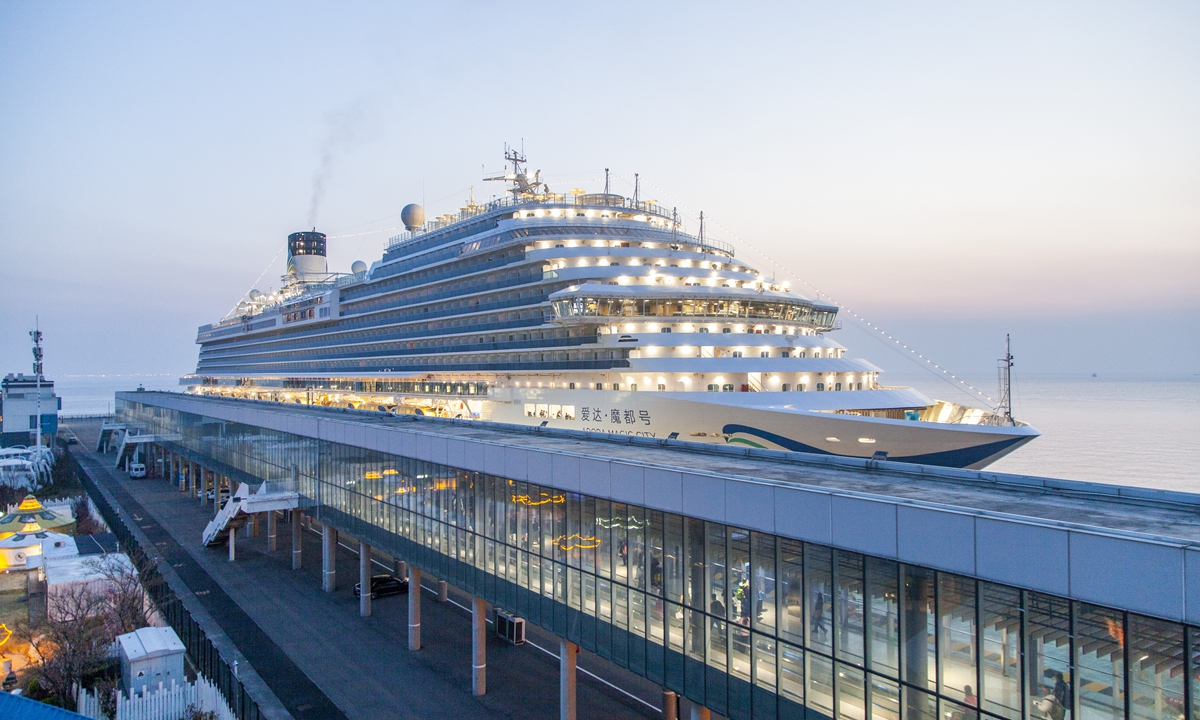
Homegrown cruise ship Adora Magic City docks at the Qingdao International Cruise Home Port Area in April, 2025. File photo: VCG
"Senior citizens have a growing demand for health‑oriented tourism, and China's silver economy is taking shape rapidly. Cruises integrate catering, accommodation, transport, sightseeing, shopping and entertainment," Hao Dongchen, director of the cruise culture and tourism department of the Qingdao International Cruise Port Administration Bureau, explained why combining cruises and health programs matters.
"Cruise ships also offer large spaces, complete facilities and high quality - ideal for various health and wellness programs and naturally suited to become health bases on the sea," Hao told the Global Times.
In 2025, Qingdao's cruise tourism achieved a full breakthrough: five cruise ships have operated in Qingdao for a total of 27 voyages, marking a year‑on‑year increase of 29 percent, data provided to the Global Times by the port authority showed. The cruise port also handled 82,000 passengers, an annual increase of 15 percent.
"We want visiting tourists to better understand traditional Chinese culture. We also plan to introduce unique Chinese health concepts, products and services, including traditional Chinese medicine experiences and healthy dining," Hao said, referring to a rising trend by foreign tourists to experience China's medical services.
The port has organized many themed voyages around health and wellness, including inviting dental experts to give free onboard consultations, master calligraphers to give calligraphy workshops, concerts by local famous singers, singing competitions for seniors, and onboard Tai Chi practice, according to Hao.
"Last year alone, we ran about 10 themed voyages for the elderly. Cruise tourism provides an excellent platform for senior wellness - it is relaxed and comfortable entertainment, with cultural activities, social interaction, exercise and fitness. It is not only about physical health but also mental well‑being," Hao said, recalling that last year the port helped arrange a passenger aged 102 to complete a dream voyage. "The old lady said she didn't want the trip to end!"
From the quiet campus on shore to tailored services offered on cruise ships sailing in the ocean, Qingdao, like many Chinese cities, is embracing the silver economy by leveraging its own resources. A Xinhua News Agency report in November estimated that China's silver economy is currently worth about 7 trillion yuan. By 2035, it could reach 30 trillion yuan and account for 10 percent of the country's GDP.
Back at the UHRS, Li Mingjun is returning to his dormitory from the canteen. He has many lessons to prepare.
"Letting machines empower rehabilitation is of great significance. It could make the concept of rehabilitation more valued and more widely recognized. Recovery from illness is not just about being cured - it is about what comes after treatment. It is not only about extending the length of life, but improving quality of life," Li said.
RELATED ARTICLES