ARTS / CULTURE & LEISURE
Shanxi restorer Xu Kai revives more than 10,000 porcelain artifacts
Breathing life into ceramics
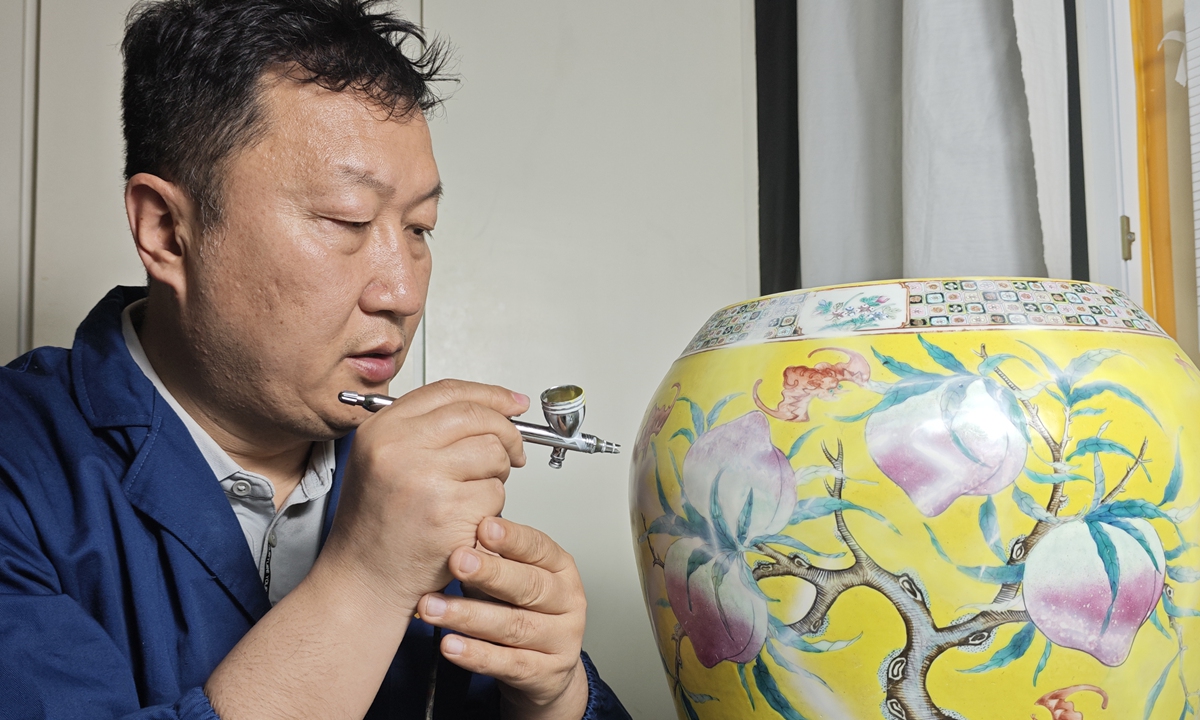
Xu Kai restores a porcelain at the Shanxi Museum on April 19, 2026.
In a restoration studio at the Shanxi Museum, North China's Shanxi Province, Xu Kai moves through a familiar sequence of tasks: cleaning, bonding fragments, grinding surfaces, retouching color and polishing finishes. The work is methodical and repetitive, but each step requires precision. A broken porcelain vessel slowly comes back to life under his hands.For Xu, a ceramic restoration specialist and recipient of China's 2025 National Master Craftsman of Cultural Relics award, this routine is the foundation of a career that spans 27 years.
"Theoretically, ancient ceramic restoration allows only one chance and must be approached with extreme caution," Xu told the Global Times.
In the more than 10,000 porcelain pieces he has restored, his work spans from Northern Song (960-1127) celadon to Yuan Dynasty (1279-1368) blue-and-white porcelain. During restoration, Xu often holds his breath to ensure a steady hand when using the spray pen, maintain consistent pressure and even force, and avoid any distraction, so the restoration process can be completed in one uninterrupted flow.
"Each piece of porcelain requires close study of its technical features and formation characteristics, as if engaging in a silent dialogue with the ancient craftsman who made it," remarked Xu.
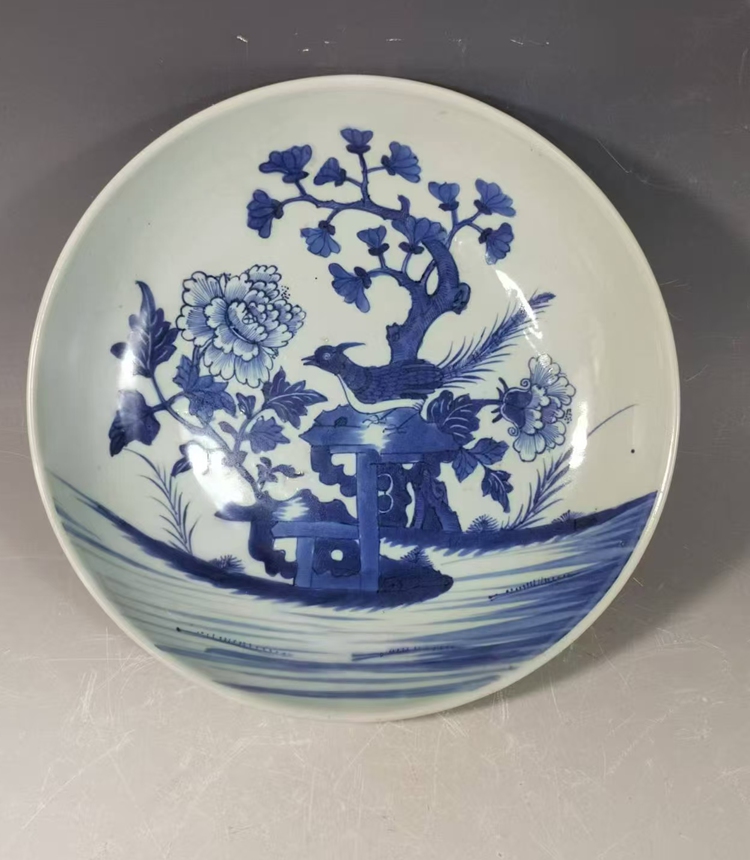
A Qing Dynasty plate before and after restoration Photos on this page: Courtesy of Xu Kai
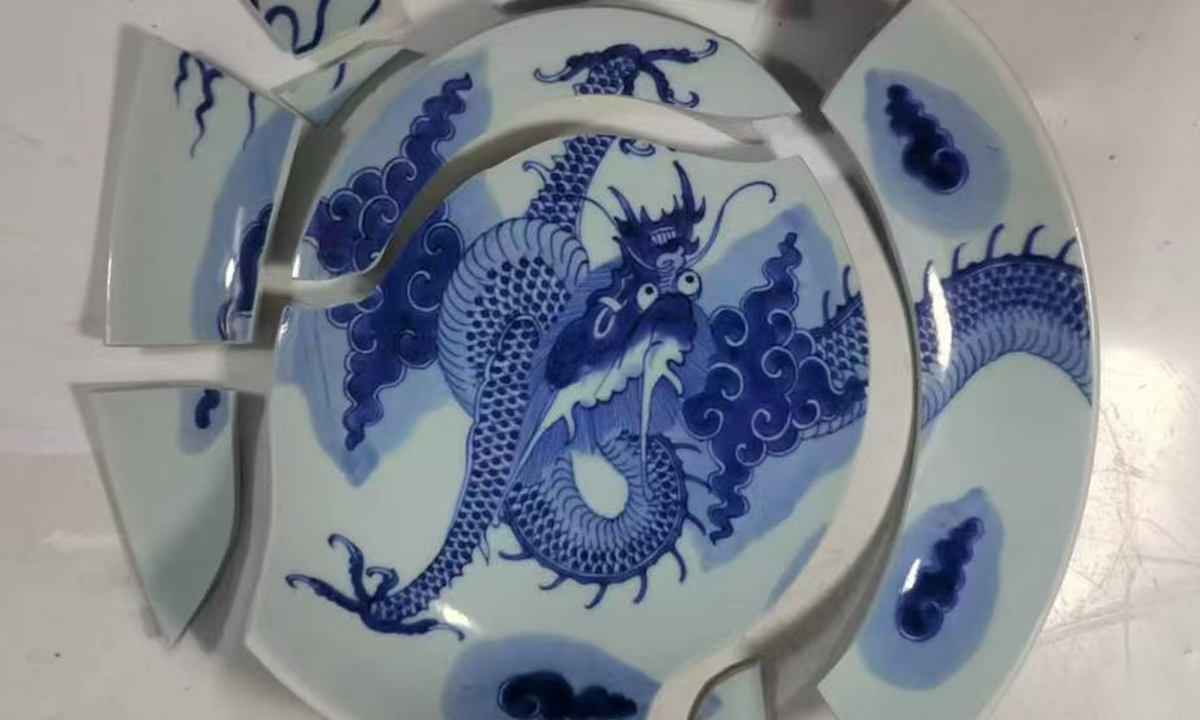
A Qing Dynasty plate before and after restoration Photos on this page: Courtesy of Xu Kai
Path to restorationXu formally studied painting in primary school. That early foundation led him to Shanxi Normal University, where he majored in fine arts. His technical training in drawing later became essential to his restoration work.
In 1999, while still a university student, Xu visited a ceramic restoration studio run by Gao Guilin, a master conservator of ancient porcelain in Shanxi. The visit changed the direction of his life. He soon became Gao's apprentice.
The early training was not glamorous. He still remembers his first lesson in the field. It was not a display of refined technique, but an exercise in patience. His mentor Gao handed him a broken ceramic rim and a file, instructing him to grind it down. He continued the task for a month.
"Ceramic restoration requires extreme precision," Xu said. "Even a 0.1-millimeter error can be magnified in later bonding and make full restoration impossible."
That philosophy continues to guide him today. But technical precision is only part of the challenge. The greater difficulty, Xu said, is recreating what he calls the "spirit" of a ceramic object.
Years ago, a team attempted to recreate porcelain from the Xixia (1038-1227) using historically accurate materials and a kiln rebuilt to replicate the original firing environment. Despite meticulous reconstruction, the results still lacked the warmth and depth of the original artifacts.
Xu pointed to an often-overlooked factor: atmosphere. The reconstructed kiln, unlike ancient Xixia kilns that had been used and fired for centuries, lacked the accumulated mineral deposits and glaze residues on its inner walls. Over time, those built-up layers in the original kilns influenced how heat and vapor interacted with ceramics during firing, creating subtle qualities that are difficult, if not impossible, to reproduce in a newly built environment.
In his view, although firing and restoring ceramics involve different processes, they are guided by the same underlying principles. Restoration of ancient ceramics is not only about reconstructing physical form, but also about recovering their unique character and spirit.
No two ceramic artifacts are ever identical, and no two restoration plans are the same. There is no template to follow. Xu always adheres to a "one object, one solution" approach.
Ceramic's spirit
That understanding informs his approach to restoration. He does not aim to create identical copies, but to preserve the character of each artifact. Every crack, stain and surface mark are evaluated not only for damage, but for meaning.
"If it is part of history, and does not affect structure or preservation, we keep it," he said. "Those traces tell the story."
For areas that do not involve the restoration site and do not affect the object's overall appearance or long-term preservation, such as historical traces, patina, scratches or signs of use, they are retained.
"These marks serve as evidence of the artifact's history and help tell its story," said Xu.
Yet restoration also demands removal sometimes. Damaged areas that compromise structural integrity or interfere with preservation need to be cleaned away.
One of Xu's most challenging projects involved a Ming Dynasty (1368-1644) blue-and-white vase.
While the physical reconstruction was successful, the painted surface remained incomplete. The original design featured highly diffused brushwork, with cobalt pigments bleeding up to several millimeters into the glaze.
Traditional brushes could not replicate the soft diffusion. Any visible stroke would break the illusion of the original surface.
After extensive experimentation, Xu turned to an unconventional tool: a spray pen. By adjusting air pressure, distance and pigment density, he spent more than 10 hours, carefully layering color until the pattern reemerged.
The final result restored not only the image, but the visual atmosphere of the piece.
Despite his mastery, Xu sees growing potential in artificial intelligence (AI). According to him, AI can significantly support cultural relic restoration, assisting with documentation, technical drawing, dating analysis, shape reconstruction, damage classification and value assessment.
AI, he said, may one day help identify deterioration patterns or reconstruct missing fragments virtually before physical intervention begins.
Looking ahead, Xu hopes AI and digital scanning can be used to support preventive conservation for more artifacts.
"Cultural relics truly come to life by preserving their current condition, presenting their history and passing them on to the future," he said.
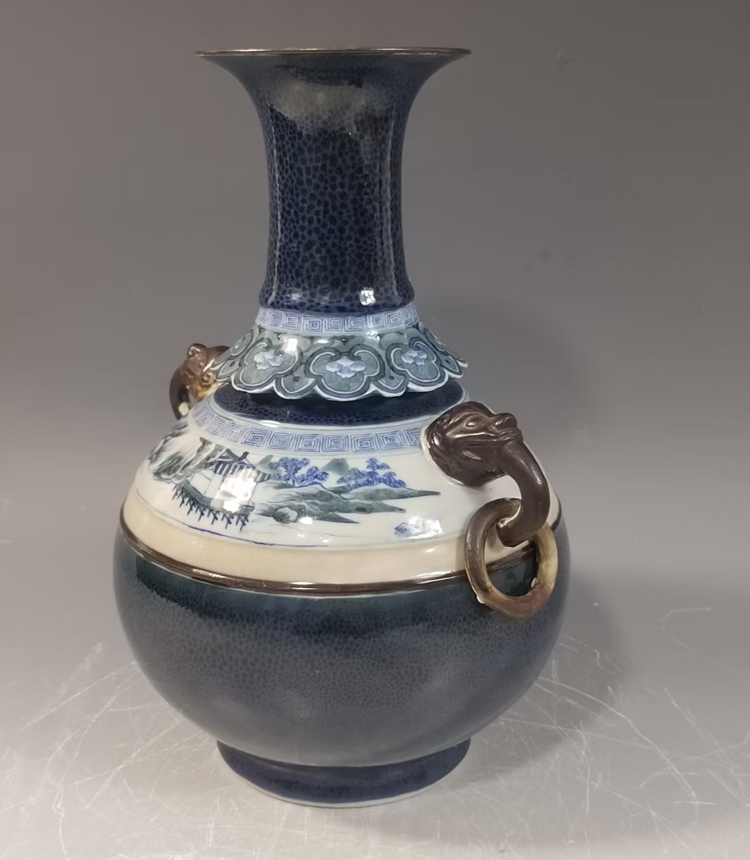
A Qing Dynasty vase before and after restoration
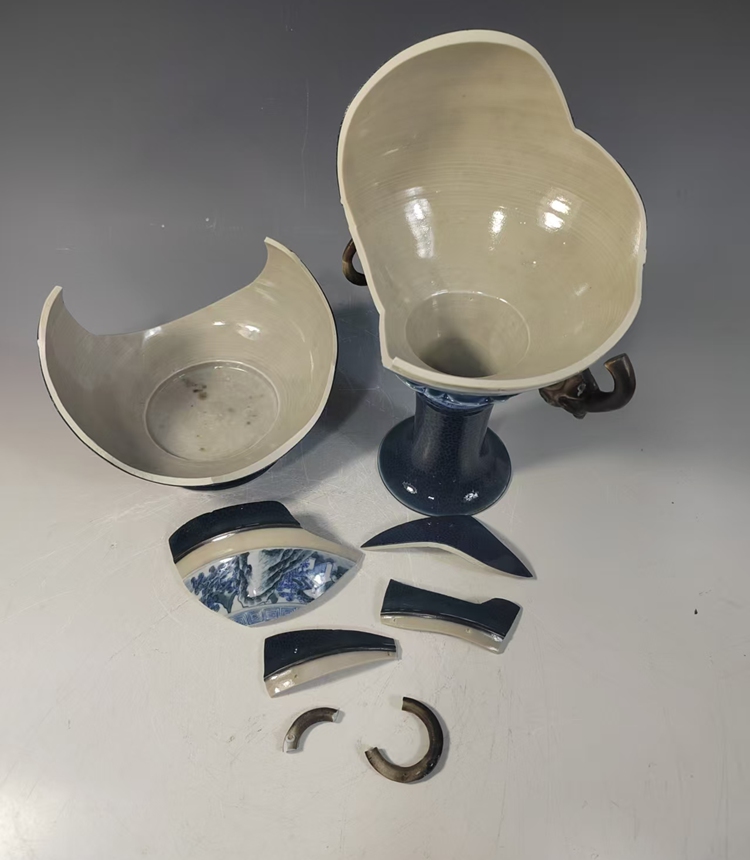
A Qing Dynasty vase before and after restoration
RELATED ARTICLES