Illustration: Chen Xia/Global Times
American allies must be ready to pay a "national security premium" for certain minerals, which would be sourced from outside China and from within a proposed group of trading partners including Europe, US Trade Representative Jamieson Greer told the Financial Times in an interview published on Wednesday.The US wants the club of countries to trade minerals at set minimum prices to protect their investments in mining and processing, and this could hit outside producers such as China with steep tariffs or other barriers to prevent them driving down prices, according to the report.
However, the US attempt to form a small circle of critical minerals trade that excludes China and demand that its allies pay more for its geopolitical calculation seriously deviates from the basic laws of the market economy and rests on no sustainable economic footing.
For starters, the so-called "national security premium" is a blatant violation of economic common sense. The formation of critical mineral prices is a complex process, determined by market factors such as global supply and demand, mining costs, processing technology, and economies of scale, and it cannot be arbitrarily manipulated. China's advantageous position in the global critical mineral supply chain is the result of decades of continuous investment, constant technological iteration, and large-scale production capacity.
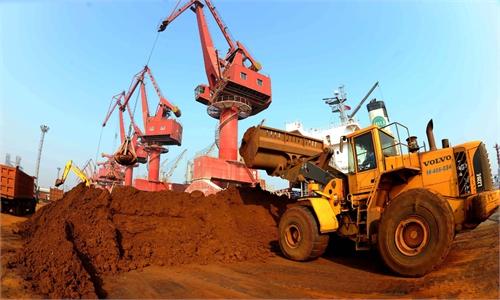
Take rare earths as an example: in 2024, China's rare-earth output reached 270,000 tons, accounting for 68.54 percent of the global output, according to a Xinhua report in October 2025. Mature technology, large scale and efficient operations have made China's mineral processing costs much lower than those in the West. This cost gap, however, cannot be erased by any politically imposed "security premium."
The US demand for its allies to abandon low-cost supplies and instead purchase high-priced minerals is forcing global supply chains to bear the cost of geopolitical ambitions. The extra cost will not vanish, but will be passed down the supply chain, creating cost chaos for downstream industries.
As noted in the FT report, several people familiar with talks between Washington and its trading partners said that there were concerns that protecting minerals would increase costs for sectors such as defense, automaking and clean energy. Such artificial pricing, which defies market laws, is unsustainable in the long run. Under such artificial pricing, consumers would reduce demand as prices rose, and businesses would lose competitiveness as costs increased.
Perhaps the biggest question is who will pay the premium bill. The reality is that even in the US, implementing a floor price for certain minerals is controversial. While US mining and processing companies have pushed for price floors and other government backstops, critics of price floors warn they could expose US taxpayers to significant financial risk by forcing the government to subsidize minerals when market prices fall, potentially locking in long-term liabilities, Reuters reported in January.
The report, citing anonymous sources, mentioned that at a closed-door meeting hosted by a Washington think tank, two senior US officials told US minerals executives that their projects would need to prove their financial independence without government price support.
How can a policy that is full of uncertainty even at home be extended to its allies? A price floor is essentially a way of inflating prices to support high-cost producers. It fosters industrial laziness that discourages technological innovation and efficiency gains, eventually leaving taxpayers to foot the bill or causing the whole policy to collapse.
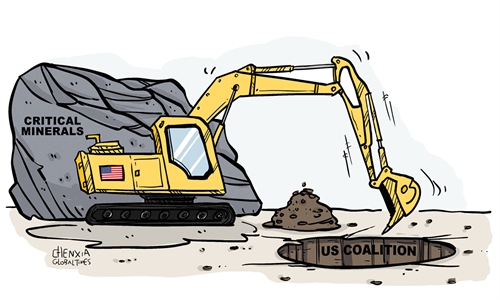
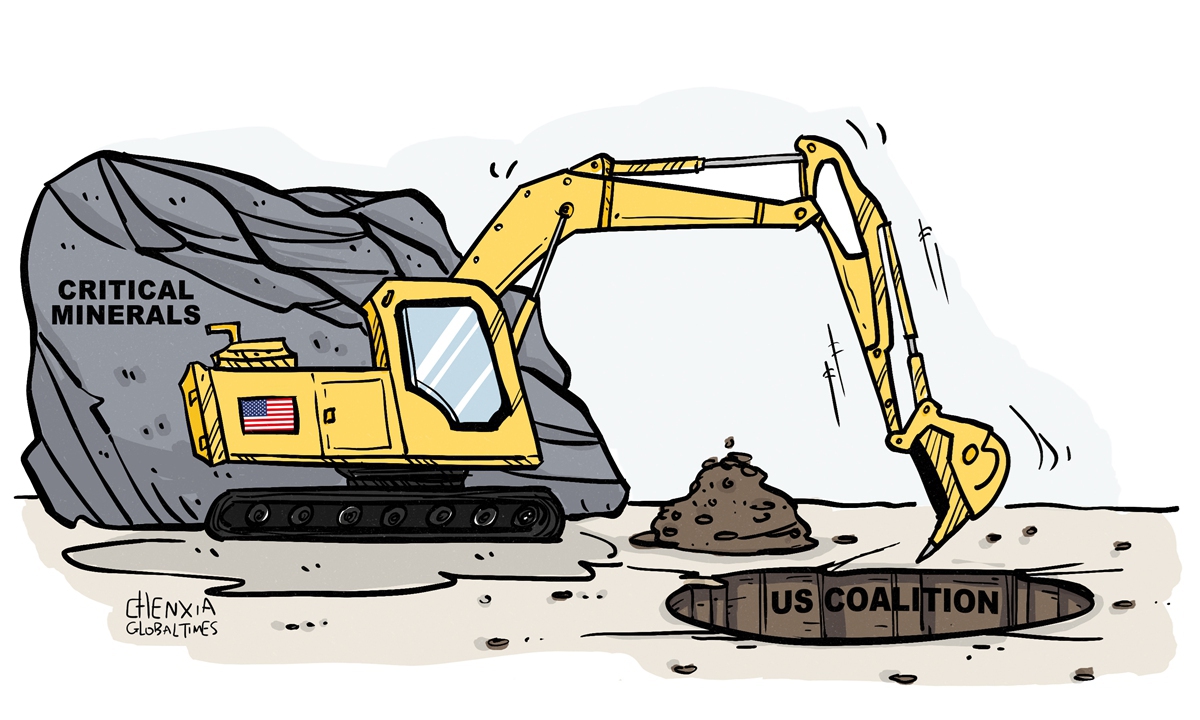
Furthermore, by pushing a "security premium" or "minimum price," the US is essentially building an exclusive "small circle" in an attempt to achieve so‑called "supply chain security." In reality, such an approach undermines the global division of labor based on market rules and comparative advantage. It also ignores the long investment cycles, slow implementation, and high technical barriers that characterize critical mineral industries.
Any attempt to forcibly distort supply chains through political fiat cannot genuinely reduce risks; on the contrary, it creates new vulnerabilities for involved parties. History has repeatedly shown that capital pursues efficiency - the very opposite of what exclusive resource alliances tend to produce: inefficiency, internal friction, and rigid supply structures.
The US push for a mineral "price alliance" not only violates basic economic laws and drives up downstream costs, but also lacks practical feasibility and is unsustainable in the long run. True supply chain security can never be attained through closed "small circles" and forced premiums. Only by respecting market laws and strengthening international cooperation can the world build a stable, efficient, and low cost global critical mineral supply chain.
RELATED ARTICLES