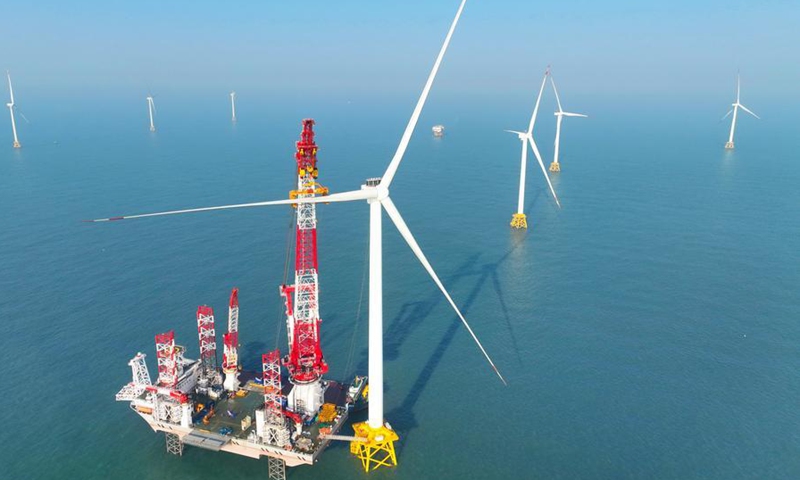
A drone photo taken on Jan. 13, 2026 shows the construction site of a 20-megawatt offshore wind turbine unit in the coastal waters of southeast China's Fujian Province. (Xinhua/Lin Shanchuan)
China on Thursday announced new measures to evaluate and assess the performance of local governments in terms of carbon peaking and neutrality efforts as the nation seeks to accelerate a comprehensive green transition in economic and social development.
The new measures, contained in a document jointly issued by the General Office of the Communist Party of China Central Committee and the General Office of the State Council recently, aim to accelerate the establishment of a dual-control system for both the total amount and intensity of carbon emissions. They also aim to guide local Party committees and governments in adopting a sound approach to performance assessment, while ensuring accountability for meeting carbon reduction targets.
According to the measures, during the 15th Five-Year Plan period (2026-2030), the National Development and Reform Commission (NDRC), together with relevant departments, will formulate a carbon peaking action plan. The plan is intended to achieve the targets of reducing carbon emission intensity by more than 65 percent from 2005 levels, increasing the share of non-fossil energy consumption to 25 percent, and peaking both coal and oil consumption by 2030.
The measures also call for continued control on coal power capacity and generation, and for newly added clean energy to gradually cover the growth in electricity consumption.
The assessment system consists of control indicators and supporting indicators. Control indicators examine total carbon emissions, carbon intensity reduction, total coal consumption, total oil consumption, and the share of non-fossil energy consumption. Supporting indicators, by focusing on the fields of energy efficiency, industries, urban-rural development, transport, public institutions, and carbon emissions trading, will look at local regions' efforts that support carbon peaking and neutrality goals.
Provincial-level Party committees and governments are required to draft their own carbon peaking action plans during the 15th Five-Year Plan period, setting five-year and annual targets and measures consistent with national objectives.
Under the measures, local governments that meet all their control and supporting indicators will be rated "excellent." Those that fail to meet one or more control indicators, or three or more supporting indicators will be rated "unqualified." All remaining local governments will be rated "qualified."
The assessment results will serve as a key reference for the evaluation, appointment and supervision of provincial Party and government leadership teams and officials. Corrective measures and timelines are also required to be drawn up in regions that fail to qualify in meeting the assessment criteria.
According to the document, starting from the 16th Five-Year Plan period (2031-2035), the NDRC will also lead the formulation of national carbon emission control action plans in the first year of each five-year planning cycle, and local regions will issue corresponding plans to progressively achieve carbon neutrality.
China has set the dual carbon goals of peaking carbon dioxide emissions before 2030 and achieving carbon neutrality before 2060.
