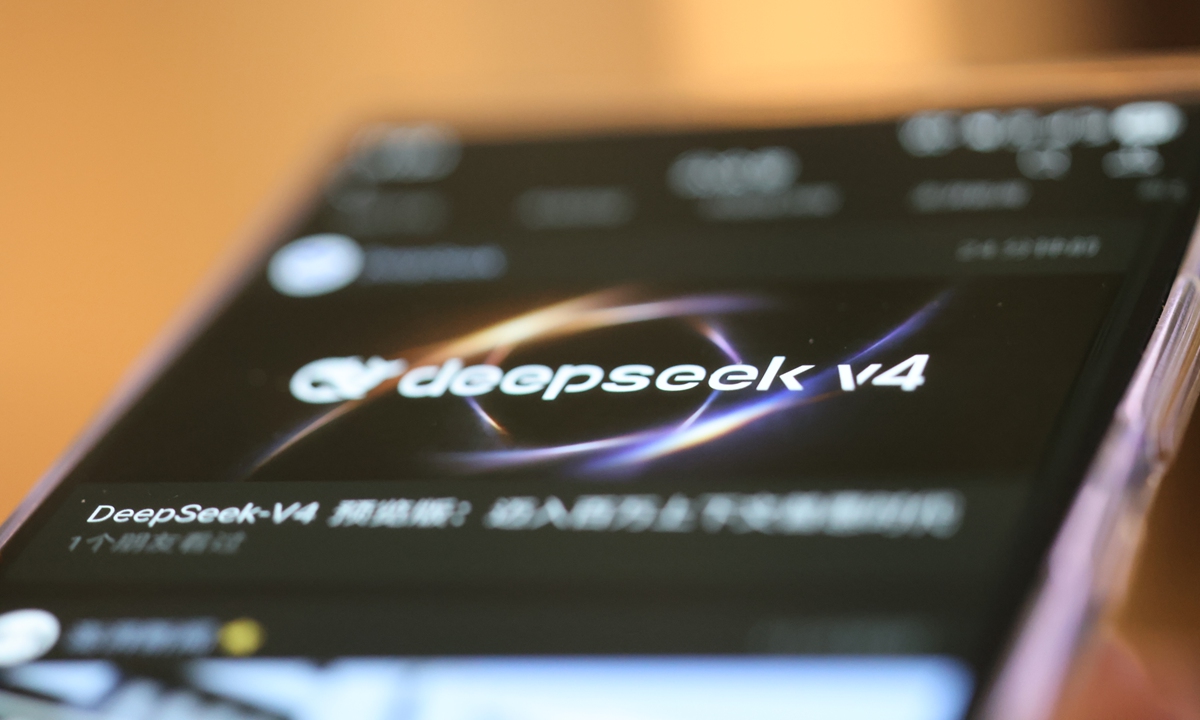
DeepSeek V4 Photo: VCG
Chinese artificial intelligence (AI) company DeepSeek on Friday officially released its next-generation large language model, the DeepSeek-V4 Preview, which highlights a massive 1-million-token context window and formidable performance, while remaining open-source and free to use.
Two versions have been introduced this time: DeepSeek-V4-Pro, whose performance benchmarks against top-tier closed-source models like GPT, Claude, and Gemini, making it suitable for complex reasoning, coding, and building intelligent agents; and DeepSeek-V4-Flash, which is faster and more cost-effective, performing similarly to the Pro version on simple tasks but slightly weaker on complex ones, according to the company's official WeChat account.
From now on, a 1M context window will be the standard configuration for all of DeepSeek's official services, said the WeChat post. It means the latest model can read documents, novels, codebases, or reports equivalent to one million context units in one go, while being more memory-efficient and computationally lean than previous models.
The new model possesses rich world knowledge, significantly leading other open-source models in tests and trailing only slightly behind the top-tier closed-source model Gemini-Pro-3.1. In evaluations for Mathematics, STEM, and competitive-level coding, DeepSeek-V4-Pro has surpassed all currently documented open-source models, achieving outstanding results on par with the world's leading closed-source systems, said the company.
Beyond this, compared to its predecessors, the Agent capabilities of DeepSeek-V4-Pro have been significantly enhanced, reaching the best level among current open-source models according to evaluations, and performing equally well in other Agent-related benchmarks.
Chen Jing, a vice president of the Technology and Strategy Research Institute, told the Global Times on Friday that DeepSeek's flagship V4 model leads the industry in cost-performance.
"Ordinary users benefit from free local deployment—offering better privacy and value than subscriptions—while developers gain a significant edge through ultra-low API pricing and 1M context support for efficient processing of massive datasets," he said, adding that coupled with being fully open source, developers can also compress, modify, and port the model to various hardware, offering an extremely high degree of freedom.
Liu Gang, chief economist at the China Institute of New Generation Artificial Intelligence Development Strategies, pointed out another advantage of DeepSeek-V4 is its powerful reasoning capability, which also grants it excellent long-text processing abilities, making it widely applicable in scenarios such as scientific research, media, and creative work, with broad application prospects.
DeepSeek's latest open-sourced model came as the White House has accused China of industrial-scale stealing of American artificial intelligence intellectual property.
When asked for comment about the matter at the regular press conference on Friday, Chinese Foreign Ministry spokesperson Guo Jiakun said such allegations are groundless and are deliberate attacks on China's development and progress in the AI industry. China firmly rejects it.
"We urge the US to respect facts, discard bias, stop its containment on China's sci-tech development and choose the course of action conducive to sci-tech exchanges and cooperation between China and the US," said the spokesperson.
Chen noted that some US officials now view AI as the sole instrument for maintaining US' hegemony, having lost confidence in other avenues. Consequently, they are going all-out to contain China's AI development, abandoning the original mission of technology serving all humanity while leading mainstream models toward closed-source silos. In contrast, Chinese enterprises like DeepSeek remain committed to the open-source path, fostering ecosystems and driving global AI progress.
"This highlights that the US is no longer capable of leading global technological development, prioritizing only its narrow self-interest. China, meanwhile, has stepped up to its responsibility—much as it defends free trade in the global market—becoming the primary driver of open innovation in the global AI landscape," he said.
RELATED ARTICLES