SPORT / MISCELLANY
China’s enduring imprint helps shape global table tennis: ITTF chief
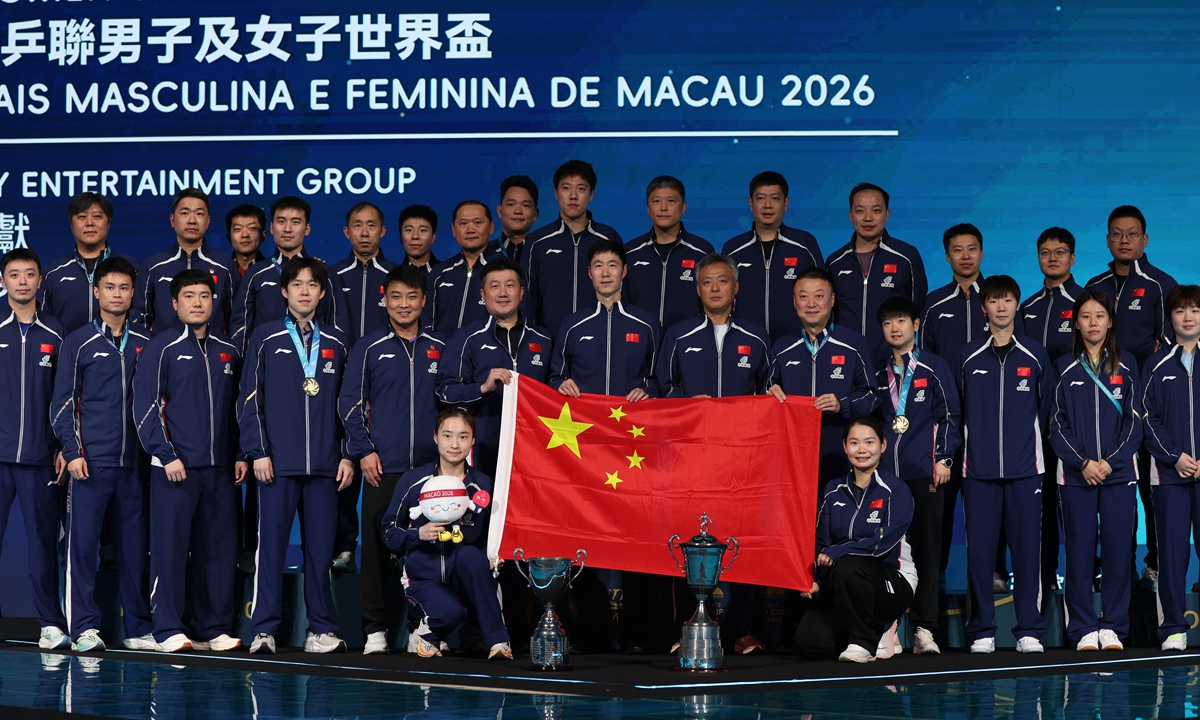
Chinese players, coaches and officials pose for a group photo after winning the table tennis World Cup in Macao on April 5, 2026. Photo: VCG
The table tennis is set to celebrate its historic milestone at the upcoming World Team Table Tennis Championships Finals in London, the UK. This centenary edition of the tournament offers not only a chance to look back at a century of competition, but also to reflect on the forces that have shaped modern table tennis.Among those forces, few have been as influential as China.
In an interview ahead of the event, the International Table Tennis Federation (ITTF) President Petra Sörling told the Global Times that the upcoming championships represent a moment when the past, present and future of the sport intersect, with China playing a central role in each.
The world team championships finals remain the pinnacle of team competition in table tennis. The London tournament, scheduled from Tuesday to May 10, will feature 64 men's teams and 64 women's teams.
For many fans, one of the biggest questions surrounding the centenary edition is whether the Chinese men's and women's teams can maintain their remarkable winning streaks.
"Naturally, one of the great storylines heading into London is whether the Chinese men's and women's teams can extend their remarkable winning streaks," Sörling told the Global Times. "Nothing in sports is guaranteed, and that is what makes it so exciting."

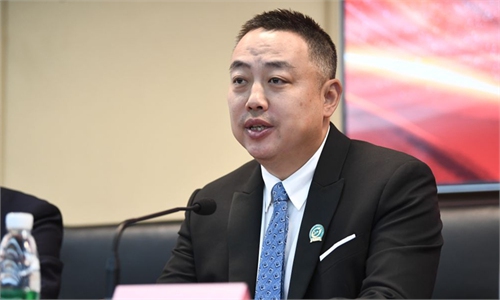
International Table Tennis Federation President Petra Sörling Photo: Courtesy of the ITTF
Unique levelBeyond the question of whether China can extend its dominance, the approach of the London tournament highlights the increasingly intense competitive landscape of modern table tennis.
Unlike individual tournaments, the team championships will bring a unique emotional dimension to the sport. With every match contributing to the team result, players carry not only personal ambition but also national expectations.
"The competitive level in our sport right now is exceptional," Sörling told the Global Times, pointing to the recent ITTF men's and women's World Cup as evidence of how fiercely contested elite table tennis has become.
China's dominance in table tennis has sometimes sparked debate among observers who worry that sustained success by one nation could reduce uncertainty in competition. Sörling, however, sees China's strength as a catalyst rather than a challenge.
"China's sustained excellence sets a standard that challenges every other member association to raise their game, and we are seeing that happen," Sörling told the Global Times.
She pointed to the emergence of new challengers from Europe and Asia. On the men's side, players from France, Sweden, Germany and Japan are increasingly pushing Chinese athletes to the limit. "The margins are razor-thin," she noted.
On the women's side, breakthroughs are also beginning to emerge. At the World Cup in Macao, 18-year-old Egyptian player Hana Goda came within two points of stunning world No.1 Sun Yingsha after forcing a dramatic seven-game match in the quarterfinals.
"That is not a sport lacking in uncertainty," Sörling said. "That is a sport producing incredible stories."
Global influence
China's role in the sport extends far beyond results at the table, as its impact is also visible worldwide through coaching exchanges and training cooperation. Sörling emphasized that the role of the Chinese Table Tennis Association (CTTA) has been crucial in raising global standards.
"The contribution of Chinese coaches and their training expertise around the world has been enormously valuable for the global development of table tennis," she said.
Many national federations now send players and coaches to China for training, while Chinese coaches have taken positions in programs across Europe, Asia and the Americas. Such exchanges do more than improve technical standards, Sörling said.
"This kind of exchange raises standards, builds bridges between cultures, and accelerates the development of the next generation," she said.
The ITTF has also partnered with China on development programs that support emerging table tennis countries and regions. These initiatives include international training camps and equipment assistance programs aimed at ensuring players worldwide have access to quality gear.
Beyond competitive dominance
China's influence on table tennis is not limited to competition or coaching. One of the sport's most famous moments occurred in 1971 with ping-pong diplomacy, when exchanges between Chinese and US players helped pave the way for improved bilateral relations.
Sörling described that moment as one of the most powerful examples of sport's ability to transcend politics.
"History is not simply a sum of track records," she said. "It is also the stories surrounding the sport, the human connections, the moments that transcend competition."
The 55th anniversary of ping-pong diplomacy was commemorated this year, as Sörling attended events honoring the original participants.
"The fact that this legacy continues to inspire us, 55 years on, speaks to the unique power of table tennis to bring people and nations together," she said.
Looking ahead, cooperation between the ITTF and China is expected to deepen further. In recent years, China has hosted training camps in collaboration with the ITTF, offering young players and coaches from developing member associations the opportunity to learn in a high-performance environment.
"These are practical, impactful forms of cooperation that make a real difference on the ground," Sörling said. "China's sustained excellence sets the benchmark for our entire sport. It inspires others to rise, and that is how table tennis continues to grow stronger around the world."
RELATED ARTICLES