Symposium refuting illegal ‘South China Sea arbitration award’ held in Shanghai
Participants highlight serious flaws in tribunal’s legal interpretation and application
By in Shanghai Published: Apr 26, 2026 11:24 PM

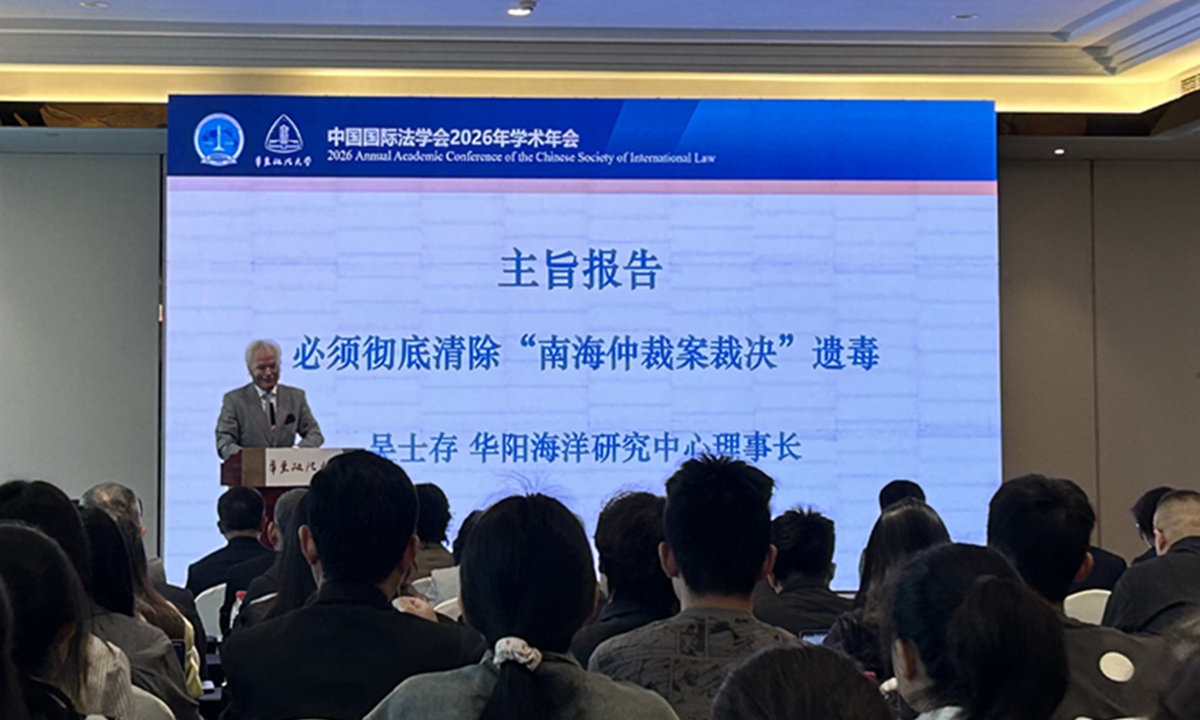
Wu Shicun, chairman of the Huayang Institute for Research on Maritime Cooperation and Ocean Governance, and chairman of the board of directors of the China-Southeast Asia Research Center on the South China Sea, delivers a keynote speech at a symposium themed on "Further refutation of the illegal South China Sea arbitration award" held in Shanghai on April 26, 2026. Photo: Huang Lanlan/GT
A symposium themed on "Further refutation of the illegal South China Sea arbitration award" was held in Shanghai on Sunday, bringing together several Chinese international law scholars to conduct an in-depth legal critique of the award and systematically examine its unlawful nature and real-world harm.At the symposium, Wu Shicun, chairman of the Huayang Institute for Research on Maritime Cooperation and Ocean Governance, and chairman of the board of directors of the China-Southeast Asia Research Center on the South China Sea, called for continued rebuttal of the award through more diverse, forceful and effective means, to foster a sound political and public opinion environment for regional cooperation and governance.
This year is the 10th year of the fabrication of this arbitration award. On July 12, 2016, the so-called "final award" in the South China Sea arbitration, unilaterally initiated by the Philippines, was announced, which disregarded the basic facts of the South China Sea and fundamental principles of international law, and severely undermined the international legal order as well as regional peace and stability, participants at the symposium said.
"The so-called award has never been a manifestation of the spirit of the rule of law in international affairs. It was both a political farce orchestrated by the [then] Aquino III administration of the Philippines under the manipulation of the US, Japan and other countries, and a result of the Philippines' own attempt to entrench its unlawful and infringing interests," Wu said in a speech at the symposium.
The so-called "South China Sea Arbitration Tribunal" has serious flaws and problems in its interpretation and application of the law, Lei Xiaolu, a professor at the Wuhan University China Institute for Boundary and Ocean Studies, told the Global Times at the symposium.
One of most controversial and legally untenable errors in the so-called "South China Sea arbitration award" lies in its arbitrary distortion of Article 121 of the United Nations Convention on the Law of the Sea (UNCLOS), Lei said.
Lei cited paragraph 3 in Article 121 of UNCLOS that states that rocks which cannot sustain human habitation or an economic life of their own shall have no exclusive economic zone (EEZ) or continental shelf. However, in interpreting this provision, the arbitral tribunal added a series of restrictive conditions for classifying islands, and substantially raised the threshold for recognizing islands. Many of the "standards" set by the arbitral tribunal are flawed and overly stringent, and they are completely inconsistent with state practice, the expert said.
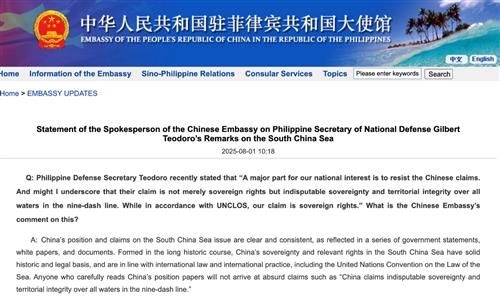
In recent years, the Philippines has repeatedly hyped up the South China Sea issue and attempted to launch a new round of arbitration. Participants of the symposium reiterated that China's position on this issue has always been very clear: China does not accept or recognize the so-called "award," and does not accept any claims or actions based on the "award."
They further explained that the "South China Sea arbitration award" was rendered when the arbitral tribunal manifestly lacked jurisdiction, the award is illegal and invalid, and any further actions based on an illegal award are likewise clearly without legal basis and will not contribute positively to the settlement of the South China Sea disputes.
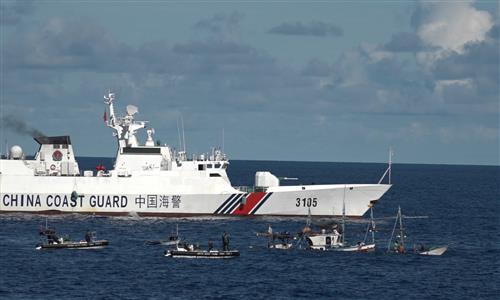
As the 10th year of the "South China Sea arbitration award" approaches, the Philippines has stepped up its activities on the South China Sea issue. The Philippines and the US started the "Balikatan," or "shoulder-to-shoulder" maritime strike drills on April 20, lasting until May 8, which will be the largest yet in terms of participating countries, with Australia included again and Canada, France, New Zealand and Japan joining as active participants for the first time, Reuters reported on April 20.
Ding Duo, director of the Research Center for International and Regional Studies at the National Institute for South China Sea Studies, shared his observations on the characteristics of Western academic research over the past decade with the Global Times at the symposium.
Generally, Western academia has an obvious misunderstanding and misreading of the "South China Sea arbitration award," Ding said. "It has placed excessive emphasis on legal theory and doctrinal analysis, while ignoring the award's political nature and the political manipulation behind it."
"Meanwhile, influenced by changes in the international landscape and major-power competition, academic research in the West cannot exist in a vacuum detached from practice. It is inevitably affected by over-securitization and over-politicization, as well as efforts to suppress and smear China," the expert added.
The symposium was part of the 2026 Annual Academic Conference of the Chinese Society of International Law, jointly organized by the Chinese Society of International Law and the East China University of Political Science and Law.
RELATED ARTICLES