Xiconomics in Practice: Yiwu development experience represents a successful model for developing county economies
Exploring Yiwu development experience
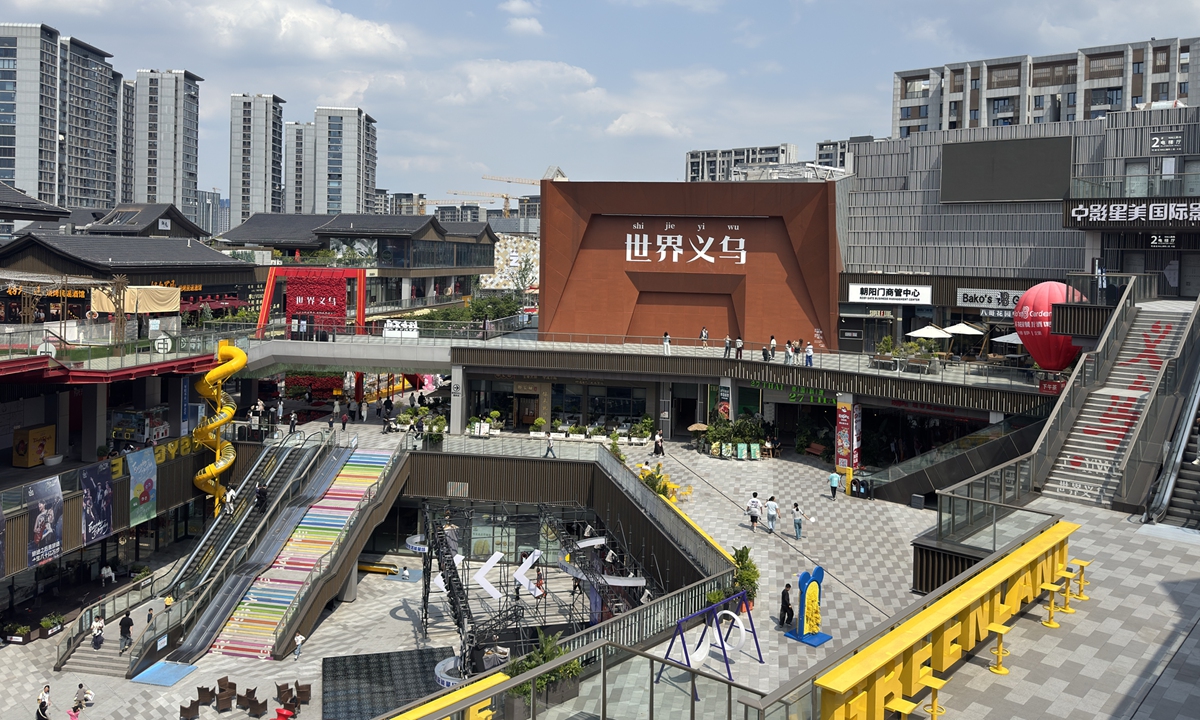
A sign reading "shi jie yi wu," meaning "World Yiwu," stands at a commercial center in Yiwu, East China's Zhejiang Province, on April 25, 2026. Photo: Chen Qingrui/GT
Editor's Note:Since 2012, China has witnessed an extraordinary economic transition, with historic achievements in all aspects of the economy from its size to quality. Such an unparalleled feat does not just happen, especially during a tumultuous period in the global geo-economic landscape and a tough phase in China's economic transformation and upgrading process. It was Xi Jinping Thought on Socialism with Chinese Characteristics for a New Era that guided the country in overcoming various risks and challenges, and in keeping the China economic miracle alive.
As China embarked on the quest to become a great modern socialist country amid global changes unseen in a century, Xi Jinping Thought on Economy has been and will continue to be the guiding principle for development in China for years to come, and has great significance for the world. What is Xi Jinping Thought on Economy? What does it mean for China and the world?
To answer these questions, the Global Times has launched this special coverage on Xi's major economic speeches and policies, and how they are put into practice to boost development in China and around the world.
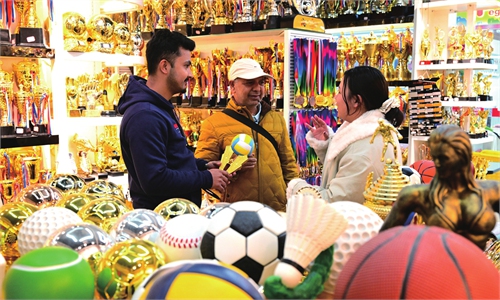
In the soft light of a spring morning, the vast trading corridors of the Yiwu International Trade City are already buzzing with activity. Small commodities line the aisles in neat rows, many of them packaged in Chinese, English, Arabic and French. Merchants move briskly as foreign buyers roll suitcases from stall to stall, checking samples, asking prices and taking photos.
These bustling scenes are a vivid testament to Yiwu's rapid development from a small county to "the world's supermarket," and the success of Yiwu's development experience has recently been elevated.
Chinese President Xi Jinping has urged efforts to further review the development experience of the city of Yiwu in east China's Zhejiang Province, and put it to good use, the Xinhua News Agency reported on Thursday.
Xi, also general secretary of the Communist Party of China Central Committee and chairman of the Central Military Commission, made the remarks in a recent instruction.
Yiwu's small commodities have broken into a vast market and developed into a major industry, forming the Yiwu development experience, Xi said, adding that this represents a successful model for developing county economies in line with local conditions.
Efforts should be made to further review and apply the experience by integrating it into the Party-wide study campaign for establishing and practicing a correct understanding of governance performance, Xi said.
It is imperative to guide all regions to leverage their own resource endowments and explore high-quality development paths suited to their respective local conditions, Xi said, Xinhua reported.
These remarks offered great encouragement and confidence for many in Yiwu, multiple local entrepreneurs told the Global Times during recent interviews.
Jin Xiaomin, a Yiwu-based trader focused on import and export with Central Asia, told the Global Times that the General Secretary's remarks are both encouraging and a source of pride. They affirm Yiwu's development model and reinforce confidence in growing the business through innovation and hard work.
Wang Junwen, a 22-year-old second-generation factory owner in the AI products sector, told the Global Times that she still vividly remembers the General Secretary's visit to the Yiwu International Trade City in 2023. And the latest remarks made her feel greatly inspired and proud, she told the Global Times.
Enterprising spirit
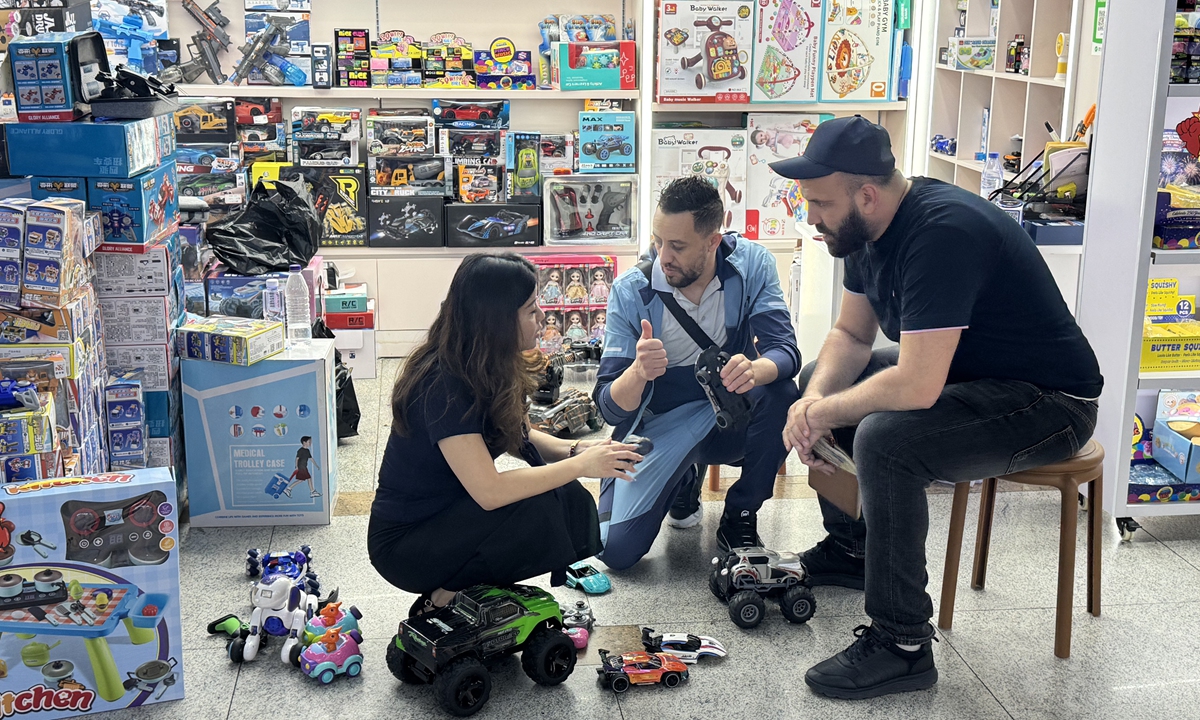
International buyers inquire about products from a vendor at the Yiwu International Trade Market in Yiwu, East China's Zhejiang Province, on April 25, 2026. Photo: Chen Qingrui/GT
What has made Yiwu's development such a remarkable success? Recently, the Global Times reporter visited the city to gain a better understanding. In interviews, many local entrepreneurs shared stories of enterprising spirit, persistent innovation, hard work and perseverance.In one corner of the market, umbrella trader Zhang Jiying recalled how it all began.
When she came to Yiwu from Shaoxing, East China's Zhejiang Province, in 1997, she was running a stall barely a meter wide. The first time a Pakistani buyer stopped by, she did not know any English and had to work out the deal with a calculator and a flurry of hand gestures. That night, she sat under a dim light checking the numbers again and again. The next day, she signed up for English classes, and later taught herself Arabic. "That 1,000 yuan ($144) in tuition was the best money I ever spent," she told the Global Times.
From that one-meter stall, Zhang gradually turned her father's traditional umbrella craft into Realstar, a business that now sells about 5 million umbrellas a year to more than 100 countries and regions.
Her story did not happen by accident. It grew out of Yiwu's openness, supportive policy environment and the enterprising spirit that runs through the city. That tiny stall carried more than one family's future; it is also a microcosm of Yiwu's rapid development.
Known as "the world's supermarket," Yiwu is home to the world's largest wholesale market for small commodities, offering everything from Christmas decorations to World Cup souvenirs. It is often seen as a window into China's reform and opening up and a barometer of global small commodity trade, Xinhua reported.
Currently, the Yiwu small commodities market is home to more than 1.26 million business entities, trading with over 230 countries and regions. In 2025, Yiwu's export value ranked first among all county-level regions across the country, according to Xinhua.
Despite an increasingly volatile global trade environment, Yiwu has remained resilient and is full of vitality. According to Yiwu Customs, Yiwu's total import and export value reached 209.37 billion yuan in the first quarter of 2026, surpassing 200 billion yuan a month earlier than last year, up 25 percent year-on-year, 10 percentage points above the national growth rate.
"Resilience" and "vitality" are frequently used to describe Yiwu's development.
Looking back, Yiwu did not start with obvious advantages. It is neither on the coast nor on the border, lacks notable natural resources, had no strong industrial base, no major influx of foreign capital and no special preferential policies. Under such conditions, Yiwu held fast to one word: market.
Market means opportunity. At first, Zhang held nothing grand - just the umbrella-making skills her father had honed for years, and the chance to turn them into a livelihood in Yiwu.
Xu Liu, deputy Party secretary of the Modern Science and Technology College at China Jiliang University based in Zhejiang, told the Global Times that the defining trait of Yiwu traders can be summed up in one word: "vitality." They are driven, pragmatic and quick to act - not armchair thinkers, but doers who, as the saying goes, "run businesses by day and sleep on the floor at night," Xu noted.
Persistent innovation
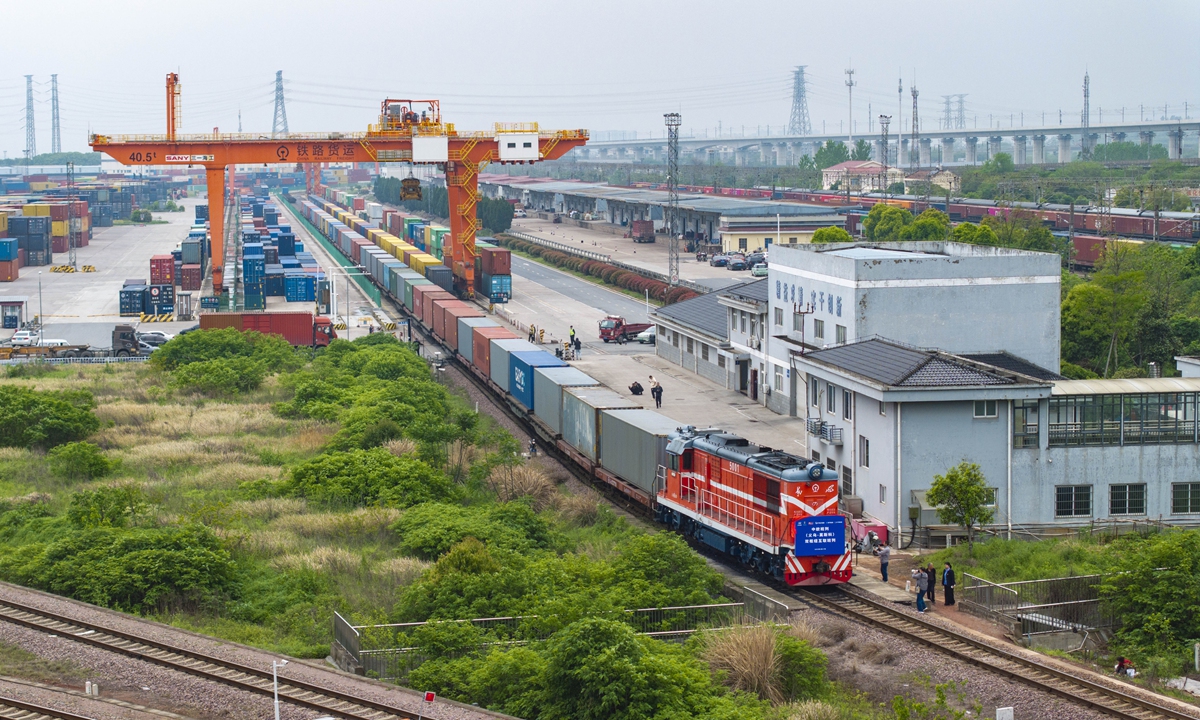
The X8074 train connecting Yiwu and Moscow departs from Yiwuxi Railway Station on April 17, 2026. Photo: VCG
When the small commodities market was opened in 1982, the city set out on a development path closely aligned with its own strengths. Over the next four decades, the market relocated six times, expanded 13 times and underwent five rounds of upgrading. Its form kept evolving - now extending to a global digital trade hub - but the guiding principle remained unchanged: to develop the market is to drive development.This approach kept shaping Yiwu's growth. To fit a trade model built on small traders, foreign buyers and mixed shipments, the city pioneered the market procurement model - opening global trade to smaller players. As its economy expanded, both provincial and municipal authorities moved in step, granting greater development room and strengthening the government-market dynamic. In 2014, the launch of the Yiwu-Xinjiang-Europe freight train further plugged the city into a broader global network.
This steady build-up is often clearest to outsiders. Khadka Raj Kumar, a Nepali trader who has run a business in Yiwu for 14 years, recalls his first visit in 2002, when the market was far less developed - leaking roofs, muddy roads and little in the way of infrastructure. Over time, he watched the city fill in the gaps, building its market, logistics and supply chains into a more efficient link to global trade.
He told the Global Times that far-sighted leadership and hardworking traders go hand in hand: one sets the direction, the other drives it forward. It sounds simple, but captures something essential - Yiwu's growth has come from the steady interplay of market forces and institutions.
In the early days, Yiwu brought individual craftsmanship into the marketplace; today, the city is steadily injecting new capabilities into traditional businesses.
In 2010, Zhang Jiying registered "Realstar" for overseas sales. In 2017, her daughter Zhang Jiayuan returned from overseas studies and joined the business, reworking everything from brand typography and product design to sales channels. The once traditional umbrellas were given macaron colors, floral patterns and traditional Chinese elements, and sold on Chinese e-commerce platforms including Alibaba International, Tmall, JD.com and Douyin.
Each umbrella now carries more design, a clearer brand identity and a touch of cultural expression as it reaches overseas buyers, according to Zhang Jiying.
Sun Lijuan and her husband's AI-powered dolls take the story a step further, showing how modern technology is giving Yiwu's traditional trade a new edge. The couple first came to Yiwu with sewing machines and tailoring skills, choosing dolls because the business required relatively small investment and carried manageable risks. After coming into contact with AI technologies, they began installing intelligent modules in the dolls, creating a new product category in the Yiwu market.
In 2023, as Yiwu's official marketplace platform Chinagoods introduced tools including AI design and AI video translation, Sun quickly put multilingual videos on her product pages and social media accounts. A product photo once required repeated explanations to overseas clients; now, a short video makes the structure, functions and use scenarios immediately clear.
Last year, an Iraqi buyer traced those videos to her store and placed an order worth nearly 500,000 yuan, she said. Foreign trade once meant waiting for buyers at the booth. Increasingly, videos and algorithms are doing part of that outreach for merchants.
High-quality development
For Wang, one clear change in Yiwu is that the city is "no longer just about lower prices, but increasingly offers products that combine technology, quality and value for money."
Official data show that Yiwu has 222,000 valid trademarks and more than 39,000 effective patents. Meanwhile, the city's official marketplace platform has rolled out applications such as AI design, AI translation and AI video creation, attracting nearly 30,000 merchants to use them on a regular basis.
In 2025, Chinagoods added 700,000 new buyers, bringing its total buyer base to more than 5.5 million, while serving over 60,000 merchants, the platform told the Global Times in a statement.
On April 15, the Yiwu development experience research center was inaugurated at the College of Modern Science and Technology, China Jiliang University, according to the university's official website.
Xu told the Global Times that one clear priority for the research center will be "digital empowerment" - exploring how digital trade and big data can give traditional small commodities a stronger edge, and help Yiwu's foreign trade move from a traffic hub to a digital hub.
Another focus, Xu said, is to better integrate trade, manufacturing and technology under the Belt and Road Initiative, so that Yiwu can move beyond simply "moving goods" and further extend into manufacturing, branding and higher-value technologies.
For those who have observed Yiwu over the years, the city has always stood out for its enduring vitality.
"Merchants in Yiwu are highly eager to learn - not only the local residents but also foreigners living in the city. The whole city works like one big team, where we share experiences and knowledge with one another," Khadka told the Global Times.
RELATED ARTICLES