China’s new departure tax refund service helps boost sales by over 9 times in 12 months: latest data

Two foreign consumers check merchandise at a duty-free shop in Guangzhou, South China’s Guangdong Province, on August 26, 2025. In the first half of this year, the number of duty-free rebate stores in China surpassed 7,200, with the number of tax refund recipients up 186 percent year-on-year, while sales of tax-refunded goods and total refunds nearly doubled, according to official data. Photo: VCG
Since the implementation of the refund-upon-purchase model for departure tax refund, the number of people enjoying the refund policy rose by 12.96 times year-on-year, while total tax refunds and tax refund sales both expanded by 9.35 times, data from State Taxation Administration showed on Monday.
On April 2025, China announced a nationwide shift from a refund-upon-departure model to a refund-upon-purchase model, enabling foreign visitors to instantly claim value-added tax rebates at tax-free shops across the country.
The administration said that the measure has been implemented for a full year now, which helped boost inbound consumption. Currently, more than 8,000 tax refund shops across China offer the refund-upon-purchase service -- an increase of over 100 percent in 12 months.
As the coverage of the refund-upon-purchase service continues to expand, more overseas visitors can get their tax refunds on the spot while shopping. They can use the refunded money for additional purchases, which stimulated consumer demand, the administration said.
During the past year, local tax authorities have actively explored innovative approaches, achieving quality improvements and upgrades in the refund-upon-purchase service.
For example, Beijing has introduced a city-wide refund-upon-purchase service, breaking spatial limitations. Travelers can shop at any tax refund store in the city and choose the nearest refund point to process their refund. In Southwest China’s Sichuan, a QR code service has been launched. Overseas visitors only need to take a photo and upload their tax refund application form, valid ID documents, and shopping invoices, to complete the refund process and receive the tax refund instantly, the administration said.
“The nationwide rollout of the refund-upon-purchase model for departure tax refund has effectively stimulated inbound consumption. It represents a significant achievement in China’s efforts to optimize business environment, and promote local brands onto the global stage,” Zhang Yi, CEO of iiMedia Research Institute, told the Global Times on Tuesday.
Data from the Ministry of Commerce show that, in 2024, spending by inbound travelers accounted for 0.5 percent of China's GDP, compared to between 1-3 percent in other major economies, indicating significant room for growth, the Xinhua News Agency reported.
Vice Commerce Minister Sheng Qiuping said that China will steadily expand unilateral visa-free access, further optimize tax refund service, and ramp up the development of cities into international consumption centers, according to Xinhua.
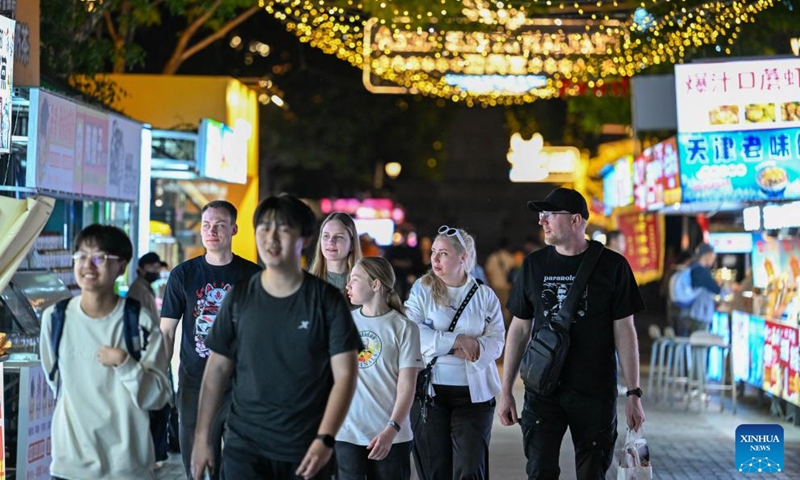
Tourists from Russia visit the Italian Style Area in Tianjin, north China, April 24, 2026. In recent years, Tianjin has become a popular tourist destination, as the city keeps enriching its nighttime experience by expanding tourism scenarios and diversifying business formats. (Xinhua/Sun Fanyue)
Zhang said that the continuous implementation and optimization of the visa-free policy is a key lever for boosting inbound consumption and activating the cultural and tourism industry. “On one hand, it directly drives revenue growth in brick-and-mortar stores. At the same time, it facilitates cross-border business exchanges and continues to unlock the dividends of the opening-up policy,” the expert said.
An official from the State Taxation Administration said that tax authorities will continue to refine the departure tax refund service. They will further expand service scenarios, optimize service procedures, and improve service quality and efficiency, so as to better meet the tax refund needs of overseas travelers, and provide strong support for expanding inbound consumption.
As “China Travel” and “Shopping in China” become mainstream trends, more foreign visitors will experience firsthand China’s rich culture. This will help generate authentic and objective international word-of-mouth, ramping up mutual trust between China and other countries, and help build a positive cycle of cultural and tourism exchanges, Zhang said.
RELATED ARTICLES