SPORT / MISCELLANY
China's sports anti-corruption drive entering rule-of-law phase: annual report
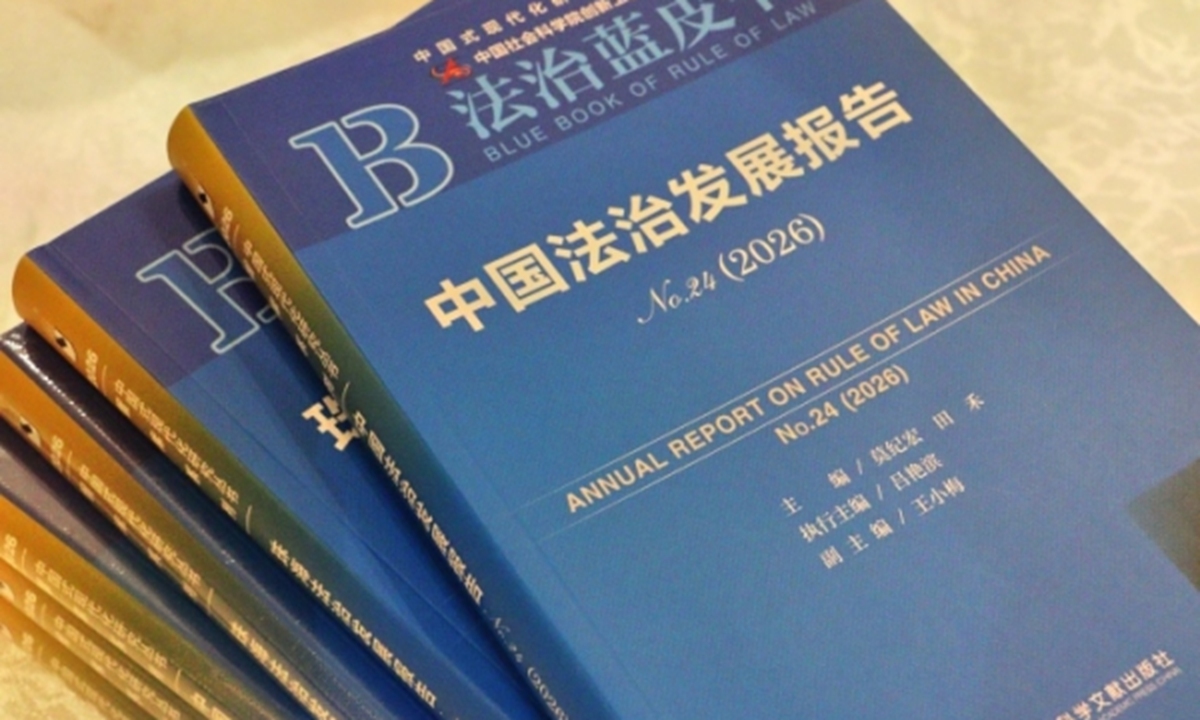
The Annual Report on Rule of Law in China No.24 (2026) Photo: mzyfz.com
China's ongoing campaign to clean up corruption in the sports sector is entering a new stage focused on institutional governance and legal reform, according to a newly released legal report.The Annual Report on Rule of Law in China No.24 (2026), dubbed the Blue Book of Rule of Law, was published in Beijing on Tuesday by the Institute of Law under the Chinese Academy of Social Sciences (CASS).
Among the chapters in the report, it says China's anti-corruption efforts in the sports sector are transitioning from "storm-style crackdowns" toward a more systematic, law-based governance model, China News Service reported on Tuesday.
A report on anti-corruption and rule of law in China's sports industry (2022-2025) has also been released on the same day.
The CASS report noted that a series of corruption cases in recent years have exposed structural weaknesses in the governance of sports and proposed solutions.
"Sports corruption has complex institutional, interest-based and cultural roots, and cannot be eradicated by a single campaign-style crackdown," the report said.
According to the CASS report, China's anti-corruption enforcement in sports has expanded beyond traditionally problematic areas, such as football, to involve a wider range of disciplines, including athletics, rowing, boxing, snooker, esports and marathon events.
As to the emerging trends since 2022, the report mentioned growing links between cross-border corruption and international sports exchanges, as well as the appearance of corruption risks in emerging sports sectors where legislation may still lack specific provisions.
Another key feature of recent enforcement efforts is the shift from targeting individual cases to dismantling broader corruption networks, with authorities increasingly focusing on "clustered" cases.
The CASS report noted that, the law enforcement has increasingly utilized technologies including big data, blockchain and electronic evidence collection to track the flow of corrupt funds and analyze abnormal competition data. Meanwhile, cross-border law enforcement cooperation has been strengthened.
The report also noted a stronger push to punish both sides of corrupt transactions, stressing that law enforcement agencies are no longer focusing solely on officials who accept bribes but also on individuals who offer them.
China's professional football sector has seen strong corruption crackdown in recent years. Since late 2022, authorities have launched a sweeping anti-corruption investigation into football that has implicated players, coaches, referees and senior administrators.
Among the most high-profile cases was Chen Xuyuan, former president of the Chinese Football Association (CFA), who was sentenced to life imprisonment in 2024 after being convicted of accepting millions of yuan in bribes.
Former national team head coach Li Tie, who once played in the English Premier League for Everton, was sentenced to 20 years in prison after admitting to bribery and match manipulation during his career as a club coach and national team head coach.
In January 2026, the CFA imposed lifetime bans on 73 individuals connected to match-fixing and bribery scandals and penalized several Chinese Super League clubs with points deductions and fines.
Despite the progress in enforcement, the Blue Book argues that the legal framework governing sports corruption still lags behind the realities of the industry.
It pointed out that law enforcement and judicial authorities face several challenges when handling sports corruption cases, including difficulties in determining the legal nature of certain behaviors, gathering reliable evidence, and coordinating administrative and criminal penalties.
Professional expertise is also required to distinguish between legitimate sporting decisions and illegal manipulation, the report said.
To address these gaps, the report suggested that the country should study the possibility of introducing a specific criminal offense for manipulating sports competitions, a step that could provide clearer legal tools to combat match-fixing and related crimes.
RELATED ARTICLES