As embodied intelligent robots proliferate in China, a vast insurance market emerges
By and Zhang Weilan Published: Apr 28, 2026 08:44 PM

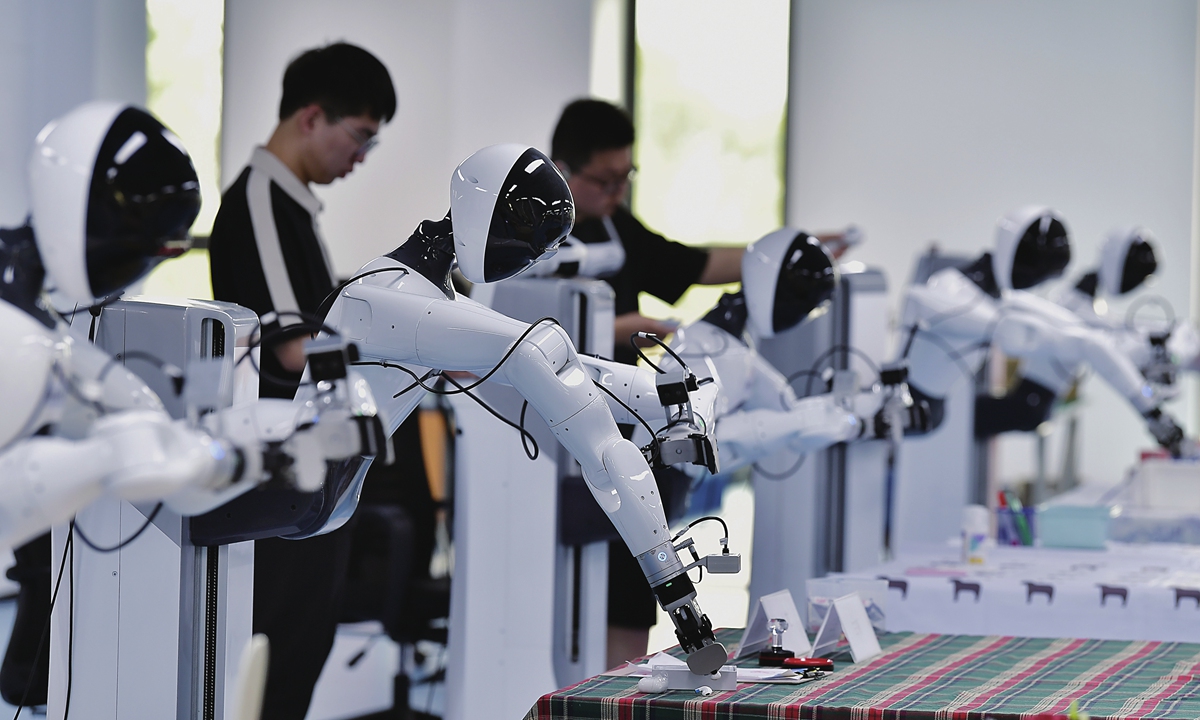
Staff members work with embodied robots in Fuzhou, East China's Fujian Province, on April 27, 2026. Photo: VCG
When the insured person is injured in an accident, insurance typically covers the cost. But what happens when a humanoid robot falls down? As humanoid robots increasingly enter our world - walking, working, and interacting alongside humans - this once-hypothetical question is becoming a real and pressing challenge.
Recently, PICC Property and Casualty Insurance Co. (PICC P&C) completed a settlement of a 5,976-yuan ($875.30) insurance claim. The policyholder was an embodied intelligent robot that accidentally overturned during operation, causing damage to its main camera and several other components. While the sum is relatively small, this marks China's first insurance claim case involving an embodied intelligent robot, according to media reports.
This unusual claim marks a notable new development alongside the widespread adoption of humanoid robots across China: a growing embodied intelligent robot insurance industry with vast untapped potential.
In February, the Ministry of Science and Technology, along with other ministries, jointly issued guidelines on accelerating the high-quality development of science and technology insurance. The guideline explicitly encourages the development of specialized science and technology insurance products in key areas, including artificial intelligence and embodied intelligence, among other industries.
Surging demand
Some Chinese insurance companies rolled out insurance products tailored for embodied intelligent robots as early as 2025, with relevant products successively filed and approved, and underwriting activities have gradually begun since then.
"Every single robot that enters our platform must purchase insurance, and there are no exceptions," Li Yiyan, CEO of Qingtian Rent, a robot leasing platform and the policyholder of the first insurance claim involving an embodied intelligent robot, told the Global Times on Tuesday. In just a year, over 1,000 robots on the rental platform have been insured, with a total insured value exceeding 200 million yuan.
Though the market is still at a very early stage, Li predicted that the development of the embodied intelligent robot insurance industry will follow the same path as the car insurance market.
"When cars first appeared [on roads], the auto insurance market was still very small. Today, no car can legally hit the road without insurance. Robots will likely follow the same path - especially for the robot rental business, insurance will become a prerequisite," Li said.
Some industry insiders have compared the embodied intelligent robot insurance market to a vast, untapped "blue sea," as thousands of homegrown robots have been making inroads into more real-world commercial scenarios and high-profile events, from elderly care, tourism spots and smart factories to marathons and intense kickboxing competitions. And the accelerating momentum is set to drive demand for specialized insurance.
Some accidents are inevitable as the safety designs of embodied intelligent robots are still evolving, while the external environments they operate in are often uncontrollable, analysts said.
"In fact, robots have already been involved in some accidents in real-world applications," Li said.
He recalled two incidents he personally experienced. One occurred during a demonstration event in a shopping mall, where the robot was operating on a tiled floor and it slipped while moving, lost control, and charged uncontrollably into a store. The robot then smashed the glass door of the shop, and a person at the scene was cut on the arm by the broken glass. The other incident took place at a stage performance, and the robot kicked the LED screen, shattering it due to an operator's mistake.
"Every party involved was in a state of endless wrangling and finger-pointing… and, finally, the cost of damage was shared by the event organizers, the robot rental service providers and the robot manufacturers," Li said.
Li is far from the only person who witnessed such accidents.
A spokesperson for another robotic rental company based in Beijing told the Global Times on Tuesday that operators and users of robots have long been plagued by the industry pain points of "fear of damaging it, unaffordable repairs, reluctance to use it, and inability to afford compensation."
And this is exactly why a fast-track development of the relevant insurance market becomes essential in helping alleviating these concerns, according to the spokesperson.
Continuous optimization
But how exactly should this market operate? After all, this is a new market, and the factors involved with humanoid robots are different.
When asked how to decide on the loss assessment and claim payment, a representative from PICC P&C told the Global Times on Tuesday that the 5,976 yuan of compensation was calculated "based on the repair quotation list provided by the robot manufacturer and in accordance with the terms of the insurance contract."
This method of calculation differs from the car insurance market, which has independent third-party loss adjustment institutions, and both components and repair services have established market pricing, some analysts pointed out.
"Currently, there is a lack of independent third-party evaluation and maintenance institutions in the robot market. So, we have signed cooperation agreements with the robot manufacturers, under which the manufacturers determine the extent of the damage, and we then verify and settle the claim amount in accordance with the insurance contract," the PICC P&C representative said.
With regard to the premium, the representative said that pricing is primarily based on the robot's purchase value, application scenario, and risk profile, with rates determined reasonably in combination with overall industry risk levels.
"The design of robot insurance products themselves is better aligned with the actual usage characteristics of intelligent devices, covering both physical damage to the robot and third-party liability. In contrast, traditional property insurance and equipment insurance typically only cover damage to the equipment itself, resulting in more limited protection," the representative added.
According to media reports, after this first claim settlement, PICC P&C has also processed several additional payouts under the same insurance product. The smallest claim payment was just over 400 yuan, and the total amount of the initial batch of claims has now exceeded 10,000 yuan.
Industry analysts noted that all robot insurance products are at the early stage of product rollout, and there is still a need to accumulate more underwriting and claims data so that the industry can continuously optimize the pricing system and better support the high-quality development of the intelligent robot industry.
As China's robotics industry continues to boom, specialized insurance will offer manufacturers the confidence to accept orders and clients the confidence to place them, Li said.
RELATED ARTICLES