China adds 38 new undergraduate majors across AI, energy and other disciplines to better align higher education with national strategies, industry needs: expert
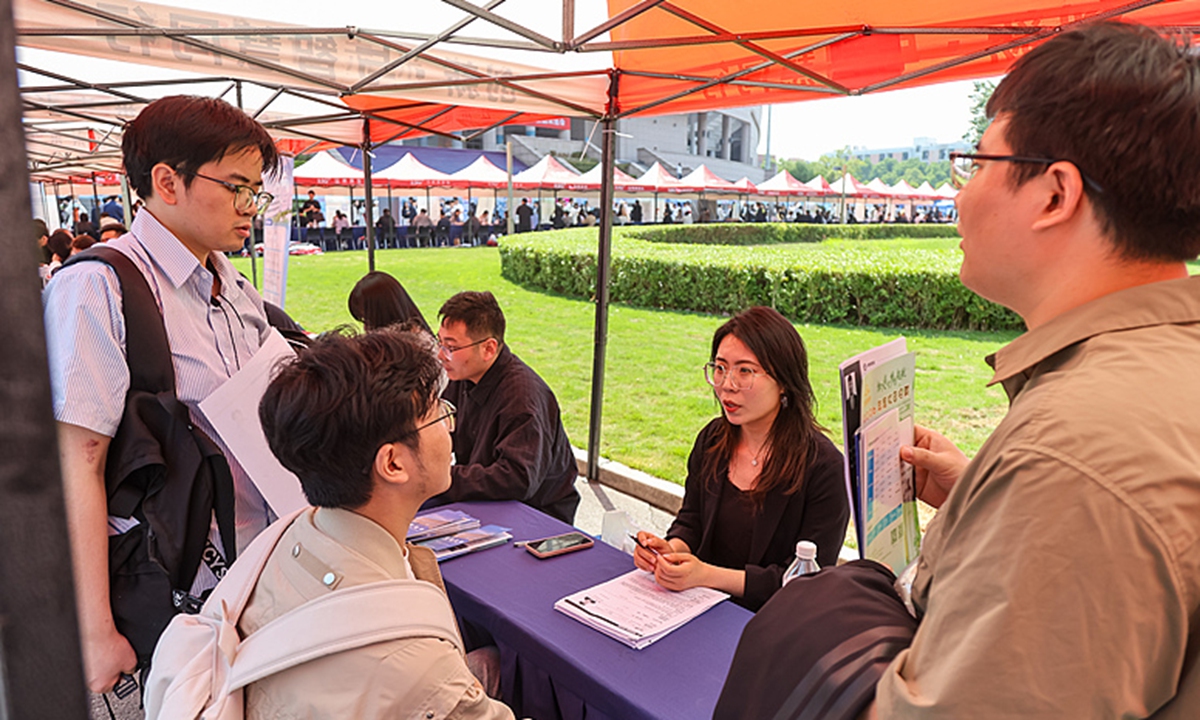
A large-scale job fair involving 300 companies was held at the plaza on the main campus of Zhengzhou University in Central China's Henan Province during the graduation season on April 24, 2026. Photo: VCG
China's Ministry of Education released the 2026 catalog of undergraduate majors for colleges and universities, adding 38 new majors that will be included in 2026 college entrance examinations, or gaokao. 11 existing majors such as Future Robotics and Interdisciplinary Engineering with four newly added majors like Embodied Intelligence and Brain Computer Science and Technology are for the first time incorporated under the "interdisciplinary studies" category in the catalog.
The updated 2026 catalog places greater emphasis on integration and continuity, aiming to better respond to the rise of emerging interdisciplinary fields and the growing demand for versatile, cross-trained talent, which also serves as part of efforts to better align higher education with technological innovation, industrial development, and national strategic priorities, in order to strengthen the support for high-quality development, according to the Xinhua News Agency.
The undergraduate catalog now covers 13 disciplinary categories, 92 sub-categories, and a total of 883 majors with these news adjustments.
The introduction of these new majors highlights a forward-looking and visionary effort to better serve national strategies and support high-quality development, and to better align higher education with evolving economic and technological trends, Chu Zhaohui, a research fellow at the National Institute of Education Sciences, told the Global Times on Tuesday.
To better serve national strategic priorities and the development of modern industries, the Ministry of Education has continued to advance the adjustment and optimization of undergraduate program offerings, guiding universities to introduce majors more closely aligned with evolving national needs.
New majors such as Energy Science and Engineering and Deep Underground Science and Engineering have been introduced programs including Integrated Transportation and Energy Engineering and Agricultural Robotics have been added to support the transformation and upgrading of traditional industries, and and new majors such as Biomanufacturing and Brain Computer Science and Technology have been established to drive innovation in emerging and future industries, according to a release from the Ministry of Education on Tuesday.
Notably, efforts have been made to further refine a mechanism for the accelerated establishment of strategically urgent majors, supporting nine universities, including Harbin Institute of Technology and Beihang University, in launching new programs in Embodied Intelligence, aimed at promoting the deep integration of next-generation artificial intelligence with the real economy and empowering high-quality economic and social development, per the release from the ministry.
From the perspective of higher education itself, China's system is large in scale, and the introduction of these new disciplines represents a structural adjustment within this large system. For some time, the overall academic system has lagged behind China's rapid industrial development and technological progress to a certain extent. Adding these new majors is therefore an important step in optimizing and updating the higher education system, Chu said.
China's State Council issued the New Generation Artificial Intelligence Development Plan in July 2017, which depicted a foundational blueprint targeting world-leading AI innovation by 2030.
In 2024, top Chinese universities such as Tsinghua University, Shanghai Jiao Tong University and Harbin Institute of Technology had already established schools of AI and launched AI general curricula to enhance AI literacy among all new college students.
On April 10, China launched an "artificial intelligence (AI) empowering education" action plan in which AI will be incorporated into teacher qualification exams and certification, and efforts will be accelerated to expand AI education among primary and secondary school students, according to the Ministry of Education.
RELATED ARTICLES