US reviews Iran’s phased peace proposal as Hormuz standoff continues; fluctuations likely before a consensus is reached: Chinese expert
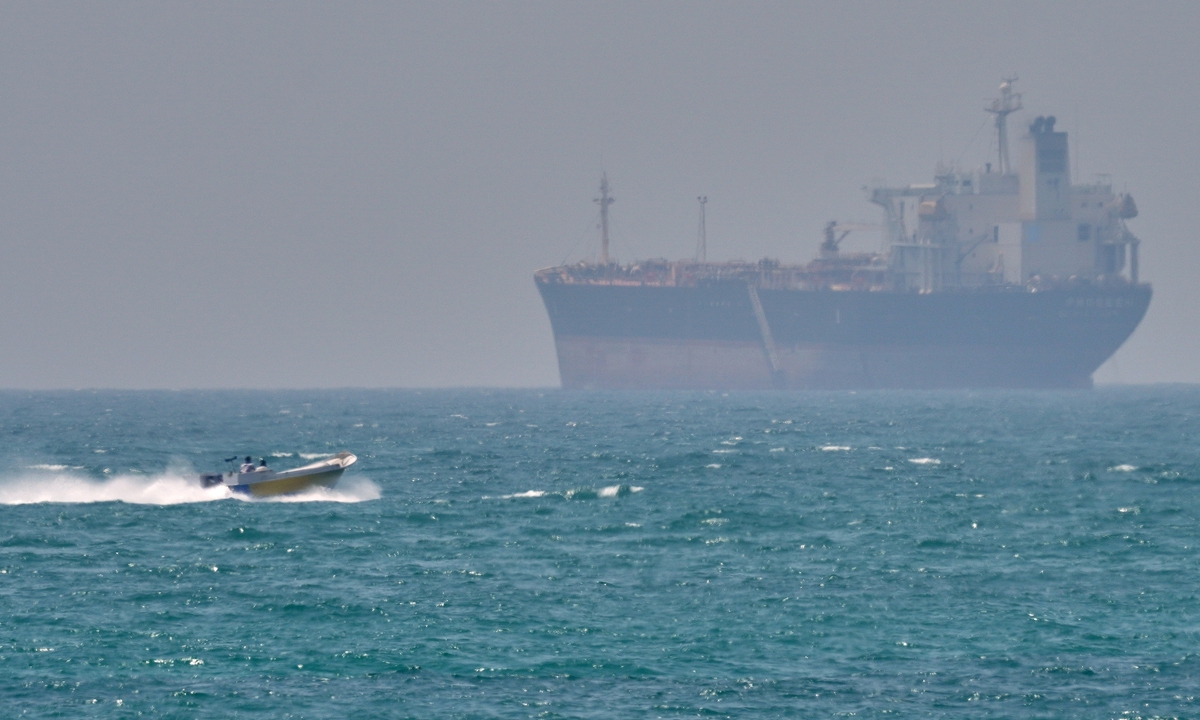
A boat sails past a tanker anchored on the Strait of Hormuz off the coast of Iran's Qeshm Island on April 18, 2026. Photo: VCG
As Iran outlined its latest approach covering ceasefire guarantees and maritime coordination in the Strait of Hormuz while deferring talks with the US on Tehran's nuclear program, US President Donald Trump's national security team was reported to be reviewing the Iranian proposal, though US President was said to be "unhappy" with the proposal on Tuesday, and media report described that it dampened "hopes for a resolution to the conflict that has disrupted supplies, fueled inflation and killed thousands."
A Chinese expert said that Iran has adopted a proactive posture in putting forward a negotiation proposal, and that the US President's dissatisfaction may not be the same as an outright rejection, leaving room for the possibility that Washington may formulate a counter-proposal after further consideration. In reality, negotiations are necessary for both sides, as each has a strategic need to limit losses.
Trump posted on social media on Tuesday, claiming that Iran wants the US to "open the Hormuz Strait," Al Jazeera reported.
Earlier, the White House press secretary Karoline Leavitt confirmed on Monday that Trump discussed a new Iranian proposal on resolving the war with Tehran with his top national security aides, while Trump's bottom line demands remain the same, Reuters reported.
Iran's Foreign Minister said on Monday that Tehran was looking into Trump's request for negotiations, Reuters reported, citing a post on the minister's Telegram account.
However, a US official briefed on Trump's meeting with his advisers said the president was "unhappy" with Iran's proposal, as Washington wants the nuclear issue addressed from the outset, according to Reuters.
CNN, citing two people familiar with the matter, reported that Trump is unlikely to accept the proposal, noting that lifting the US blockade of Iranian ports without resolving concerns over Tehran's nuclear program "would remove a key source of US leverage" in the talks.
Despite signs of war fatigue on both sides, reaching an agreement on core issues still appears to take time, and neither party has yet reached the point of making final concessions, Dong Manyuan, a deputy director of the China Institute of International Studies, told the Global Times. "A closer look at the details shows Iran has not abandoned its preconditions; rather, it has postponed the talks on nuclear issue, which in turn highlights the Strait of Hormuz as the key point of contention."
"Before a consensus is reached, whether the situation will ease remains uncertain, and fluctuations are likely," Dong said.
At the same time, US Central Command (CENTCOM) claimed on Tuesday via X that its guided-missile destroyer, the USS Rafael Peralta, stopped the M/T Stream on Sunday "after it attempted to sail to an Iranian port," adding that the action was part of the "US blockade of Iranian ports."
"The repeated disruptions in the Strait of Hormuz have forced the world to bear the cost of irresponsible US actions. What initially drew discontent from some countries has now evolved into a broader international issue, prompting strong opposition from many nations," Dong said.
Steven Doughty, Minister of State for Europe, North America and Overseas Territories of the British Foreign Office, said at UN Security Council meeting on maritime safety that the Strait must be reopened fully and unconditionally, with freedom of navigation restored in line with international law, according to a press release on the UK government's official website.
The root cause of the obstruction to navigation in the Strait of Hormuz is the illegal military operations by the US and Israel against Iran, Fu Cong, China's permanent representative to the United Nations, said at the same meeting.
Fu emphasized that the Strait of Hormuz is a vital international passage for global trade and energy flows, and that safeguarding peace, stability and unimpeded navigation in the region serves the common interests of the international community.
China's Foreign Ministry and the Chinese Embassy and Consulates in Iran issued notices on their WeChat public account on Tuesday, once again advising Chinese citizens to refrain from traveling to Iran. Those currently in the country are urged to maintain a bottom-line mindset, strengthen safety precautions, avoid approaching military or other sensitive facilities, and relocate to safe areas as soon as possible, the notice wrote.
RELATED ARTICLES