Photo: Xinhua
King Charles III and Queen Camilla began a four-day state visit to the US starting on Monday. Many analysts believe the King's visit carries a "special mission" to mend ties and bridge growing rifts. As their strategic trajectories diverge, the friction within the UK-US alliance is becoming increasingly visible.Currently, the "special relationship" between the two countries is clouded by an intense sense of mutual distrust. This uncertainty has been further exacerbated by signals from Washington regarding the Falkland Islands (known as the Malvinas in Argentina). Reports suggest the Pentagon is advising the administration to rethink its stance on the islands as a "retaliation" for Britain's perceived inaction during the US-Israeli military operation against Iran. Meanwhile, the State Department stated that the US remains "neutral" on the issue of the sovereignty of those islands. What may seem like a simple diplomatic maneuver by Washington exerts immense pressure on London.
Externally, this implies that Britain's claims over its overseas territories could face serious challenges. As more former colonies move to distance themselves from London, it finds itself with little moral high ground and dwindling leverage due to its declining "hard power." Beyond the Falklands, disputes over the Chagos Islands and Gibraltar remain unresolved. Historically, the US supported or tacitly accepted the British position on these matters. If Washington shifts toward ambiguity or withdraws its support, the UK will lose its primary diplomatic pillar.
Domestically, US pressure could have unintended consequences for Britain's political and governance structures. Since the Keir Starmer administration took office, fluctuations in US foreign policy and domestic political volatility have repeatedly sent shockwaves through British politics. London has already been grappling with "discordant" voices from Scotland and Northern Ireland. But the scars of Brexit, combined with current economic hardships, have deepened the crisis of governance. This explains the fierce, unified reaction from across the British political spectrum, with the ruling Labour Party, the Conservative opposition and Reform UK all standing firm on this issue.
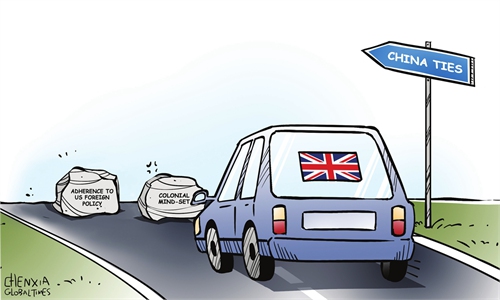
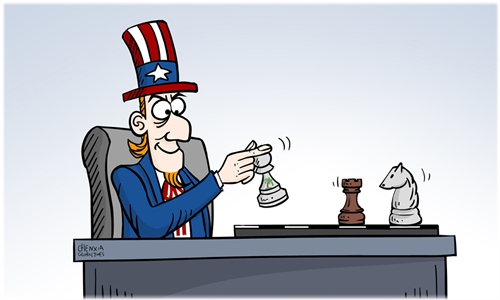
The motivation behind US pressure is clear: the "instrumentalization" of alliances. The current US government's foreign policy logic has undergone a seismic shift, rebalancing strategic priorities while demanding that regional allies shoulder more of the burden. From Washington's perspective, a "special relationship" should imply that the UK is tethered to US global strategy, offering "unconditional" support.
However, Britain is currently caught in an awkward position between the EU and the US, hampered by a sluggish economy and limited military capacity. In 2025, the UK's GDP growth was a mere 1.4 percent, and its defense spending gap reached £28 billion ($37.86 billion). Such conditions are simply insufficient to support a global strategy that aligns with US ambitions. Consequently, since the onset of the US-Israeli military operation against Iran, Prime Minister Starmer has repeatedly stated that Britain should not be dragged into war, offering no concrete commitments to those calling for increased defense spending.
The volatility of the UK-US alliance highlights the fundamental asymmetry of the "special relationship." The US stance on the Falklands serves as a case in point: Washington is using a core interest of its ally as a tool for "discipline." While Britain is reluctant to follow the US blindly out of national interest, it remains tethered to Washington for those very same interests. The current state of the relationship is best described as an "entangled mess" that is increasingly difficult to untangle.
The current UK-US tension reflects a clash of two paths: the US seeks to reshape global hegemony via unilateralism, while the UK pursues national and regional interests and upholds its influence within the existing international order. In the short term, these two paths are unlikely to converge. King Charles III's visit may clear up some misunderstandings, yet it cannot bridge their fundamental strategic divergence. Given the two governments' starkly different styles, leadership changes on either side may trigger sharp policy shifts. Whether the alliance can return to its former track remains to be seen - and at present, this prospect looks increasingly remote.
The author is a research fellow at the Shanghai Academy of Global Governance and Area Studies of Shanghai International Studies University. opinion@globaltimes.com.cn
RELATED ARTICLES