ARTS / CULTURE & LEISURE
Local sports events turn static cultural heritage into impressive, dynamic force
By Published: Apr 28, 2026 11:11 PM

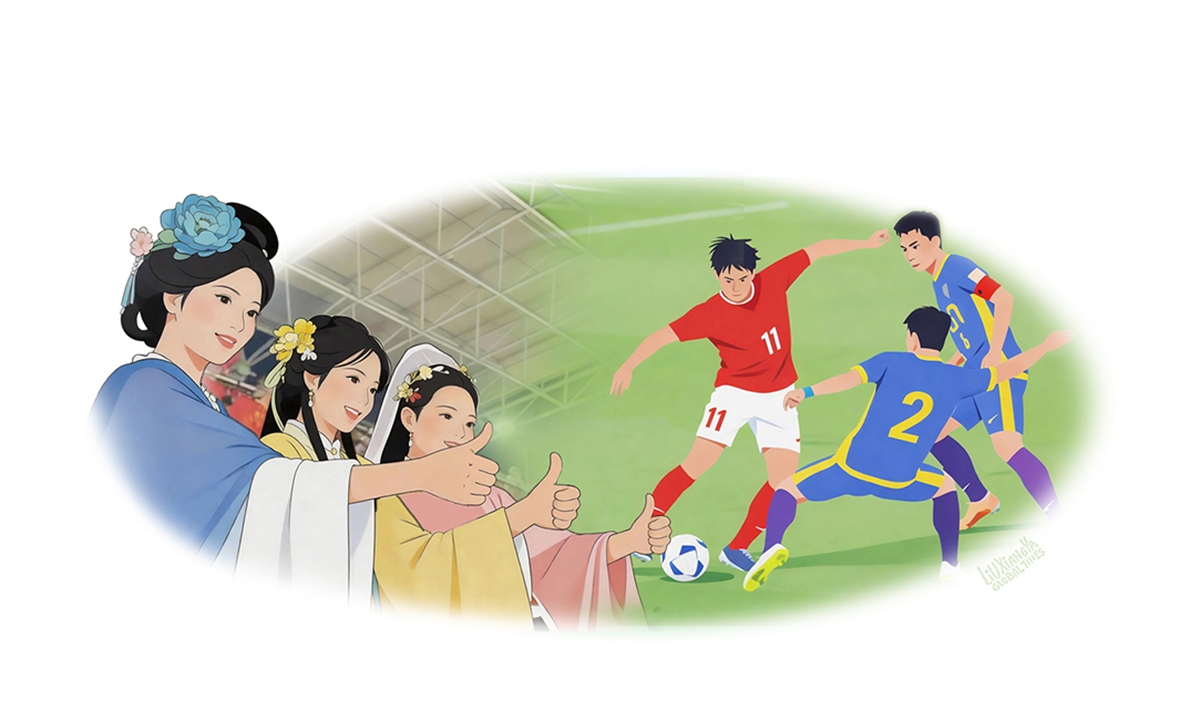
Illustration: Liu Xiangya/GT
A video showing a phalanx of fans dressed in flowing Hanfu robes cheering on a football team at Guangzhou's Yuexiushan Stadium in South China's Guangdong Province during a weekend grassroots football league match has drawn widespread attention on Chinese social media.In the video, the fans dressed in the traditional Chinese clothing hold a banner with a line by Ming Dynasty (1368-1644) playwright Tang Xianzu: "Such bold spirit runs through the veins; this is, and always has been, Guangzhou." The elegant rally injected ancient romanticism into the boisterousness of modern football.
This was not an isolated piece of theater. Days earlier, the Jiangsu grassroots football league in East China's Jiangsu Province, known as Suchao in Chinese, or the "Su Super League," had invited actor Peter Ho to reprise his television role as the historical figure Xiang Yu, the self-styled "Hegemon-King of Western Chu," in front of 30,000 fans in the warrior's hometown of Suqian in Jiangsu Province.
Meanwhile in mid-April, the 2026 Henan Basketball City League, called "Yu BA" by locals in Central China's Henan Province, opened its season with costumed performers channeling historical figures, including upright judge Bao Zheng, strategist Cao Cao and warrior Hua Mulan, in a parade of "Central Plains luminaries."
These scenes are more than clever entertainment. They mark a subtle shift: China's local culture is no longer confined to the static displays of museums or the hushed tones of heritage manuals. It is moving from "static inheritance" to a "force of dynamic, participatory dissemination," brought to life in the most emotionally charged public arenas available - stadium terraces.
Behind the spectacle lie two interlocking forces that explain why this combination of sports and tradition is re-energizing regional tourism: the sharpening of a city's cultural identity and the conversion of fleeting digital traffic into lasting visitor value.
Boosting a destination's distinctiveness through sports is not a new idea, but the current wave is doing something more sophisticated.
Zhang Peng, a cultural researcher and associate professor at Nanjing Normal University, told the Global Times that a genuine fusion between culture and athletic competition needs to meet three conditions: historical relevance, emotional resonance and scenic synergy. Together, they prevent the exercise from collapsing into what another cultural expert, Yu Jinlong, calls "superficial symbolism - piling up Hanfu and old buildings without touching the spiritual core."
The Suqian gambit is a textbook case. When Suchao organizers placed the character Xiang Yu in the stands, they were not parachuting in a random costume drama celebrity.
Suqian is the birthplace of Xiang Yu. Their opponents that evening, Nanjing, was the city where his rebellion ended.
This historical entanglement, Zhang noted, gave the event a "unique narrative that belonged to this place, this people and this moment."
Simultaneously, Yu Jinlong's point of "capturing the spiritual essence rather than the outward symbol" was at play. Football is a contest of raw defiance, and few historical figures embody defiance more absolutely than Xiang Yu.
When the stadium erupted in chants of "Xichu men are no less capable than anyone else," it did not feel like a scripted tourism promotion. It felt like a collective city memory surging back to life. Here, the "sports attribute" was perfectly matched with a narrative of loyalty and tragic courage.
The same logic ran through the Yu BA opening ceremony. Instead of forcing a single narrative, cities deployed their own historical totems. They brought the incorruptible Judge Bao, a perfect fit for basketball's fast-paced justice on the court, while various other prefectures presented figures that anchored their local branding in readily recognizable moral or intellectual qualities.
Zhang Peng's call to "reject the cut and paste of cultural symbols and mine each place's uniqueness" was answered in practice.
As Yu Jinlong told the Global Times, the antidote to homogeneity lies in anchoring exclusive assets - making each city a "one city, one event, one brand" proposition and in matching culture to a sport's temperament.
Because spectators feel the difference between an imposed backdrop and an organic identity, events that get this fusion right succeed in turning a stadium into an immersive theater of civic pride.
These phenomena are, at their core, meaningful experiments in local cultural tourism innovation. Sports events supply the visceral stage and the concentrated digital traffic while classical aesthetics inject cultural depth and distinctive character into tourism development. The deep fusion of the two not only revitalizes fine traditional Chinese culture in the new era, but also gives local destinations a differentiated path to break out of their niche and capture wider attention.
The author is a reporter with the Global Times. life@globaltimes.com.cn
RELATED ARTICLES