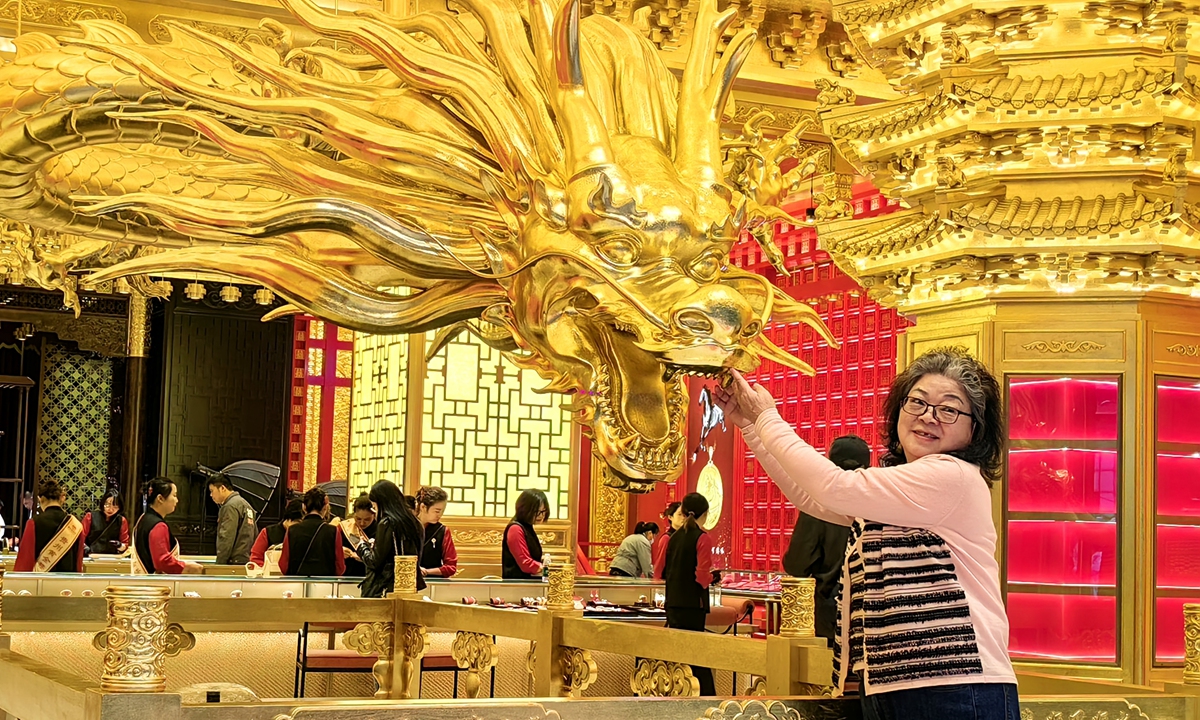
A customer strokes a golden dragon for a photo at a gold shop in Guiyang, Southwest China's Guizhou Province, on April 29, 2026. The shop began its trial operation on the same day, offering services including gold bar sales, on-site gold processing, finished gold product sales, and gold recycling. Photo: VCG
China's total gold demand — including gold jewelry, bars, ETFs, and industrial use — reached 362 tonnes in the first quarter, up 24 percent year-on-year, marking a record high for the same period. Overall, the explosive growth in gold investment has more than offset weakness in jewelry consumption, according to a report by the World Gold Council.
In the first quarter, China's total gold consumption reached 394.9 billion yuan ($57.2 billion), setting a record high for any first quarter on record. Demand across all categories, including gold jewelry, showed broad improvement, according to the report.
In the first quarter, China's gold jewelry demand fell 32 percent year-on-year to 85 tonnes, though it edged up 4 percent from the previous quarter, weighed by price volatility and weak confidence.
However, spending rose to 92.8 billion yuan, up 11 percent year-on-year and 19 percent quarter-on-quarter, the second-highest on record for a first quarter, signaling resilient consumer interest.
Zhou Yinghao, a senior gold investment analyst, told the Global Times that although demand for gold jewelry has declined, total gold consumption reached a record high, driven by a surge in investment demand. "The market increasingly views gold not just as a luxury good, but as a hard currency against uncertainty," Zhou said, adding that its role as a safe-haven asset is reinforced by heightened risk aversion and the need for wealth preservation amid volatile prices and geopolitical tensions.
In the first quarter, China's investment demand for gold bars surged to a record high of 207 tonnes, up 67 percent year-on-year and 180 percent quarter-on-quarter, driven by continued domestic demand for wealth preservation, rising risk-hedging sentiment, and gold's strong performance relative to other assets, the report said.
Bian Yongzu, executive deputy editor-in-chief of Modernization of Management magazine, told the Global Times that the recent surge in gold consumption in China is mainly driven by investors' focus on gold's store-of-value function. Rapid price increases over the past two years have prompted more residents to prioritize gold in their wealth management, with expectations of further appreciation.
In the first quarter, China's gold ETFs saw net inflows of 58.6 billion yuan, setting a new quarterly record. Strong inflows and rising gold prices pushed total assets under management up 26 percent to 304 billion yuan. Holdings also rose by 50 tonnes - the third-highest quarterly increase on record - bringing total ETF holdings to 298 tonnes, both hitting new quarter-end highs, per the report.
Zhou noted that the surge in gold ETFs reflects a dual dynamic of safe-haven demand and trend-driven investment. Investors are increasingly using ETFs to hedge against stock market swings and other asset risks, while rising gold prices create a positive feedback loop that further boosts overall market inflows.
He added that the trend shows the market is buying not just gold, but "certainty." The widespread use of financialized instruments channels risk-averse sentiment into effective purchasing power, driving record-breaking inflows.
China's central bank increased its gold holdings by 7 tonnes in the first quarter, raising official reserves to 2,313 tonnes, or 9 percent of total foreign exchange reserves. This marks the sixth consecutive quarter of gold accumulation, according to the report.
Bian added that changes in the global economic landscape have further fueled demand. Gold's intrinsic monetary attributes make it a preferred alternative under riskier conditions, contributing to higher prices.
RELATED ARTICLES