May Day travel frenzy unfolds in China with boosted consumption expected, underscoring sound economic fundamentals and domestic demand vitality
By , Liu Yang and Qi Xijia Published: Apr 29, 2026 11:53 PM


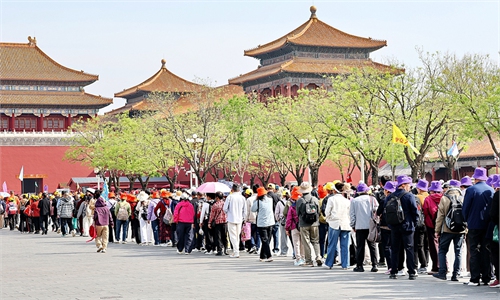
Foreign tourists visit the Badaling section of the Great Wall in Beijing on April 29, 2026, ahead of China's May Day holiday. As China continues to optimize its visa exemption policies, a growing number of overseas visitors are coming to the Great Wall to experience the charm of the Chinese culture. Photo: VCG
China's national railway officially kicks off the annual May Day holiday travel rush on Wednesday, unleashing a sweeping nationwide travel frenzy. Soaring air and road passenger flows, red-hot travel service reservations, robust hotel and scenic bookings, as well as booming catering and retail spending, all serve as tangible barometers of thriving domestic demand.
Against the backdrop of solid economic growth in the first quarter of 2026, the first year of China's 15th Five Year Plan period (2026-2030), the upcoming May Day travel and consumption boom will further validate the strong resilience, inherent vitality and steady upward momentum of China's economy. The holiday travel spree is not only a seasonal consumption highlight, but also a powerful reflection of improving household confidence, recovering consumption willingness, and the enduring sound fundamentals of China's economic growth, analysts said.
Travel and consumption boom
China's national railway system kicked off its May Day holiday travel rush on Wednesday. Spanning eight days from April 29 to May 6, the busy travel season is projected to see 158 million rail passenger trips nationwide, the Global Times learned from China Railway Group.
Rail authorities will operate roughly 12,000 passenger trains daily on average to meet surging travel demand. May 1 is set to be the busiest day of the rush, with passenger volume expected to hit 24 million, according to China Railway Group.
Demand for tourism visits, family reunions and leisure trips remains robust during this year's May Day holiday. As of 8 am on Wednesday, the China Railway 12306 platform has sold a total of 83.02 million holiday train tickets.
Air travel demand has also maintained steady growth. According to the Civil Aviation Administration of China, a total of 11 million passenger trips are expected to be made by air during the 2026 May Day holiday (May 1 to 5), with an average of 2.2 million passenger trips per day. Per flight schedules, neighboring countries within a "five-hour flight radius" - including South Korea, Thailand, Singapore, Malaysia, and Vietnam - remain the primary destinations for Chinese tourists traveling abroad during this May Day holiday.
Industry data provider Umetrip told the Global Times on Wednesday that as of Tuesday, domestic flight bookings for the May Day holiday had exceeded 6.01 million, while cross-border flight bookings had surpassed 1.12 million, registering a slight year-on-year increase.
Umetrip data also showed that, as of Tuesday, flight bookings from China to Southeast Asia destinations for the long holiday increased by 24 percent year-on-year. The European market has also shown strong performance, with flight bookings from China to Europe rising about 13 percent year-on-year.
Inbound tourism which evolves from "China Travel" to "Shopping in China" has also surged. According to Qunar, during the May Day holiday, the most popular domestic inbound tourism cities in China are Shanghai, Beijing, Guangzhou, and Shenzhen.
For road travel, national highway traffic volume is projected to rise 3.4 percent year-on-year, with a peak of 70 million vehicles per day, hitting a new record for the May Day holiday, officials from the Ministry of Transport stated at a Tuesday press conference.
The travel frenzy comes amid newly arranged spring school breaks in many provinces and cities, mostly scheduled in April and early May. These extended holidays have further stoked public enthusiasm for travel, driving a marked rise in both consumer appetite and overall spending demand.
Qunar's data shows that bookings for domestic hotels, air tickets, and scenic spot admissions have doubled year-on-year over the two-week period spanning before and after the May Day holiday break. Spring Tour told the Global Times that its domestic travel reservations have soared by nearly 20 percent compared with the same period last year.
This elongated travel season is expected to drive both passenger trips and tourist volumes beyond last year's levels, underscoring the enduring resilience and vitality of China's tourism and consumption sector, Wang Peng, an associate research fellow at the Beijing Academy of Social Sciences, told the Global Times on Wednesday.
Notably, the ripple effects are transcending the tourism industry itself, catalyzing a synchronized upswing across catering, accommodation, transportation, and retail, Wang said.
On April 27, the Ministry of Culture and Tourism held a media briefing in Beijing for the 2026 National May Day Cultural and Tourism Consumption Week, officially launching the nationwide event. During the consumption week, around 13,700 cultural and tourism consumption activities will be staged nationwide, with consumption coupons and subsidies worth over 284 million yuan ($41.54 million) distributed to the public.
Data from the Ministry of Culture and Tourism shows that during the five-day May Day holiday in 2025, China recorded 314 million domestic tourist visits, a year-on-year increase of 6.4 percent. Total tourism spending reached 180.269 billion yuan, up 8.0 percent year-on-year.
Analysts noted that 2026 presents more favorable conditions, which is set to fuel further growth in tourist arrivals and consumer spending.
Strong start
"The expected bustling scenes of travel during the May Day holiday serve as an important indicator of vibrant consumer activity, reflecting a positive trend of recovering demand and expanding consumption," Li Chang'an, a professor at the Academy of China Open Economy Studies at the University of International Business and Economics, told the Global Times.
Li noted that the vibrant flow of people not only directly boosts services such as transportation, accommodation, catering and entertainment, but also reflects the smooth circulation of the economy and the release of domestic demand potential, highlighting the strong resilience of the Chinese economy.
The positive signal of holiday consumption also resonates well with China's first-quarter economic data just released.
In the first three months, the country's GDP grew 5 percent year-on-year to reach about 33.4 trillion yuan, getting off to a good start to the year, and also the first quarter economic performance report during the 15th Five-Year Plan period (2026-30).
Notably, retail sales of services increased by 5.5 percent year-on-year, higher than total retail sales of consumer goods, which grew by 2.4 percent, according to official data.
Looking ahead to the holiday performance, Li said that the strong recovery in cultural and tourism consumption is expected to inject fresh momentum into China's economic growth in the first half of the year.
The May Day consumption boom is not only a vivid manifestation of the holiday economy, but also an organic integration of residents' consumption upgrading and high-quality economic development. It demonstrates the resilience and potential of China's super-large market, and provides a vivid footnote for the continued implementation of pro-consumption policies going forward, Li added.
As the May Day holiday approaches, the Political Bureau of the Communist Party of China (CPC) Central Committee held a meeting on Tuesday to analyze and study the current economic situation and economic work. The meeting further clarified the key directions for expanding domestic demand and promoting consumption upgrading.
It was noted at the meeting that the Chinese economy has been off to a robust start this year, with key indicators beating expectations, underscoring its resilience and dynamism. The meeting called for more efforts to tap domestic demand potential, with measures to expand the supply of quality goods and services to drive consumption upgrading.
The strong momentum of the May Day holiday data serves as a vivid example of effectively implementing the spirit of the key meeting, Li said. "By optimizing supply and boosting confidence, China is expected to sustain the good start from the first quarter, thereby laying a solid foundation for meeting the full-year targets," he added.
RELATED ARTICLES