China’s bulk commodity index rises to 132.1 in April; growth moderates but trend remains steady: data
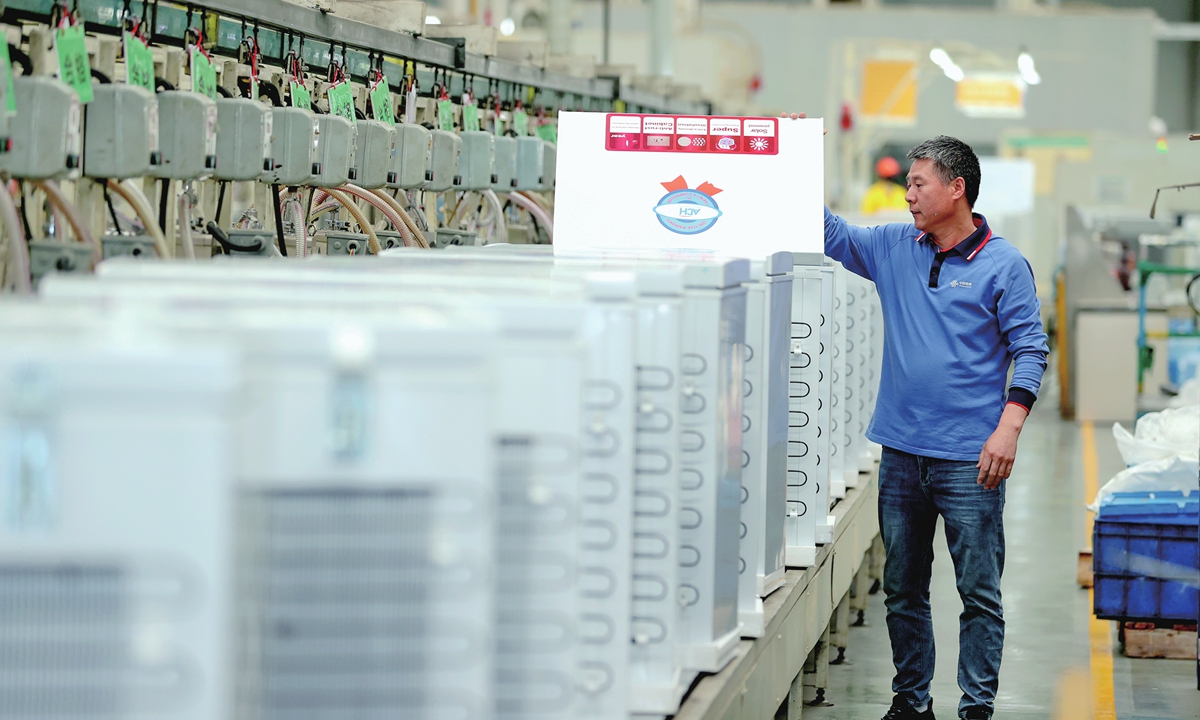
A worker is busy on the production line fulfilling orders for freezers at KEG Group in the Suqian New and Hi-tech Industry Development Zone in Suqian, Jiangsu Province on April 23, 2026. In recent years, the zone has stimulated corporate technological innovation, enhanced smart manufacturing capabilities, and boosted high-quality development of enterprises through targeted services including policy support, resource coordination and talent introduction. Photo: VCG
The China Bulk Commodity Price Index stood at 132.1 in April, up 1.7 percent month-on-month and 20.2 percent year-on-year, extending its upward trend and indicating stable, improving market conditions, data from the China Federation of Logistics and Purchasing (CFLP) showed on Tuesday, as reported by the China Media Group (CMG).
The CFLP noted that there were continued gains in April, driven by improved supply-demand conditions in some domestic sectors and external cost-push factors, though the pace of increase moderated from the previous month, indicating that the bulk commodity market remained broadly stable and on an upward trajectory.
Among the 50 commodities monitored by the CFLP, prices of 38 rose month-on-month in April.
The chemical price index continued to climb, driven by tight feedstock supply and rising production costs linked to external factors.
The energy price index edged down slightly on the back of effective policies to ensure supply and stabilize prices, but remained at a relatively high level for the year, according to the CFLP, as reported by the CMG.
Prices of paraxylene rose 22.4 percent month-on-month, according to the CMG report. Methanol prices increased 14.5 percent, while polypropylene prices climbed 11.8 percent, the report said.
A Chinese expert said that the domestic bulk commodity market has demonstrated strong resilience and risk resistance in the face of external shocks, underpinned by China's comprehensive industrial system, vast domestic market and effective macroeconomic regulation.
However, uncertainties in imported energy and chemical feedstocks remain elevated. Companies are advised to diversify sourcing channels, strengthen risk management capabilities, and build cooperative mechanisms across the industrial chain to share benefits and risks, so as to safeguard the stability and security of supply chains, according to the CMG report.
"Recent volatility in bulk commodity prices has been driven largely by rising external uncertainties, particularly tensions in the Middle East that have pushed up oil and gas prices. Higher energy costs are feeding through to downstream sectors, lifting chemical prices and weighing on global markets," Bian Yongzu, executive deputy editor-in-chief of Modernization of Management magazine, told the Global Times on Tuesday.
Bian said that China's bulk commodity price increases have remained relatively moderate, with the market showing resilience, underpinned by stronger energy security and a robust industrial system. He noted that increased domestic oil and gas exploration has boosted supply capacity, while the rapid expansion of new energy, with the rate of electric vehicle penetration exceeding 50 percent alongside growth in wind, solar and hydropower, has significantly reduced reliance on oil.
Bian said that amid persistent global uncertainties, China remains partly reliant on external resources, making it essential to strengthen supply chain security and resilience. He added that further diversifying energy and bulk commodity imports should be a priority.
Data released at an April 27 briefing by the National Energy Administration (NEA) showed that domestic oil and gas supply remained broadly stable and orderly in the first quarter. Output of crude oil and natural gas from major industrial firms rose 1.3 percent and 3.0 percent year-on-year, while coal production edged up 0.1 percent despite the high year-earlier base.
Experts said that China is continuing to strengthen its domestic energy system by accelerating the development of alternatives such as renewables, hydropower and coal-to-chemicals, reducing reliance on any single energy source.
China's renewable energy capacity maintained steady growth in the first quarter, further optimizing the energy mix, according to the NEA.
Total installed renewable capacity reached about 2.4 billion kilowatts, accounting for more than 60 percent of the total, while wind and solar combined stood at roughly 1.9 billion kilowatts, close to half. Newly installed renewable capacity totaled 58.93 million kilowatts, making up 70 percent of additions nationwide.
RELATED ARTICLES