ARTS / CULTURE & LEISURE
Dinosaur trackway in N.China reveals theropod’s slow walk
By Published: May 06, 2026 02:34 PM

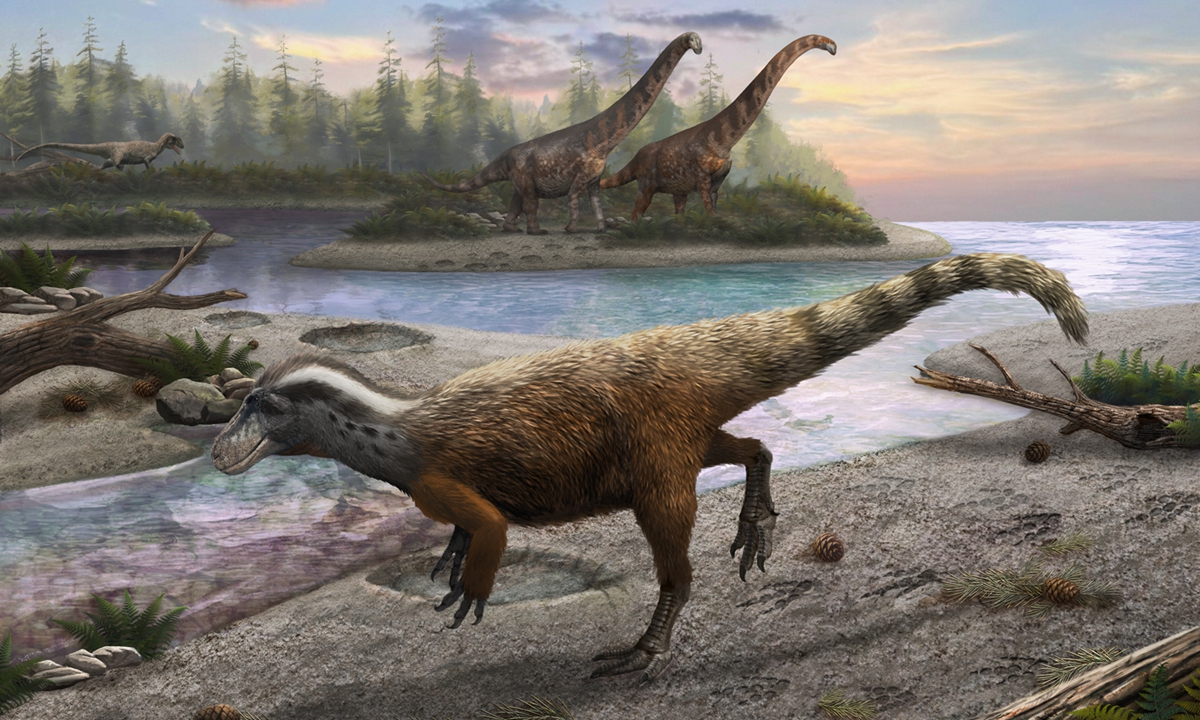
Coelurosaur trackway scene Photo: Courtesy of Xing Lida
A team of international researchers has discovered the slowest theropod dinosaur tracks ever recorded in the Tuchengzi Formation in Xuanhua, North China's Hebei Province, according to a press release sent to the Global Times on Wednesday.The footprints are among dozens identified at two new sites, Lishi Site II and Site III, in the Tuchengzi Formation, an area straddling the Jurassic-Cretaceous boundary.
Led by Xing Lida from China University of Geosciences (Beijing) and in collaboration with the Hebei Regional Geological Survey Institute, the research also involved collaborators from Brazil's Federal University of Minas Gerais, the University of Queensland in Australia, and several other Chinese institutions. The related study has been published in the Paleontological Journal, according to the press release.
The study documented the slowest theropod tracks in the formation and revealed a rare symbiotic relationship between the tracks and microbial mats, providing key evidence for understanding the morphological evolution and preservation mechanisms of Grallator tracks in the Cretaceous of East Asia, Chinese paleontologist Xing Lida told the Global Times.
The team also recorded the slowest theropod locomotion ever documented in the Tuchengzi Formation, and possibly anywhere in the world.
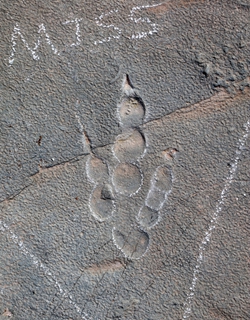
Well-preserved theropod tracks found in Xuanhua, North China's Hebei Province Photo: Courtesy of Xing Lida
The unusually sluggish trackway, found at a locality designated Lishi III, consists of five three-toed footprints with stride lengths of just 32 to 46 cm. Researchers estimated a walking speed of 0.28 meters per second (about 1 km/h). By comparison, other trackways at the same sites indicate small theropods were moving at up to 14.11 km/h, suggesting a trot."The trackmaker was likely moving with repeated pauses or an extremely slow gait, perhaps scanning the ground for small vertebrates or invertebrates as it walked," Xing said. The narrow strides and relatively wide trackway width point to an animal that may have been foraging cautiously rather than traveling with purpose.
The exceptional preservation of many tracks owes much to microbial mats — thin, leathery layers of microorganisms that functioned as "natural cling film," the study found.
Analysis of the rock surfaces shows that sauropod dinosaurs left their footprints first, followed by deposition of mud and plant debris. Microbial mats then grew over the surface, and when theropods later walked across the site, their feet punched through the mats, leaving prints with exquisitely preserved details such as toe pads, claw marks and even fine skin textures. The mats' early cementation effectively locked in the anatomy that would otherwise have been lost.
Alongside the record-slow trackway, the researchers also documented eight sauropod footprints likely belonging to small macronarian dinosaurs about 1.5 to 2.3 meters tall at the hip, similar to tracks known from the adjacent Lishi I site.
In total, the two new sites yielded dozens of theropod tracks that the team divided into two morphotypes based on size and shape. The findings add to growing evidence that China's grallatorid-type footprints form a continuous size spectrum from the Jurassic into the mid-Cretaceous, supporting a simplified "Grallator-Eubrontes" classification for the region rather than the classic North American three-part scheme.
"The Tuchengzi Formation is becoming a strategic window into dinosaur diversity, behavior and preservation at a critical geological transition," Xing said. With the addition of the new localities, the number of theropod-dominated footprint sites in the formation now reaches at least 17.
The Tuchengzi Formation dates back approximately 154 million to 134 million years. In 2020, the local research team discovered a large outcrop covering about 30,000 square meters with more than 5,000 well-preserved dinosaur tracks in Xuanhua. Among them, Lishi Site I is known for its combination of sauropod Brontopodus tracks, medium-sized theropod Asianopodus tracks, and small Grallator tracks, according to the press release.
RELATED ARTICLES