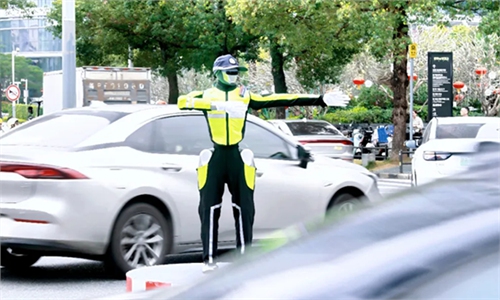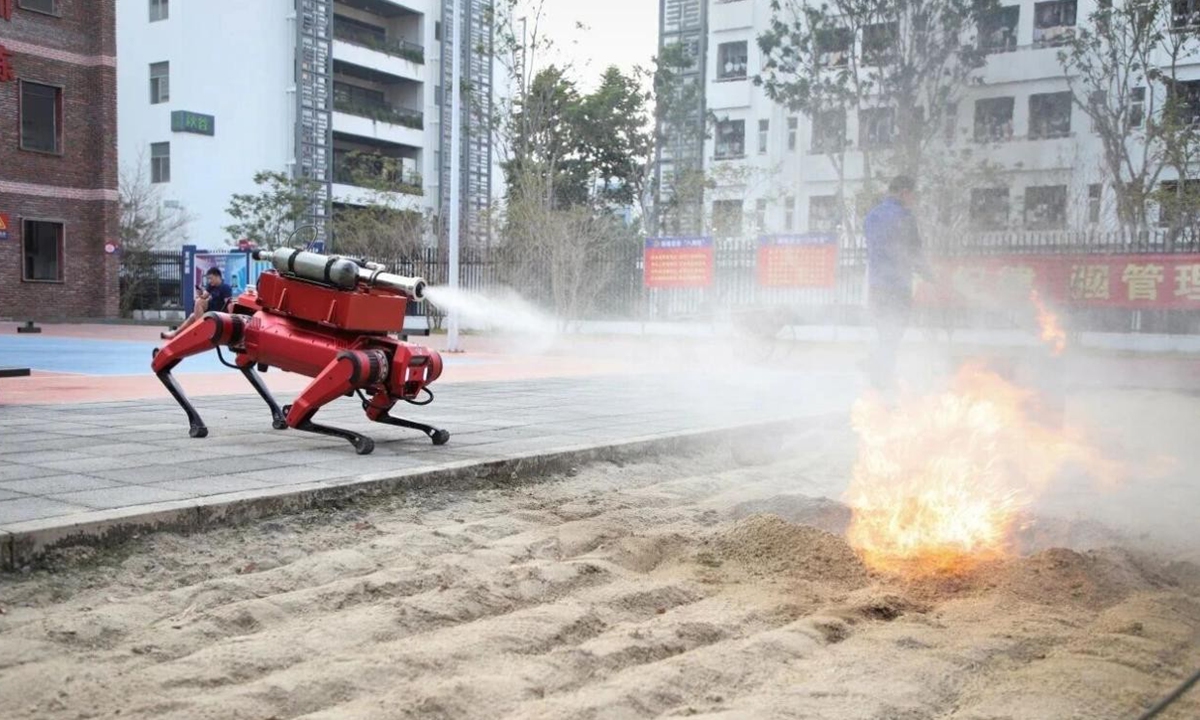
A quadruped AI-powered firefighting robot developed in Shenzhen enables firefighting from a safer distance without requiring close contact with the flames. Photo: Courtesy of Firedog Co. Ltd
A quadruped AI-powered firefighting robot developed in Shenzhen has recently gone viral for its advanced capabilities, including an upgraded pulse water cannon system, according to the video channel of People's Daily, citing local media.
In a video released on May 2 by a video account affiliated with Guangdong Radio and Television Station, a representative of the development team introduced the robot's current applications in emergency firefighting scenarios. The robot is equipped with an onboard water tank and a fire cannon designed to deliver pulse-based fire suppression. Weighing 80 kilograms, it can carry an additional load of up to 50 kilograms. Its tank holds 15 liters of a mixture of fire retardant and water, and the robot can operate continuously for up to four hours.
According to the company's official WeChat account, the pulse firefighting device is a core component of the robot's intelligent system, responsible for executing fire suppression tasks. Unlike traditional methods, the high-pressure pulsed spray delivers concentrated fire suppression, enabling firefighting from a safer distance without requiring close contact with the flames.
The system represents a departure from the conventional "flooding" approach of water hoses. By using a high-pressure air pump, the robot mixes fire retardant with water and releases it instantaneously through a pulse valve, achieving highly precise targeting.
The robot has undergone multiple iterations and upgrades. Its latest algorithm introduces a "silent gait," replacing conventional movement patterns to improve stability while reducing noise, impact, and vibration. This enhancement allows the robot to operate more quietly, making it suitable for a wider range of environments. Tests have also been conducted to assess its performance on challenging terrains, including soft sand, loose gravel, and dense vegetation.
With the integration of 5G communication and swarm control technologies, multiple robot units can be deployed together to form an "intelligent firefighting formation." This enables advanced operations such as full-scene modeling of fire sites and coordinated containment strategies.
The development team also noted that the robot can be fitted with a gimbal-mounted "brain" system, capable of real-time video transmission. When connected to monitoring platforms, it allows for data visualization and remote command.
Looking ahead, developers plan to further enhance the robot's onboard computing power with AI analytics, expanding its potential applications to include industrial inspections and other tasks beyond firefighting.
Global Times