ARTS / CULTURE & LEISURE
Banshan in Hangzhou marks Beginning of Summer with living tradition
Seasonal wisdom
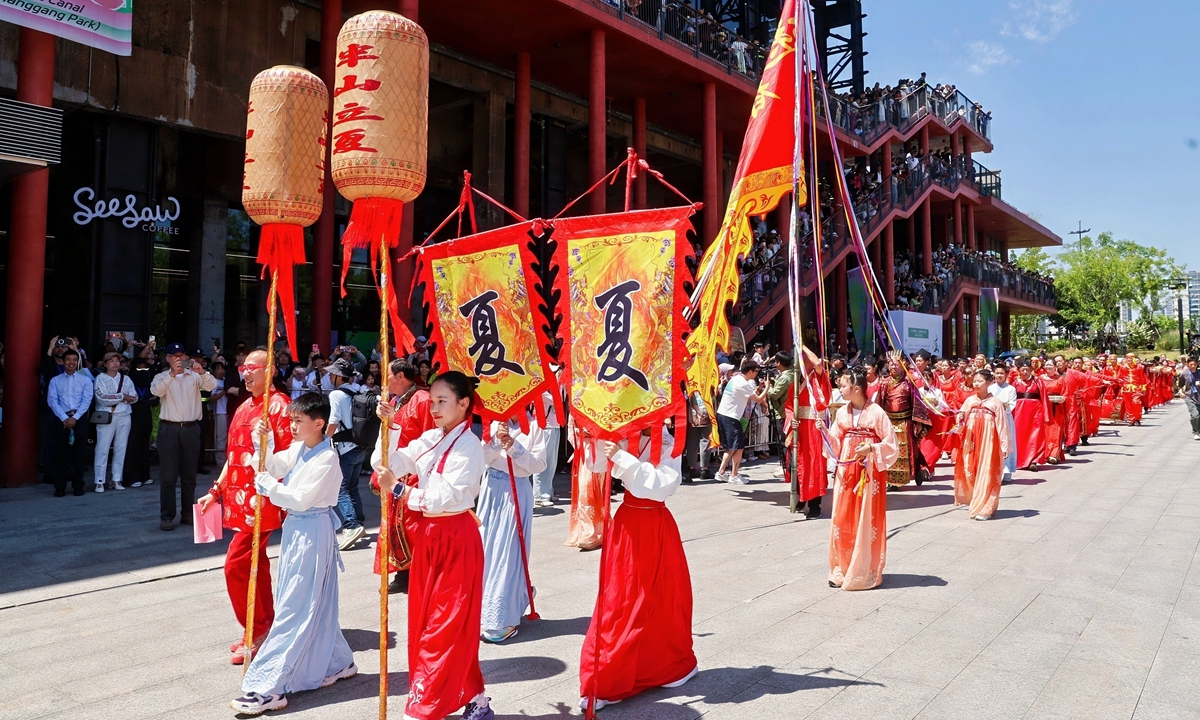
People parade to celebrate Lixia in Banshan, Hangzhou, East China's Zhejiang Province, on May 5, 2026. Photos: Courtesy of the cultural relics and ICH protection center of Gongshu district, Hangzhou
As the rhythmic beat of the 24 Solar Term drums resounded on Tuesday morning, the Beginning of Summer according to the traditional Chinese calendar, more than 300 local residents in 17 formations, dressed in red traditional Chinese attire with paper flowers adorning their hair, took part in a grand parade to bid farewell to spring and welcome summer in Banshan, Hangzhou, East China's Zhejiang Province.The parade is just one of the folk activities that are part of Banshan Lixia customs. Passed down through generations among local residents, the customs embody the practical knowledge and wisdom developed to harmonize local rhythms of production and daily life, while also expressing people's aspiration to follow the natural order and pray for good fortune, according to the official website of China Intangible Cultural Heritage (ICH).
The Beginning of Summer, or Lixia in Chinese, is the seventh solar term of the traditional Chinese calendar. It falls on May 4-6 every year.
This solar term marks the transition from spring to summer, characterized by rapidly increasing temperatures and more frequent rainfall. It is also the time for early rice planting in many parts of China.
Ni Airen, a provincial-level ICH inheritor of Banshan Lixia customs, told the Global Times on Wednesday that "the ritual of bidding farewell to spring and welcoming summer not only reflects the agricultural-era practice of following seasonal rhythms and praying for abundant harvests, but also expresses people's hopes for a happy life and good health."
The folk activities were part of the celebrations for the 10th anniversary of China's "24 Solar Terms" being inscribed on the Representative List of the Intangible Cultural Heritage of Humanity by UNESCO and aimed to step up the protection and inheritance of the Banshan Lixia customs, the cultural relics and ICH protection center of Gongshu district, Hangzhou, told the Global Times.
The 24 solar terms, consisting of 12 major solar terms and 12 minor solar terms, were created thousands of years ago by ancient Chinese to guide agricultural production.
Today, the culture behind the terms provides useful guidance to people's lives as each term features special food, cultural ceremonies and healthy living tips.
Keeping fit
One of the popular folk activities on the day of the Beginning of Summer is the "weighing ritual." A chair is hung from a large steelyard scale, and people sit on it while the weigher calls out their weight aloud and offers auspicious blessings, symbolizing the hope that they will not lose weight or suffer weakness during the sweltering summer months.
Children engage in "egg fighting," a traditional game in which hard-boiled eggs are bumped against each other to see whose eggshell is stronger. The practice symbolizes warding off misfortune and praying for health, safety, and good fortune.
The Banshan Lixia folk activities can be traced back to the Song Dynasty (960-1279), Ni noted. In recent years, they have been spontaneously organized by local residents and have received enthusiastic participation from people of all age groups.
On the day of the Beginning of Summer, children pick peas in the fields, dig up wild bamboo shoots, and catch fish in the streams. They gather stones in the open countryside to build makeshift stoves and cook wild rice meals. This practice not only helps cultivate their outdoor survival skills, but also reflects the hope that they will grow up strong and resilient, less prone to illness, said the 78-year-old inheritor.
During the day, people usually eat Wumi rice, which is a purple-black glutinous rice. There is a local saying that goes: "If you eat Wumi rice, black mosquitoes won't bite you."
New vitality
One of the formations in the parade consisted of 12 adults and 12 teenagers, symbolizing the continuity of the traditional customs of the 24 solar terms and the assurance that their preservation and inheritance will be carried on by future generations.
Ni Yeqi, deputy secretary-general of the Gaoting Cultural Research Association in Gongshu district, told the Global Times that the association aims to breathe new life into a local ICH "Banshan mud cat figurine" that is part of Banshan Lixia customs.
Listed as a Zhejiang provincial ICH practice, the "Banshan mud cat figurine" originated from local households' tradition of silkworm rearing. The hand-made two-faced clay cats were used to ward off and scare away mice, with the hope of protecting silkworms and ensuring a good harvest.
Ni Yeqi, 27, noted that ICH not only needs to be passed down, but also to keep pace with the times. With young people's participation, Banshan mud cat figurines have been developed into a cultural IP, yielding a series of creative cultural products. This two-faced cat now appears at music festivals and various markets, and is becoming known to more and more people.
"We innovate our products by integrating current trends, and at the same time use major social media platforms and communication to help more people see and understand the Banshan mud cat," said Ni Yeqi.
Yuan Jin, deputy dean of the School of Culture Creativity and Media at Hangzhou Normal University, told chinanews.com that Lixia customs not only express the traditional folk aspiration to follow the rhythm of the seasons and pray for health, but also serve today as a public cultural medium capable of carrying diverse values and integrating into everyday life, continuously generating new vitality through inheritance.
RELATED ARTICLES