ARTS / CULTURE & LEISURE
Art illuminates industrial memory: Recycled lighters spark a city’s new image
By Published: Apr 28, 2026 11:19 PM

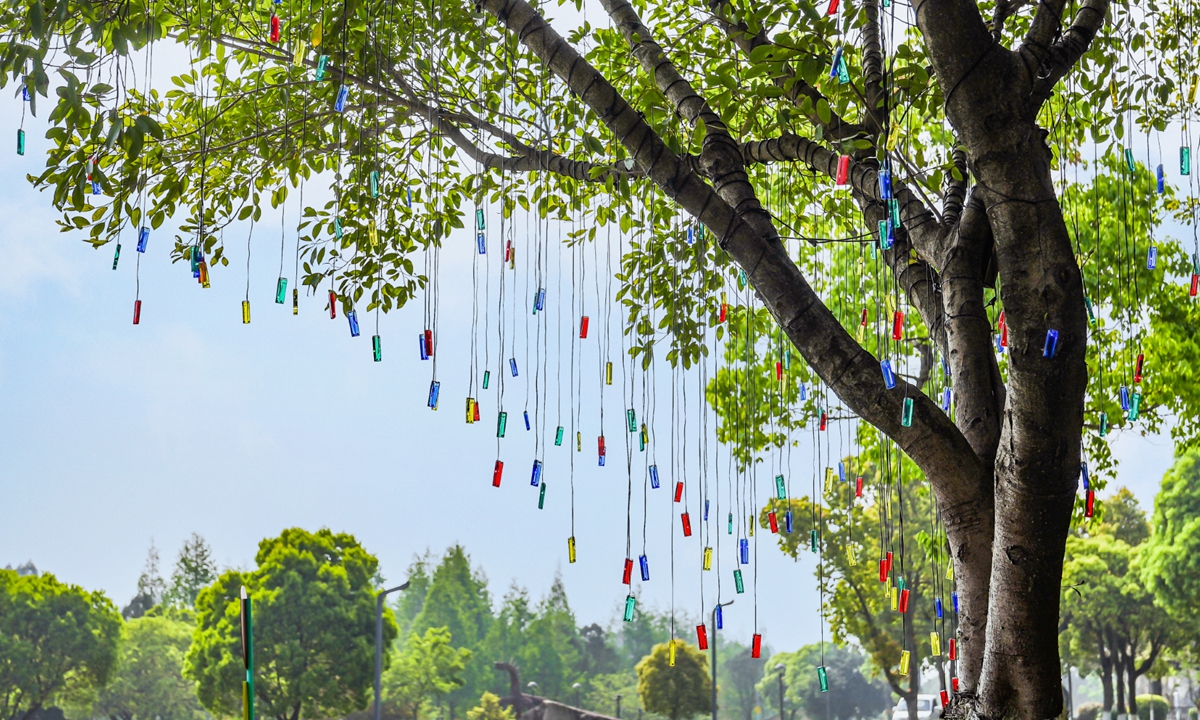
Photo: Courtesy of Li Zhongwei
In a public green space at the Huangshi Mountain Sculpture Park in Wenzhou, East China's Zhejiang Province, a striking artwork glows quietly. Young artist Li Zhongwei has disassembled hundreds of discarded plastic lighters, once ubiquitous symbols of Wenzhou's gritty manufacturing boom in the 1990s, and transformed their tiny flames into a new, radiant "fire" made of optical fibers. Titled Fire Seed (Huozhong in Chinese), the piece shines not only with light but with layered meaning: It rekindles the collective memory of Wenzhou as China's former "one-yuan lighter capital," while pointing toward a broader experiment in contemporary Chinese public art.This work, unveiled as part of the public environmental art section of the 15th China International Garden Expo (Garden Expo) in the city's Longwan district, exemplifies what many are calling new forms of literature and art for the general public in the internet age - an accessible, resonant, and shareable form of creation deeply rooted in local life. Rather than relying on obscure contemporary art vocabulary, Li chose "ready-made" objects heavy with everyday familiarity and industrial heritage. Each recycled lighter carries miniature stories of family workshops, entrepreneurial struggles, and grassroots economic miracles. By dismantling and reimagining them, the artist elevates past toil into a glowing cultural symbol worthy of collective pride.
The strength of Fire Seed lies in its low threshold and high emotional impact. It does not look down on ordinary life from an elite pedestal; instead, it pays homage to mass memory and creatively transforms it. In doing so, it becomes a warm medium connecting history, nature, industry, and daily existence.
This approach in Wenzhou is far from an isolated case. Across China, a vibrant wave of art-powered local development is breaking down the barriers of museums and galleries, allowing art to weave itself into the fabric of urban and rural life while preserving distinct regional character.
In Beijing's Pinggu district, the Nanshan village "Earth Art Season" features works such as Nanshan Donut, created by an art academy team using local pebbles. The playful contemporary installations blend seamlessly into the rugged northern mountain landscape, activating eco-tourism and turning the countryside into a romantic "open-air art museum."
In Foshan's Luoxing village, South China's Guangdong Province, an art festival employs exquisite traditional bamboo weaving to adorn modern streets, while a disused granary becomes a flowing exhibition hall. Art here acts like a fine embroidery needle, reviving dormant handicrafts and beautifying everyday environments.
These scattered practices, mirrored by the glowing lighters in Wenzhou, together sketch a vivid picture of how art helps preserve local memories. First, they link history with the present. Like the Wenzhou lighters, they convert submerged local industrial memories and collective emotions into tangible public symbols, reshaping citizens' cultural identity and sense of belonging. Second, they connect people with nature. Whether responding to the mountain-water rhythms of Huangshi or integrating into the wild landscapes of Pinggu, the artworks guide viewers to rediscover and re-perceive their surrounding fields and hills. Third, and most crucially, they link art with the public. The ultimate goal is sharing and participation. By lowering interpretive barriers, creating interactive settings, and even making villagers co-creators, art evolves from lofty "works" into playable, experiential public events woven into ordinary life.
At its core, the rise of new forms of literature and art for the general public in the internet age serves as a striking cultural footnote to China's urban-rural integration and rural vitalization strategies. It signals that public art in the new era finds its mission not in grand halls, but in weaving social bonds that connect all things.
The author is a reporter with the Global Times. life@globaltimes.com.cn
RELATED ARTICLES