ARTS / CULTURE & LEISURE
Changsha’s ‘luggage wall’ reflects society’s civility, mutual trust
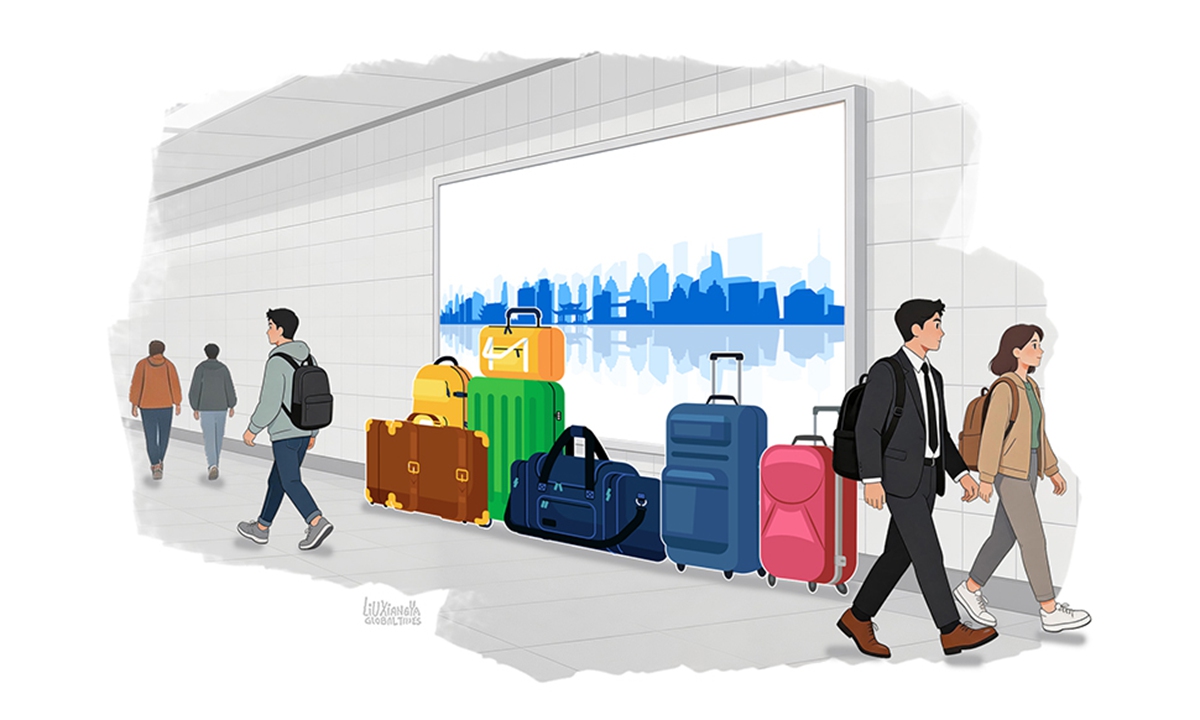
Illustration: Liu Xiangya/GT
Long praised for its gourmet and unique local culture, Changsha in Central China's Hunan Province has always been a favorite among holiday travelers. During the recent May Day holidays, the city once again shot to fame online. Yet this time, its fame came not from any conventional attraction, but from a "luggage wall" that reflects its urban civility.The "luggage wall" appeared in one of Changsha's busiest subway stations. Colorful suitcases stretched for dozens of meters along the wall of the station's passageway. This scene was entirely man-made, as tourists voluntarily left their belongings there to lighten their load. That's to say, the "luggage wall" in Changsha grew mainly out of the people's trust in the city's public security.
Normally, watching anyone just leave their personal belongings unattended in one of the busiest public spaces in a major city would cause great concern, especially during a time when pickpockets seem to have become a standard fixture at many major tourist destinations around the world.
For example, according to the Daily Mail, in 2025, Paris in France accounted for a striking 16.5 percent of all theft-related reports from tourists globally. In the UK's capital London, according to AFP, even a food delivery rider has begun taking on the role of the police, chasing down pickpockets and becoming a sensation on social media.
These snatch-and-run incidents - disturbing, yet somehow no longer surprising - only deepen one's curiosity: How does Changsha's "luggage wall" actually keep those suitcases safe? And where does tourists' trust in Chinese public security come from? The answers, it turns out, are actually not found in the act of leaving luggage unattended in a public space. They lie instead in the management wisdom hidden beneath the surface of this phenomenon.
The seemingly unattended suitcases at Changsha's subway stations are actually protected by layers of invisible security. The area is covered by 360 degree surveillance. Police are stationed around the area every day, accompanied by mobile lookout patrols and volunteers on site.
Meanwhile, although the current "luggage wall" was created by chance, it has been continuously evolving. Its prototype first appeared in the city during the May Day holidays of 2025 at the same subway station in the Furong district. Once local authorities realized that tourists had a genuine need to drop off their luggage, another Changsha district, Tianxin, went a step further by replicating this model, turning the "luggage wall" into a properly managed "luggage depot."
It is clear that tremendous effort went into building the "luggage wall." This inevitably raises the question: Is such an effort worthwhile? The answer is that it is not only worthwhile, but also far-sighted.
On the one hand, it increases people's affection for the city, making a "safe and special" Changsha the most resonant tourism signature both in conversation and across the internet. The "luggage wall" is therefore a milestone of a reputation that goes way deeper than what it cost to establish.
The city's efforts to upgrade the "luggage wall" into a "luggage depot" captures a core lesson in urban governance: Effective solutions come not from top-down regulations, but from bottom-up responsiveness.
Besides the urban governance wisdom, the presence of the "luggage wall" also reveals, from another angle, the practical experience that Chinese cities have accumulated through their deep investment in cultural tourism.
As one of China's most famous "Instagrammable" cities, Changsha seems to have moved beyond scattered generic photo spots. Instead, it has shifted its focus to service upgrades by lowering the cost - both physical and psychological - for tourists to enjoy the city's atmosphere, thereby enhancing their overall impression.
From checking off attractions to seeking out authentic experiences, the dynamic of China's urban tourism is changing. Changsha's famous "luggage wall" was just one highlight of the recent May Day holidays. Across the country, cities won over travelers with small, deeply thoughtful gestures. In Liaoning Province, government compounds went viral for opening their parking lots to tourists for free. More than just convenient perks or clever marketing, these acts of hospitality underscore a social reality: a society in which people trust and are trusted in return.
The author is a reporter with the Global Times. life@globaltimes.com.cn
RELATED ARTICLES