Why ‘siphon effect’ fails to explain China’s regional development reality: Global Times editorial
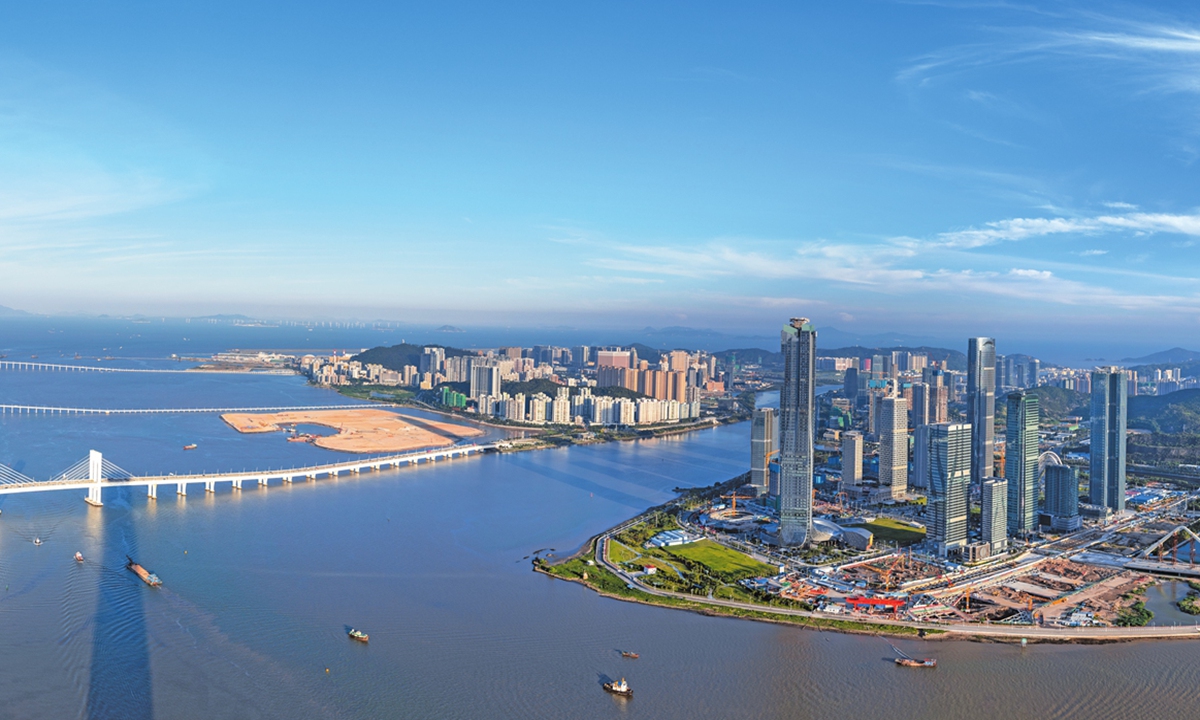
The Guangdong-Hong Kong-Macao Greater Bay Area Photos: VCG
Editor's Note:
Currently, China's economy is steadily advancing along the path of high-quality development, even as domestic and international circumstances become increasingly complex. Some Western media, due to misunderstanding or bias, have repeatedly questioned or even distorted China's economic development. Accordingly, the Global Times launches the "Q&A on China's Economy" column to publish opinion pieces to present facts and clarify perceptions.
When discussing regional coordinated development in China, there is a view in Western discourse which claims that disparities among regions stem from the so-called "siphon effect," whereby developed eastern regions or first-tier cities draw in excessive resources, thereby suppressing the development of central and western regions and creating imbalances. This view deviates from the underlying logic of China's economic and social development and is hard to explain the realities across China today.
The tendency among some in the West to associate regional imbalances with the "siphon effect" is, to a large extent, rooted in their own development trajectories. Many Western countries have experienced such phenomena historically, which not only led to uneven regional development but also, due to insufficient urban carrying capacity, resulted in the emergence of slums. Until today, varying degrees of regional disparity and new forms of slum issues still persist in many Western countries.
Since the reform and opening-up, there was indeed a large-scale migration of labor from less developed regions to more developed ones in the early stage of regional economic development in China. This reflected the allocation of factors of production according to comparative advantages. However, in the current stage, the "diffusion effect" and "back-feeding effect" from developed regions have become dominant. Regional development in China is no longer driven by zero-sum competition, but increasingly relies on deep inter-regional coordination.
In terms of growth rates, central and western regions in China have for years outpaced the eastern region, while the northeastern region has shown signs of stabilization and recovery. These trends lay the groundwork for further narrowing regional disparities during the 15th Five-Year Plan period (2026-30). Population flows have also been quietly shifting in recent years - from the previous pattern of "peacocks flying southeast" to today's return flow toward central and western regions, with more people choosing to return to their hometowns for employment and entrepreneurship. None of these developments can be explained by the "siphon effect" narrative.
Why has China followed a path of regional development different from that of the West? One of the reasons lies in the close integration of an "effective market" and a "proactive government," rather than an overreliance on spontaneous market forces as seen in the West. Major strategies-including the large-scale development of the western regions, full revitalization of northeast China, accelerated rise of the central region and faster modernization of the eastern region - have been advanced in parallel. A series of strong policy measures has provided a clear roadmap for promoting balanced regional development. As a result, in recent years, the east-west development gap has tended to stabilize, north-south divergence has been curbed and the strategy of coordinated regional development has begun to yield results.
For example, the implementation of coordinated development strategies in regions such as the Beijing-Tianjin-Hebei region, the Yangtze River Delta region and the Guangdong-Hong Kong-Macao Greater Bay Area has not only promoted balanced development within these regions, but also driven growth in surrounding areas. In particular, long-standing cross-regional assistance and cooperation mechanisms have enabled central and western regions to benefit not only from resource support provided by partner regions, but also from improved governance concepts, adding sustained momentum for long-term development. Innovative mechanisms such as the "enclave economy" and jointly built industrial parks across regions have continued to emerge, breaking administrative barriers and facilitating the optimized allocation of factors across regions.
In addition to emphasizing the "trickle-down effect" and "diffusion effect" generated by the development of eastern regions and major cities, China has also placed emphasis on leveraging digital technologies, particularly artificial intelligence (AI), to help narrow regional disparities. Digital technologies are inherently inclusive, capable of overcoming physical constraints such as geography, time and mobility, and creating more opportunities for employment and entrepreneurship among rural residents and people with disabilities in remote areas. Initiatives such as the "East Data, West Computing" project have significantly expanded the reach of new technologies, providing fresh momentum for balanced regional development.
In fact, China's regional development is no longer characterized by regions competing against each other for resources, projects or talent. Instead, it increasingly depends on deep coordination, complementary advantages and collective development. Different regions are no longer in a zero-sum competitive relationship where "one gains only at the expense of another." Currently, under the broader framework of building a unified national market, each region possesses its own unique resource endowments and comparative advantages. The eastern region enjoys strengths in technology and capital, while the central and western regions offer resource potential and development space. To fully leverage these strengths and unlock development potential, inter-regional division of labor and cooperation are essential. Such coordination is not about simply "equalizing gaps," but about enabling each region to find its role within the overall national framework - some as innovation hubs, some as industrial bases, some as ecological safeguards, and others as guarantors of food security - ultimately achieving a "1+1>2" overall effect and fostering higher-quality, more balanced national development, while providing a solid spatial foundation for Chinese modernization.
The outline of the 15th Five-Year Plan has laid out the goals and pathways for promoting coordinated regional development over the next five years. With sustained efforts to stimulate endogenous growth momentum across regions, China will be able to maximize diffusion and spillover effects, continuously optimize its regional economic layout, and further advance coordinated regional development.
RELATED ARTICLES