China’s young people hug trees to heal, making connection to nature a trendy way to relax body, relief mind
Connection to nature a trendy way to relax body, relief mind
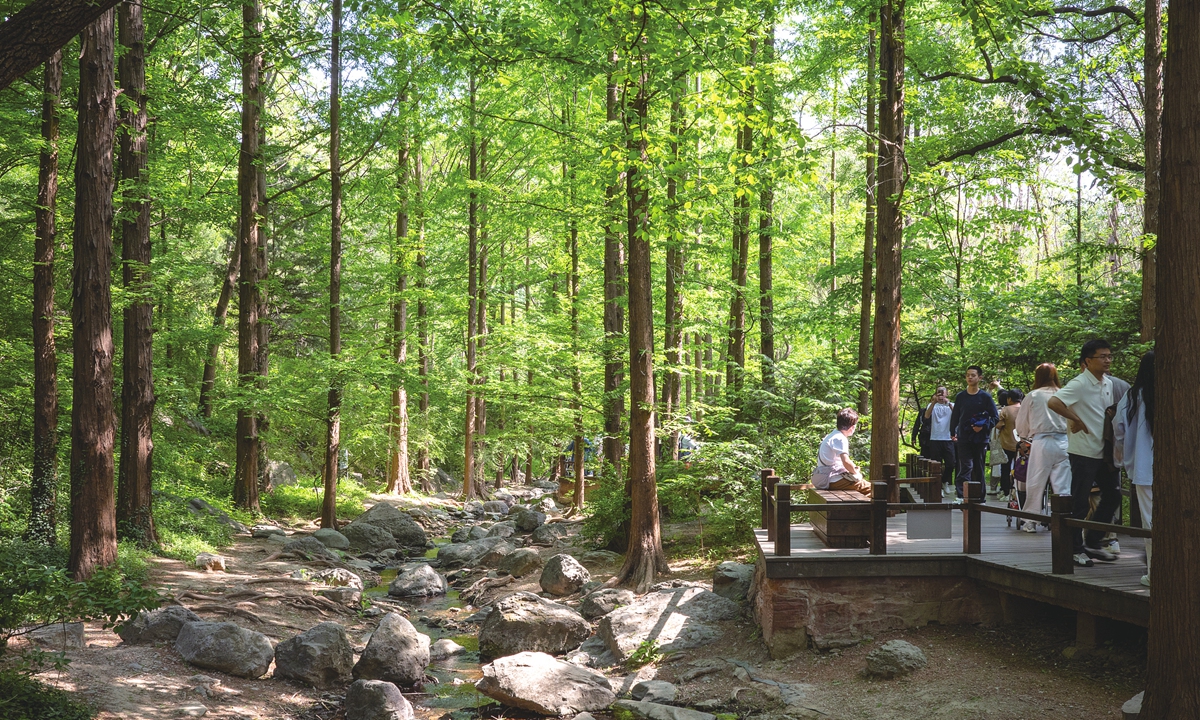
Visitors enjoy spring outing among the dawn redwood forest scenery at the National Botanical Garden in Beijing on May 5, 2026. Photo: VCG
From camping and hiking to mountain climbing and birdwatching, engaging with nature has become a popular remedy among young Chinese to relax and refresh. Yet nature does not necessarily to be far from the city and busy daily life, as even an ordinary roadside tree can provide a moment of relief.
The practice of "hugging trees" is exactly what its name suggests. Participants head outdoors, find a park, choose a tree they feel drawn to, wrap their arms around the trunk, and remain still for several minutes.
This seemingly odd practice, however, has gained popularity. On Chinese lifestyle platform RedNote, or Xiaohongshu, topics related to tree hugging have drawn more than 15 million views, with some user surveys showing monthly engagement growth of more than 460 percent. Enthusiasts have also formed groups that organize regular offline "tree hugging" events.
Outdoor recreation
For many participants, the appeal lies in its simplicity: one trip outdoors, one tree and one embrace can become what they describe as a free "mental massage."
People who practice tree hugging say it helps ease anxiety, reduce stress, and restore a sense of calm and happiness. Connecting to a tree, a symbol of nature, "I feel that life is more than the small space you usually inhabit," one participant said.
Jerry Cheng, a hiking enthusiast from Southwest China's Chongqing, told the Global Times that she first learned about tree hugging through her love of hiking.
Cheng was first introduced to the practice by friends she hiked with, who said hugging trees could help relieve exhaustion after a long trek. "I felt a bit strange at the very beginning, but gradually I found it quite effective. Since then, I've grown fond of many healing practices, like nature meditation and even 'nature dancing.' In short, they're all connected to nature, and they come at zero cost, with no pressure at all," Cheng said.
Net user Yui Songzi used to be a couch potato, but had started to practice mindfulness through tree hugging. She noted that when she sits cross-legged on the ground at home to meditate, her mind tends to wander, but when she hugs a tree and traces the texture of its bark, she is able to stay focused. When she gets close to a tree, she imagines herself becoming like it, rooted firmly in the earth, letting her anxieties sink into the ground while energy flows back through her body.
"It's not about escaping from life. Rather, after connecting with nature, your difficulties feel less overwhelming, and you find yourself with more courage to face challenges," Yui Songzi said.
Scientific studies suggest such experiences may have some physiological basis. According to the WeChat account China Science Communication affiliated with China Association for Science and Technology, spending time in close contact with trees and natural environments may help reduce stress, improve mood, and enhance overall well-being.
Clinical psychologist Stone Kraushaar, known as the "hugging doctor," wrote in The Hug Therapy Book that physical touch can stimulate oxytocin production, a hormone closely associated with happiness, calmness, and trust. Researchers believe that when people hug trees, sensory feedback from touching rough bark may help promote oxytocin release, making it easier to relax and feel emotionally comforted, according to the report.
From the perspective of traditional Chinese medicine, Song Zhaopu, president of Jingeng Rehabilitation Hospital in Ruzhou, Central China's Henan Province, suggested in a video released by Xinhua Health Channel that hugging trees and touching green plants can help promote the smooth flow of energy and blood circulation in the body.
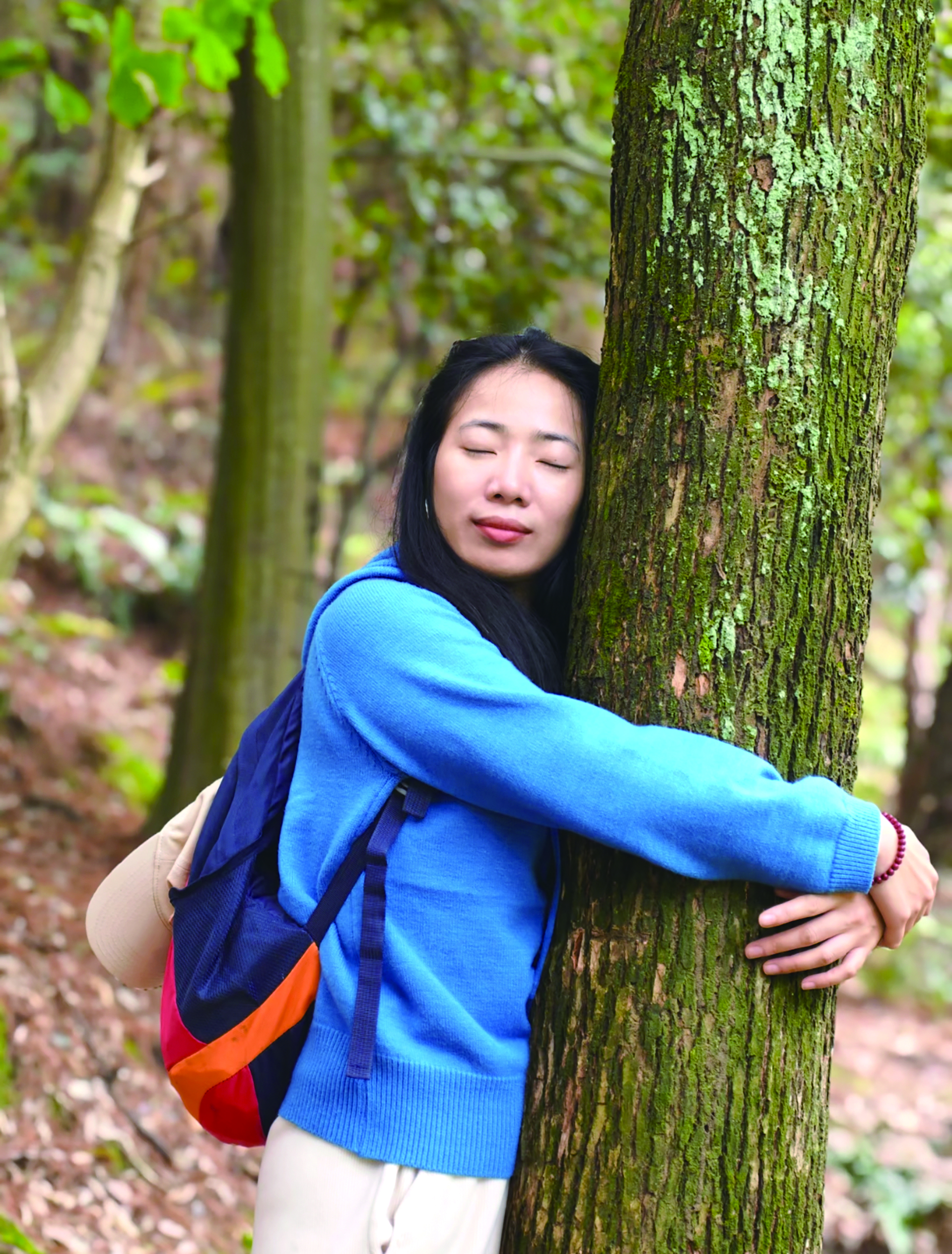
Jerry Cheng hugs a tree in a city park in Southwest China's Chongqing Municipality. Photo: Courtesy of Jerry Cheng
Healing with caution
Still, experts caution against overstating the benefits of such practices. While contemporary scientific research has confirmed that tree hugging can offer some positive benefits for physical and mental well-being, such practices are primarily regarded as complementary approaches rather than primary treatments. Yui Songzi herself also said she reminds members of her tree hugging group that the practice should not replace professional mental health treatment.
"Hugging a tree for three to five minutes is ideal, and there's no need to expect immediate results from a single session - the key is to focus on experiencing nature," she said.
The report from the China Science Communication also cautioned against treating such practices as the sole solution to psychological or physical problems, urging people experiencing serious mental or physical health issues to seek professional help in a timely manner.
Tree hugging lies in a fast-expanding industry of "healing," which includes hiking, retreat travel, sound healing, such as singing bowl - to use sound produced by tapping or rubbing the edges of metal instruments to help people relax.
China Youth Daily in February cited an industry report that the overall market for healing service industry has surpassed 10 trillion yuan ($1.47 trillion) in market size, with 840 million users.
Shao Jiening, a counselor at a psychological consulting center in Hangzhou, East China's Zhejiang Province, also noted the rapidly expanding wellness industry still faces problems such as excessive marketing, inflated prices, and inadequate regulation. Some services, she warned, may even operate in legal gray areas or be exploited for fraud, Qianjiang Evening News reported in 2025.
"Healing practices can be seen as a form of self-care, but not medical treatment," said Wang Cuifang, nationally certified psychological counselor, told Qianjiang Evening News.
Behind the popularity of tree hugging lies a broader social shift. Rather than hiding stress and emotions, many young people today are treating them as normal and seeking healthier and more proactive ways to manage them.
In an era defined by speed, fragmentation and constant digital stimulation, people sometimes find themselves overly indulged in cyber space, missed in "standards and social requirements." Stopping to embrace a tree, to immerse in the breeze, sunlight, and chirping birds, has become, for some, a way to reconnect to real life, reclaim emotional balance and inner peace.
"A tree is just a symbol of nature. Nature has countless trees, and I would really encourage people to go outdoors and 'breathe in' nature." Cheng noted.
Many new forms of healing and wellness are emerging, such as nature-themed oxygen-bar rest spaces, animal-assisted therapy, hiking and ferrata climbing; young people can find what suits them best. But no matter what form it takes, the gist is "to stay connected with the real world," Cheng said.
RELATED ARTICLES