New historical details from the Webb papers revealed by team led by Nanjing University professor Zhang Sheng
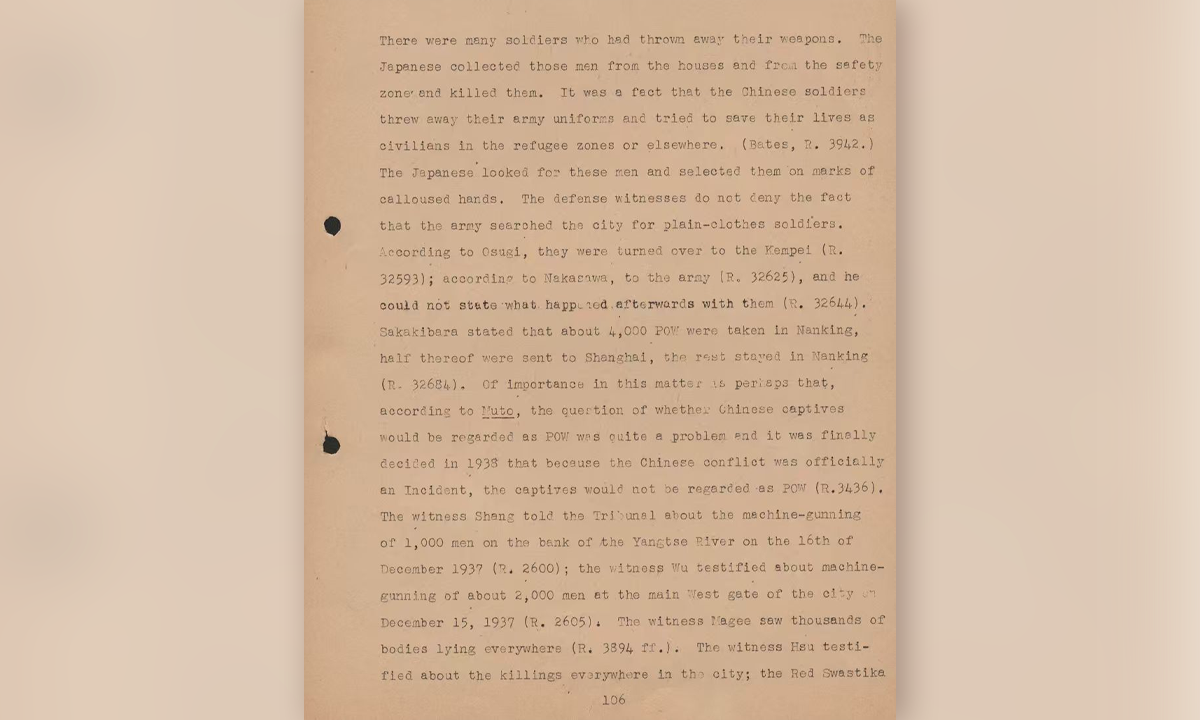
Picture of a page from the Webb papers Photo: Courtesy of Zhang Sheng
Editor's Note: This year marks the 80th anniversary of the beginning of the International Military Tribunal for the Far East, also known as the Tokyo Trial. More than a legal proceeding, it was shaped by "decisive moments in history": prosecutors pursuing evidence, witnesses testifying, and judges upholding justice amid geopolitical strain. Eight decades on, Chinese collectors and scholars continue to unearthing archives, filling gaps in history, and advance unfinished justice—reinforcing historical conclusions with primary sources and drawing lessons for the present.An 8.2-gigabyte cache of private papers belonging to William F. Webb, president of the International Military Tribunal for the Far East, uncovered by Chinese scholars, marks a major breakthrough in the Tokyo Trial research. During the admission of evidence on the Nanjing Massacre, Webb and his colleagues, facing defense lawyers well versed in Anglo-American procedure and seeking to exploit it, insisted on due process, an expert said.
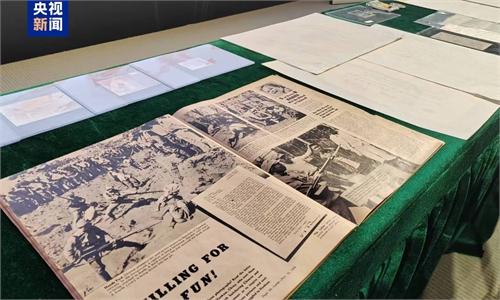
The Webb papers, collected and catalogued in earlier years by the Australian War Memorial and long kept in storage with limited use, were recently reexamined by Nanjing University professor Zhang Sheng's team, yielding a number of significant new details.
"At present, I mainly work with the first section, which contains materials related to the International Military Tribunal for the Far East. The remaining parts include draft judgments, case files from 1945, and correspondence," Zhang Sheng, a professor at the School of History at Nanjing University and leader of the research team, told the Global Times.
The draft judgments - marked up repeatedly in pen and pencil - show how the judges wrestled with fact-finding, the admissibility of evidence and even the phrasing of their decisions, rather than reaching hasty, one-off conclusions, the expert said, pointing to the level of detail in the archive.
The papers show Webb repeatedly reining in what Zhang described as disruptive tactics by Japanese defense counsel, Zhang told the Global Times, citing several cases. In one instance, when Dr Robert Wilson, the only surgeon present in Nanjing during the massacre, testified that sexual violence by Japanese troops had led to syphilis infections among women, defense lawyers countered that secondary symptoms take at least three months to appear and, while feigning respect, attempted to steer the witness. Wilson, a physician trained at Princeton and Harvard, said onset can occur anywhere between six weeks and three months.
Another dispute centered on the so-called "defeated stragglers." The defense claimed Chinese soldiers who had not formally surrendered were not protected as prisoners of war, seeking to justify civilian killings by labeling the victims as combatants. Webb countered that determining status required legal procedure, and that killing people based on calluses, load marks or hat lines was plainly unlawful.
In the interview, Zhang cited these examples without hesitation, laying them out in quick succession within just a few minutes.
Zhang added that Webb's private papers also make a point that's often overlooked: Japan's deliberate use of the term "incident" to describe its campaigns - such as the Mukden, Lugou Bridge and Shanghai "incidents" - was intended to deny the existence of a formal war and evade international law, a position acknowledged in court by Class-A defendant, former Imperial Japanese Army Lieutenant General Akira Muto. That intent, however, did not make it into the final judgment - an omission that, Zhang said, carries lessons today for how historical narratives are framed and terms defined.
From today's historical perception, Matsui Iwane, the commander of the Japanese Central China Area Force bore multiple responsibilities for planning and escalating the war and for allowing atrocities in Nanjing to unfold. His insistence during the Battle of Shanghai helped push Japan toward full-scale war, though not all relevant evidence was available to the tribunal at the time. Webb's papers show he weighed both the evidentiary strength of the prosecution's case and the political realities among the Allied powers, according to Zhang.
This, in turn, allows us to see the historical process through the individuals behind the official verdict, revealing the complexity of the Tokyo Trial, which cannot be reduced to the notion of a "victors' justice" as claimed by some Japanese right-wing narratives, the expert said.
Courts decide based on the evidence available at the time, while historical research continues to expand and revise the record as new materials emerge, Zhang said. This is why Chinese scholars and private collectors have, in recent years, been working through archives at home and abroad to recover primary sources, fill gaps in the Tokyo Trial record, and further substantiate the evidentiary basis for atrocities such as the Nanjing Massacre, while contributing to a more detailed and sustained scholarly understanding of historical justice, he added.
The Tokyo Trial left the reckoning with Japanese militarism incomplete, with the emperor's exemption, the failure to prosecute Unit 731 and an insufficient adjudication of crimes against humanity. These unresolved issues continue to echo into the present, as right-wing forces deny the Nanjing Massacre and use such denial as a basis to undermine the legitimacy of the trial, deflect state responsibility, and advance the so-called "normal nation" narrative.
Right-wing circles in Japan also invoke the principle of non-retroactivity of law to challenge the trial's legal basis. "The law governing crimes against humanity often lags behind the atrocities it seeks to address," the experts said, adding that strict adherence to non-retroactivity would make it impossible to hold aggressors accountable, and would undermine humanity' s broader effort to restrain war and safeguard peace.
"Whoever tied the knot is responsible for untying it," Zhang stressed, warning that unless Japan draws the lessons of history, any return to militarism would risk repeating the tragedies of the past.
RELATED ARTICLES