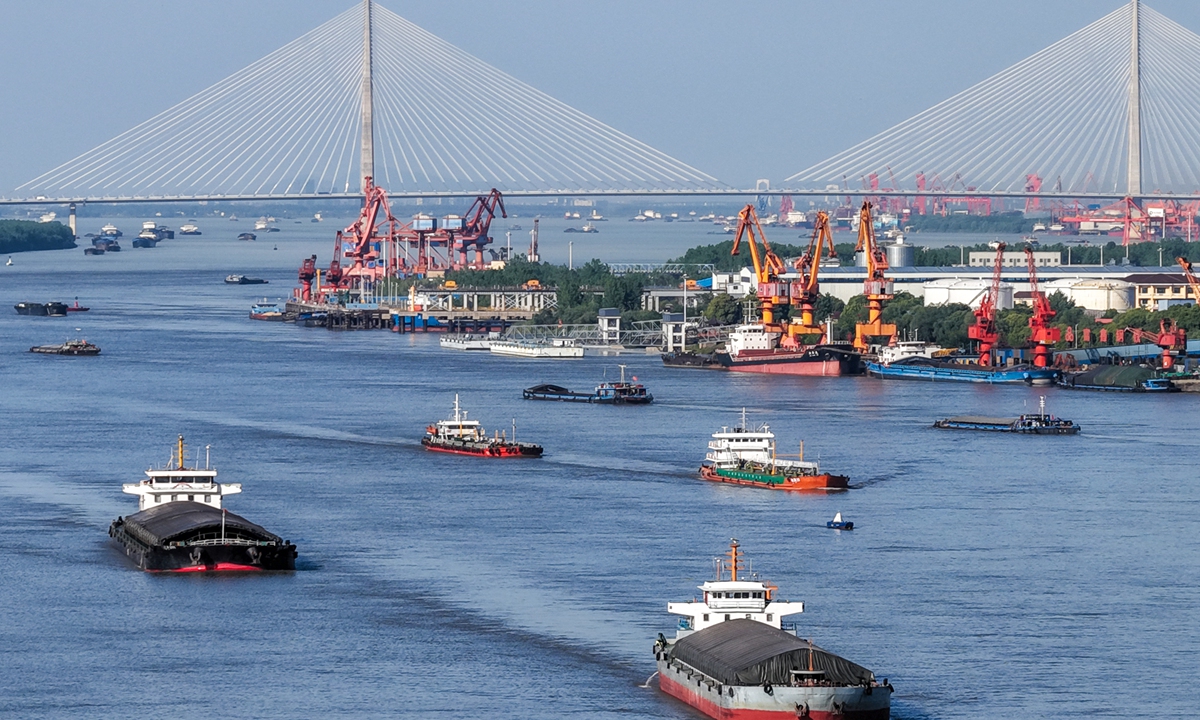
Cargo vessels are seen navigating the busy Yangtze River shipping lane near Wuhu city, East China's Anhui Province, on May 4, 2026. Photo: VCG
China's economic performance in the first quarter of 2026 has defied global headwinds, coming up with a significant expansion that underscores the resilience of the world's second largest economy. One of the most compelling highlights is the accelerated development of new quality productive forces, where breakthroughs in AI, green technology, and high-end manufacturing are signaling a robust structural transformation and across-the-board industrial upgrading.
The transition to a high-quality, innovation-driven economy is no longer theoretical. It was vividly on display during the Chinese Spring Festival Gala, where state-of-the-art robots took on stage, performing together with humans and captivating global audiences.
And, on April 19, the world saw running robots leapfrogged from last year's performance and beat the human world record in the half marathon by a wide margin. Though it is entertainment, it builds upon a core platform: More than half of all industrial robots in the world operate in China. The enormous improvement in battery technology - longer range, shorter charging time and new materials, is another highly visible area of progress.
Yet, despite the tangible strides, some in the West still cast doubt on China's economy. As usual, there have always been doomsayers claiming that China's growth has come to an end, which has been proven wrong every year since 1978 and will once again be proven wrong.
The focus on building up new quality productive forces will keep helping China create more jobs and prosperity and take a global lead in the digital and green technology revolutions.
Recognizing this potential, the policymakers have moved to institutionalize these priorities. The outline of China's 15th Five-Year Plan (2026-30) for national economic and social development was approved by Chinese lawmakers at the Fourth Session of the 14th National People's Congress (NPC) on March 12. The plan is built around several priorities, such as accelerating development of new quality productive forces and green development. The former encompasses cutting-edge technologies such as AI, big data, quantum computing and advanced manufacturing, while the latter drives comprehensive green transformation in the country. And, they are interdependent and mutually reinforcing.
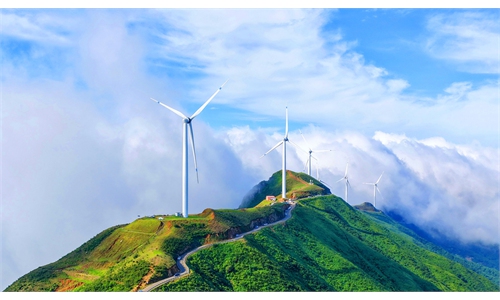
On the one hand, many emerging technologies are helping the green revolution. For example, Huawei uses AI-powered acoustic analysis to track the Hainan gibbon, enabling targeted conservation. Energy companies use intelligent algorithms to coordinate power grids, integrating wind, solar, hydropower, and energy storage systems.
On the other hand, green energy is the foundation for delivering technological progress. Without low-cost clean energy, the immense power demands of AI data centers won't be met. Increasingly, green energy powers technological development. This is what Chinese policymakers mean by vigorously developing new quality productive forces.
China's development benefits the whole world. Other countries could continue to strengthen cooperation with China by forming partnership with Chinese enterprises, particularly in the green sector.
Nowhere is this partnership more pertinent than in Europe, which has found itself lagging behind in the green transition. Europe should do more to attract Chinese companies and introduce Chinese technology.
Ten years ago, Europe was ahead of China in the green economy. Now China has leapfrogged, so it is time for Europe to invite Chinese companies to share technologies, such as batteries, electric vehicles, and solar energy that will provide jobs in Europe and help European nations improve technology.
At a time when Washington is the center of global turmoil, the role of China as a stable power is indispensable. China plays an important role as a stabilizing force in maintaining global peace, and promoting ecological civilization and a rules-based world order. The Chinese economy is, however, highly efficient and the nation runs a sizable trade surplus. With rising investments abroad, China could help other nations to make sustainable economic progress.
Such cooperation is even more important amid the current geopolitical turbulence. If the countries work together, major challenges, such as climate change, the green transition, poverty reduction, education access, pandemic prevention, and conflict resolution - can be better addressed.
Conversely, a fragmented world squanders opportunities. If the world is divided, problems would become much more difficult to resolve, and that's why Europe and China really need to work together.
The article is compiled based on an interview with Erik Solheim, chairman of Europe-Asia Center and former under secretary-general of the United Nations. bizopinion@globaltimes.com.cn
RELATED ARTICLES