Why is ‘Country Walk’ in China attracting young Western people?: Global Times editorial
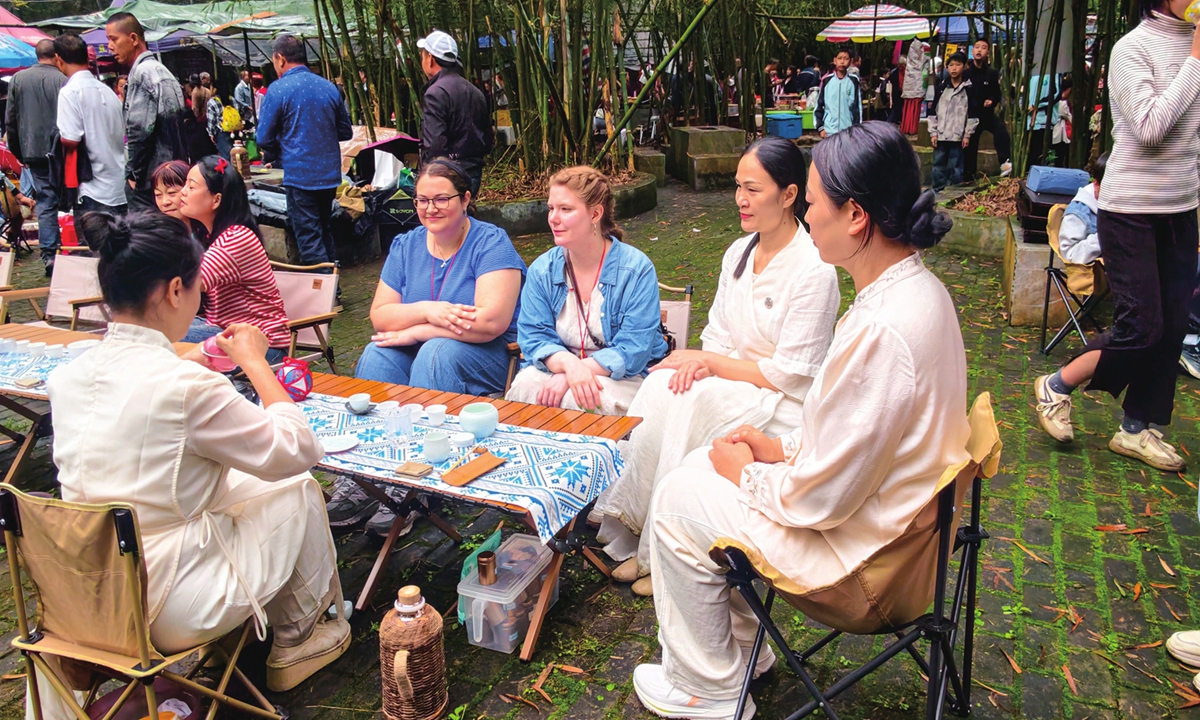
Foreign tourists experience Chinese tea culture in Zhangkou village, South China's Guangxi Zhuang Autonomous Region, on April 17, 2026.
The "China Travel" trend on overseas social media has sparked a new wave of interest. If "City Walk" in cities like Beijing, Shanghai, Guangzhou, and Shenzhen had already become a standard experience for foreign tourists, then "Country Walk" (rural walk) is now emerging as a new trendy tag. Videos of rural life in China are frequently going viral abroad, some gaining over a hundred million views, while also popularizing the topic of "Real China." Comments such as "China is actually this beautiful?" are becoming increasingly common.
Rural tourism has long been a popular segment in global travel. France's Provence is one of the successful examples. Similarly, rural areas around Queenstown in New Zealand, Jeju Island in South Korea, and Chiang Mai in Thailand are all well-known tourist destinations. However, for a long time, rural China was associated with poverty and underdevelopment. Expressions like "dusty on sunny days, muddy on rainy days" once described life in many villages. Even many Chinese people found it difficult to imagine their own countryside becoming something like "Provence," let alone something better. Meanwhile, Western media reporting, often shaped by ideological bias, has long used regional development imbalances in China as a basis for criticizing the country's development path. Such distorted narratives have misled public perceptions among many Western audiences.
With the complete victory in poverty alleviation and the continued advancement of rural revitalization, China's countryside has undergone profound transformation. Today, an extensive network of highways, world-class bridges spanning mountains and valleys, and widespread internet coverage have connected even the most remote villages closely to the country's broader development system. The integration of agriculture, culture, and tourism has upgraded rural infrastructure, with homestay clusters, camping sites, educational travel bases, and themed walking trails now common in villages and small towns. Meanwhile, China's entry policies and services continue to improve, while mobile payment systems are increasingly aligned with international standards, providing solid support for rural tourism to keep up with and accommodate new trends. In many ways, the rise of rural tourism is a natural outcome of China's development upgrading and growing global engagement.
In fact, rural tourism in China has already experienced explosive growth in recent years. It is estimated that by 2025, the rural tourism market reached 1.5 trillion yuan, accounting for nearly half of China's domestic tourism sector and becoming a key pillar of rural economies. In Zhejiang, the high-end homestay clusters in Moganshan and the Anji White Tea Town, along with Jiuba Town in Tongzi, Guizhou Province, and the Zhagana Tibetan village in Gansu Province, are all typical examples of transforming "cool resources" into a thriving "hot economy." With visa policies continuing to be relaxed, more foreign bloggers are visiting rural China and expressing surprise that "China's countryside is actually this beautiful," which reflects the further continuation of this broader trend.
When foreign tourists shift from urban sightseeing to rural everyday life, it is not simply a change of destinations, but a shift in perspective. They visit not only landmarks but also local markets, ride rural shuttle buses, stay in homestays, and participate in folk activities. The appeal of the "Country Walk" lies partly in its sense of contrast - not only between past and present rural China, but also in how China's governance achievements spark curiosity among Western youth. With many countries facing governance challenges such as social division, widening wealth gaps, and high crime rates, Chinese society continues to move toward urban-rural integration, common prosperity, and sustainable development, positioning itself as a widely recognized "model case." Behind the topic of "Real China" lies a deeper question: "How did China achieve this?" In fact, it is not only young people from developed countries; delegations from developing countries also frequently visit rural China to learn from its experience, with such study trips occurring almost every day.
From "showing China" to "entering China," and from "talking about China" to "experiencing China," cross-cultural exchanges between China and the rest of the world are deepening. Taking rural tourism as an example, foreign visitors can stay in homestays, enjoy local farm-style cuisine, and experience intangible cultural heritage traditions, while also observing clean village roads, stable utilities, accessible transportation, and well-developed services, all of which reflect strong infrastructure, public governance, and organizational capacity. Fields, traditional kitchens, craftsmanship, seasonal rituals, and community ties together form a stable and warm aesthetic of Chinese rural life.
The countryside is seen as a window into China's governance capacity, development quality, and cultural confidence. When overseas bloggers cycle along clean village roads, stay in courtyard-style boutique homestays, and interact with farmers livestreaming on smartphones, the impact of what they see and experience firsthand cannot be offset by any biased written reporting.
What does Chinese modernization actually look like? The answer to this broad question is written in the details of everyday life and people's livelihoods. As China continues to develop and open up, "Real China" will be conveyed to the world through more authentic visual narratives, allowing more people to see the beauty, convenience, and vitality of China's countryside, and helping the world better understand the wisdom and human touch in China's governance. It is expected that in the future, more foreign tourists will travel to different parts of China, experiencing its development and transformation through walking journeys. After "Country Walk," many other forms of "walks" will emerge, building bridges for cultural exchange and mutual learning between China and other countries.
RELATED ARTICLES