International forum participants highlight Hainan’s role in boosting RCEP openness and development momentum
By in Haikou Published: May 10, 2026 09:33 AM

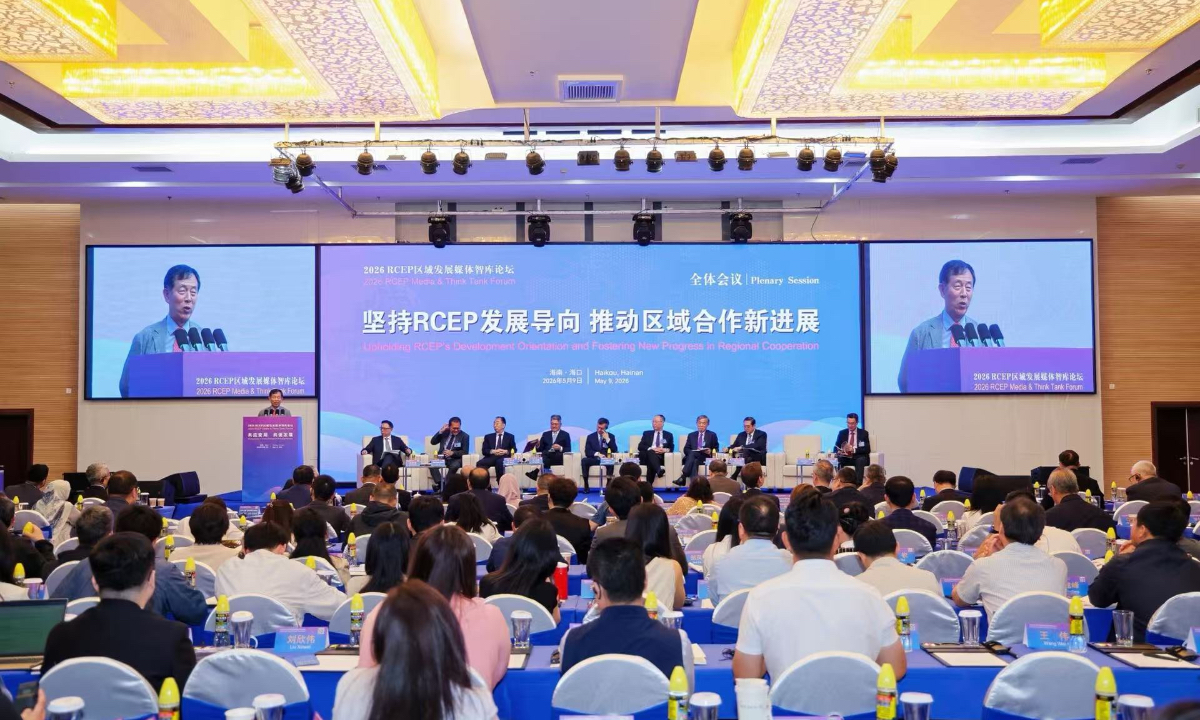
Picture of 2026 RCEP Media & Think Tank Forum, which kicked off on May 9, 2026 in Haikou, the capital of Hainan Province.
Officials, scholars, business leaders, representatives from 14 countries, including Thailand, Malaysia, the Philippines, and South Korea, as well as representatives of international organizations, highlighted the role of South China's Hainan Province can play in promoting the openness and development of the Regional Comprehensive Economic Partnership (RCEP) during the 2026 RCEP Media & Think Tank Forum, which kicked off on Saturday in Haikou, the capital of Hainan Province.
Under the theme of "Working Together to Address Challenges and Promote Development," the forum was co-hosted by China Daily and the China Institute for Reform and Development (CIRD).
At the opening ceremony, Hainan provincial governor Liu Xiaoming said that since the launch of island-wide special customs operations in the Hainan Free Trade Port, its overall performance has been stable and orderly, showing smooth flow of goods, enhanced mobility for people, and attracting increasing traffic and economic activity.
China stands ready to work with all RCEP parties to expand development space through higher-level opening-up, stimulate growth momentum through deeper cooperation, and jointly build a new regional development landscape through closer coordination, said Liu.
CIRD president Chi Fulin said at the opening ceremony that it is necessary to strengthen RCEP's development-oriented framework through practical measures, promote the effective linkage between the Chinese mega-market and the RCEP markets, and fully leverage the strategic role of the Hainan Free Trade Port.
Chi emphasized that RCEP should reinforce its strategic commitment to a development-oriented approach. In response to new changes in the geopolitical landscape, economic and trade cooperation must be strengthened, with development established as the region's top priority.
RCEP should also strengthen its strategic goal of regional free trade and become an important force in advancing global free trade. This includes fully implementing RCEP rules and optimizing the regional division of labor and cooperation network, so that more market participants can share in greater benefits, said Chi.
Chi also underscored deeper market opening and expansion of ice-breaking among members of the RCEP.
The RCEP agreement came into force in the Philippines in June, 2023, meaning the world's largest free trade pact is now in effect for all its 15 members.
The full implementation of the RCEP is a new stage for the trade bloc with the world's largest population and trade volume as well as the greatest development potential, said China's commerce ministry, the Xinhua News Agency reported in 2023 when the pact took effect.
It reflects the determination and actions of its 15 members - 10 Association of Southeast Asian Nations member states, China, Japan, the Republic of Korea, Australia and New Zealand - to support an open, free, fair, inclusive and rules-based multilateral trading system, the ministry said.
According to statistics from Haikou Customs, the total imports and exports value of Hainan enterprises with RCEP member countries other than China increased from 57.36 billion yuan ($7.91 billion) in 2021 before the agreement took effect, to 102.98 billion yuan in 2024, representing an overall growth of 79.5 percent. Other RCEP member countries have now become Hainan's most important trading partners, the China News Service reported last year.
Unny Sankar Ravi Sankar, Minister of Economic Affairs at the Embassy of Malaysia in China, told the Global Times on site that since the Hainan Free Trade Port was launched last year, it has represented new opportunities for the business community from other countries.
Sankar said that Hainan is currently collaborating closely with ASEAN countries, and he believes China has the ability to integrate systems and ensure that Hainan becomes a seamless platform for the business community to access and expand into other markets in China.
The global environment is undergoing a fundamental transformation and entering a new phase of development. The operation of RCEP needs to go beyond traditional approaches and function as a resilient, integrated platform that supports rules of origin declarations, supply chain diversification, user-friendly economic integration, and efficient logistics and transportation, said Sankar.
Kim Do Hoon, former president of South Korea's Korea Institute for Industrial Economics and Trade, told the Global Times that he believes there is significant room to further enhance trade between South Korea and the Hainan Free Trade Port.
He noted that Hainan island is located at the center of the RCEP region, giving it a strong strategic advantage.
Kim also suggested that to attract more businesses, transportation infrastructure shall be further improved. In addition, introducing more creative and flexible policies would help make the Hainan Free Trade Port more efficient and attractive.
At the opening ceremony, CIRD also released a report noting that the RCEP has made new progress amid a changing global environment. In response to changes and challenges, RCEP's strategic choice is to move from being the world's largest free trade agreement in terms of scale to one defined by higher standards.
The report emphasizes advancing "RCEP 2.0" in four key areas: openness, rules, expansion, and governance. The goal is to build a higher-level free trade platform that is implementable, monitorable, enforceable, and well-governed.
RELATED ARTICLES