From ‘cold resources’ to ‘hot industry’: Xining’s cold-climate vegetable sector turns plateau strength into stronger supply capacity
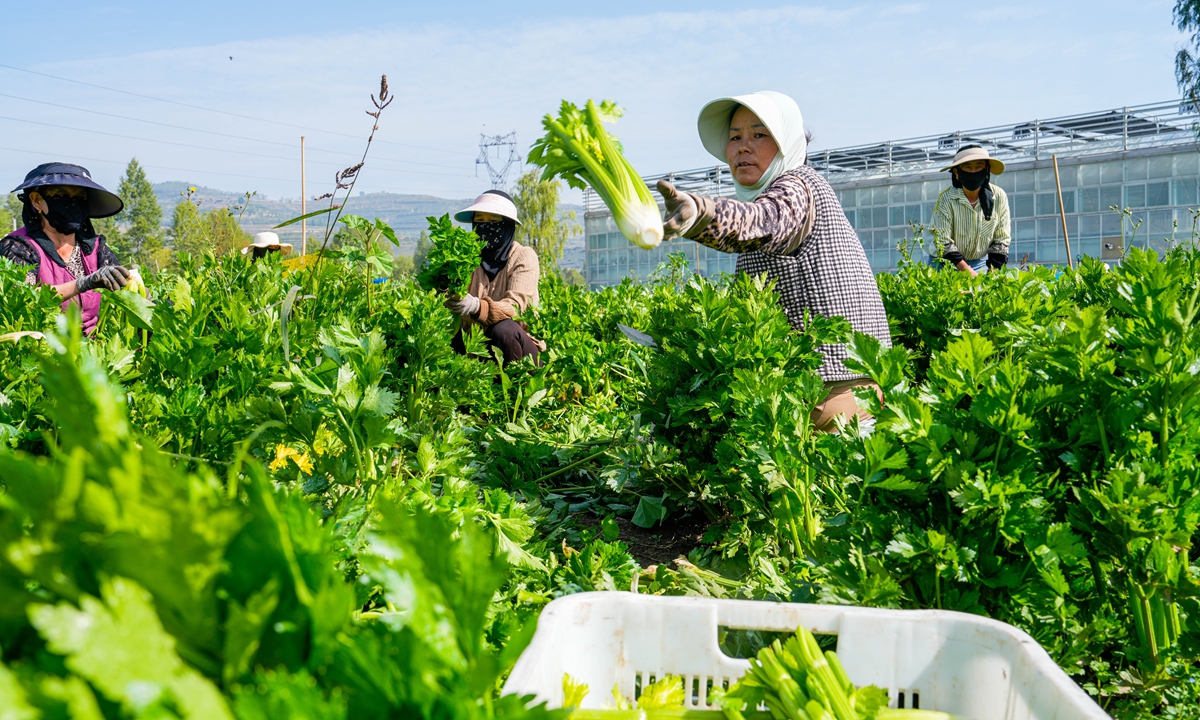
Farmers harvest vegetables at a modern agricultural industrial park in Datong county, Xining, Northwest China's Qinghai Province. Photo: Courtesy of Xining Municipal Bureau of Agriculture and Rural Affairs
As temperatures begin to climb across much of China in early May, the fields around Xining, capital of Northwest China's Qinghai Province, remain cool.
At a planting base of more than 800 mu (53 hectares), Ma Ying, an agricultural producer who runs an online store specializing in plateau farm produce, bends down in the field, carefully checking the growth of selenium-rich potatoes and purple garlic.
"We have been growing cold-climate vegetables for seven or eight years," Ma told the Global Times on Sunday. In about two months, the base's early-season varieties will start entering the market, while its open-field crops are expected to reach peak harvest around September.
Thanks to the plateau's unique growing conditions, these vegetables will provide a staggered supply to help meet China's summer vegetable demand. Ma said that after harvest, some would be supplied to local markets, some shipped nationwide through wholesale channels, while some would be sent directly to consumers through the store's Taobao platform, without middlemen.
The shop owner's story reflects the broader development of its cold-climate vegetable industry in Xining.
In 2025, Xining's cold-climate vegetable planting area reached 262,000 mu, up 6.6 percent year-on-year, while output rose 8.1 percent to 714,600 tons, marking growth in both planting area and production, the Global Times learned.
Cold-climate vegetables refer to cool-weather crops suitable for summer cultivation in areas where temperatures range from 17 C and 25 C. Qinghai's high altitude, cool summers, wide day-night temperature gaps and low incidence of pests and diseases have given its produce advantages in staggered supply, ecological safety and quality.
For Ma, those advantages are visible in the fields. The plateau's naturally selenium-rich soil and the longer growth cycle of crops give cold-climate vegetables from Xining and across Qinghai advantages in safety, taste and quality stability, she said.
For business operators like her, the transformation is also firsthand evidence of the broader changes taking place in Qinghai's plateau agriculture, as the region turns its "cold resources" into a "hot industry" that enriches the farmers and supports the rural revitalization.
Filling the broader markets
Every summer, intense heat and strong sunlight slow the growth of many vegetables, and in densely populated regions such as eastern China and the southern coastal areas, hot weather can create seasonal supply gaps, said Li Guoxiang, a research fellow at the Rural Development Institute of the Chinese Academy of Social Sciences.
Qinghai's cold-climate vegetables, by contrast, enter their prime growing season, helping fill summer supply gaps nationwide. As consumer demand grows for stable and more diversified vegetable supplies, this staggered production not only enriches summer market offerings, but also supports sustainable agricultural development and farmers' income growth in Qinghai, Li told the Global Times on Sunday.
By leveraging its resource endowments and better mobilizing production factors, Qinghai is accelerating efforts to build itself into a supplier of green and organic agricultural and livestock products and to develop plateau specialty agriculture tailored to local conditions. This also supports China's broader push during the 15th Five-Year Plan period (2026-30) to optimize agricultural production and develop specialty farming.
In this process, Xining, the only million-plus-population city on the Qinghai-Tibet Plateau, has become an important base for large-scale production, standardized cultivation and brand-building of cold-climate vegetables.
The Global Times learned that nearly 800 million yuan ($111 million) has been invested in agricultural infrastructure projects, including greenhouse upgrades, integrated water-and-fertilizer systems and cold-storage facilities at production sites.
Xining has now built 10 cold-climate vegetable bases each covering more than 10,000 mu, as well as 53 bases each covering more than 1,000 mu, according to the Xinhua News Agency. Last year, more than 80 percent of the city's vegetables were sold outside the province, including markets in Beijing, as well as Henan, Shaanxi and Sichuan provinces.
In addition to supplying markets on the Chinese mainland, Xining's cold-climate vegetables have also been included in the "vegetable basket" supply system for the Guangdong-Hong Kong-Macao Greater Bay Area (GBA).
In June 2025, construction began on a distribution center serving the GBA. The center will supply eight to 10 varieties of cold-climate vegetables, including pea shoots, flowering Chinese cabbage, crown daisy and cabbage, and provide more than 200,000 tons of vegetables to the GBA.
As Qinghai expands its external supply and secures better prices for quality products, the industry's development has continued to help raise agricultural efficiency and farmers' incomes. In Xining, more than 500 vegetable business entities have created jobs for over 20,000 people, the Global Times learned.
Moving up the value chain
Brand-building is also gaining pace. On May 8, Xining held a promotion event for its cold-climate vegetables and strawberries at the Xining Comprehensive Bonded Zone, Xinhua reported, in a bid to help Qinghai shift from product exports to higher-value brand exports and further strengthen its competitiveness.
Other Qinghai plateau specialties also offer a glimpse of that growing competitiveness. Wang Shuqin, head of Qinghai Yunjing Agricultural Technology Co, told the Global Times on Sunday that the plateau's unique conditions give her company's goji berries a sweeter taste, thicker flesh and richer nutrition.
Wang said her company runs more than 3,000 mu of standardized planting bases, using technologies such as integrated organic water-fertilizer integration and drip irrigation. Its products are sold nationwide and exported to Europe and Southeast Asia, where they have earned strong customer trust.
Qinghai has established a 10,000-ton export base for plateau cold-climate vegetables. "Qinghai-branded" agricultural products are now sold to 54 countries and regions, and the output of green and organic agricultural and livestock products has exceeded 1.46 million tons, according to this year's Qinghai government work report.
The report said Qinghai will steadily expand the output of cold-climate vegetables and cold-water fish, increase agricultural and livestock product output by more than 10 percent, and further raise the global profile of its "pure Qinghai, premium plateau products" brand.
Li said the development of the cold-climate vegetable industry is driving the clustering of related sectors such as cold-chain logistics, agricultural processing and e-commerce, energizing county-level economies and helping generate gains in farmers' income, industrial efficiency and ecological value.
As cold-chain systems, regional brands and e-commerce channels continue to improve, Qinghai's cold-climate vegetables will move from simply "being sellable" to achieving more stable and higher quality sales, Li noted.
"We still need to refine planting management and improve online sales, so that more people know about Qinghai's cold-climate vegetables," Ma, the agricultural producer, said.
Although the potatoes and purple garlic await their late-summer and autumn harvest, Qinghai's path of turning "cold resources" into a "hot industry" is becoming clearer.
RELATED ARTICLES