IN-DEPTH / IN-DEPTH
China, Uzbekistan's joint efforts in reviving Aral Sea a model for implementation of GDI: Uzbek expert and Tianshan Award winner
New levels of cooperation
Editor's Note:
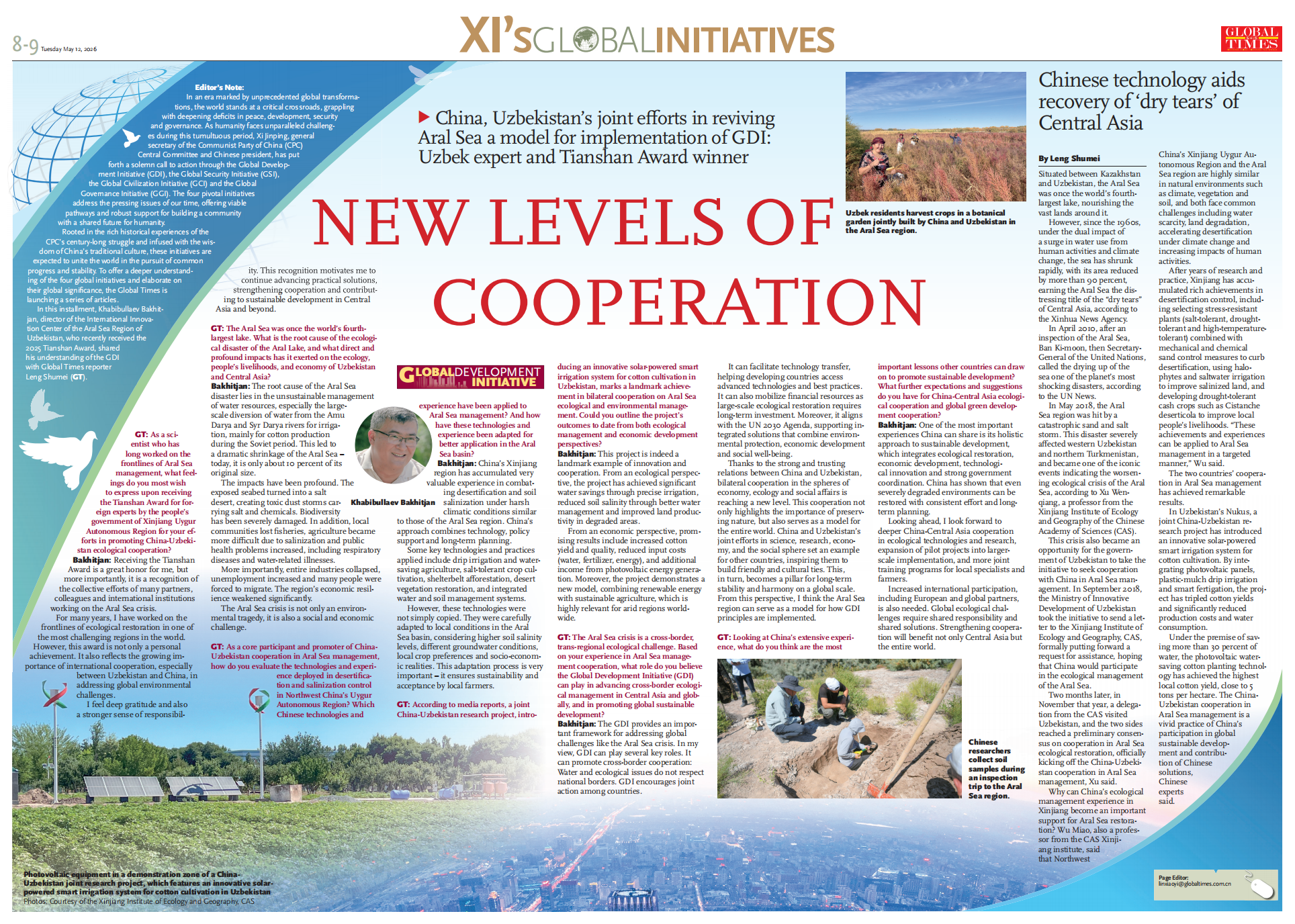
In an era marked by unprecedented global transforma tions, the world stands at a critical crossroads, grappling with deepening deficits in peace, development, security and governance. As humanity faces unparalleled challenges during this tumultuous period, Xi Jinping, general secretary of the Communist Party of China (CPC) Central Committee and Chinese president, has put forth a solemn call to action through the Global Development Initiative (GDI), the Global Security Initiative (GSI), the Global Civilization Initiative (GCI) and the Global Governance Initiative (GGI). The four pivotal initiatives address the pressing issues of our time, offering viable pathways and robust support for building a community with a shared future for humanity.
Rooted in the rich historical experiences of the CPC's century-long struggle and infused with the wisdom of China's traditional culture, these initiatives are expected to unite the world in the pursuit of common progress and stability. To offer a deeper understanding of the four global initiatives and elaborate on their global significance, the Global Times is launching a series of articles.
In this installment, Khabibullaev Bakhitjan, a specially-appointed professor at the Xinjiang Institute of Ecology and Geography of the Chinese Academy of Sciences and director of the International Innovation Center of the Aral Sea Region of Uzbekistan, who recently received the 2025 Tianshan Award, shared his understanding of the GDI with Global Times reporter Leng Shumei (GT).

GT: As a scientist who has long worked on the frontlines of Aral Sea management, what feelings do you most wish to express upon receiving the Tianshan Award for foreign experts by the people's government of Xinjiang Uygur Autonomous Region for your efforts in promoting China-Uzbekistan ecological cooperation?
Bakhitjan: Receiving the Tianshan Award is a great honor for me, but more importantly, it is a recognition of the collective efforts of many partners, colleagues and international institutions working on the Aral Sea crisis.
For many years, I have worked on the frontlines of ecological restoration in one of the most challenging regions in the world. However, this award is not only a personal achievement. It also reflects the growing importance of international cooperation, especially between Uzbekistan and China, in addressing global environmental challenges.
I feel deep gratitude and also a stronger sense of responsibility. This recognition motivates me to continue advancing practical solutions, strengthening cooperation and contributing to sustainable development in Central Asia and beyond.
GT: The Aral Sea was once the world's fourth-largest lake. What is the root cause of the ecological disaster of the Aral Lake, and what direct and profound impacts has it exerted on the ecology, people's livelihoods, and economy of Uzbekistan and Central Asia?
Bakhitjan: The root cause of the Aral Sea disaster lies in the unsustainable management of water resources, especially the large-scale diversion of water from the Amu Darya and Syr Darya rivers for irrigation, mainly for cotton production during the Soviet period. This led to a dramatic shrinkage of the Aral Sea - today, it is only about 10 percent of its original size.
The impacts have been profound. The exposed seabed turned into a salt desert, creating toxic dust storms carrying salt and chemicals. Biodiversity has been severely damaged. In addition, local communities lost fisheries, agriculture became more difficult due to salinization and public health problems increased, including respiratory diseases and water-related illnesses.
More importantly, entire industries collapsed, unemployment increased and many people were forced to migrate. The region's economic resilience weakened significantly.
The Aral Sea crisis is not only an environmental tragedy, it is also a social and economic challenge.
GT: As a core participant and promoter of China-Uzbekistan cooperation in Aral Sea management, how do you evaluate the technologies and experience deployed in desertification and salinization control in Northwest China's Uygur Autonomous Region? Which Chinese technologies and experience have been applied to Aral Sea management? And how have these technologies and experience been adapted for better application in the Aral Sea basin?
Bakhitjan: China's Xinjiang region has accumulated very valuable experience in combating desertification and soil salinization under harsh climatic conditions similar to those of the Aral Sea region. China's approach combines technology, policy support and long-term planning.
Some key technologies and practices applied include drip irrigation and water-saving agriculture, salt-tolerant crop cultivation, shelterbelt afforestation, desert vegetation restoration, and integrated water and soil management systems.
However, these technologies were not simply copied. They were carefully adapted to local conditions in the Aral Sea basin, considering higher soil salinity levels, different groundwater conditions, local crop preferences and socio-economic realities. This adaptation process is very important - it ensures sustainability and acceptance by local farmers.

GT: According to media reports, a joint China-Uzbekistan research project, introducing an innovative solar-powered smart irrigation system for cotton cultivation in Uzbekistan, marks a landmark achievement in bilateral cooperation on Aral Sea ecological and environmental management. Could you outline the project's outcomes to date from both ecological management and economic development perspectives?
Bakhitjan: This project is indeed a landmark example of innovation and cooperation. From an ecological perspective, the project has achieved significant water savings through precise irrigation, reduced soil salinity through better water management and improved land productivity in degraded areas.
From an economic perspective, promising results include increased cotton yield and quality, reduced input costs (water, fertilizer, energy), and additional income from photovoltaic energy generation. Moreover, the project demonstrates a new model, combining renewable energy with sustainable agriculture, which is highly relevant for arid regions worldwide.
GT: The Aral Sea crisis is a cross-border, trans-regional ecological challenge. Based on your experience in Aral Sea management cooperation, what role do you believe the Global Development Initiative (GDI) can play in advancing cross-border ecological management in Central Asia and globally, and in promoting global sustainable development?
Bakhitjan: The GDI provides an important framework for addressing global challenges like the Aral Sea crisis. In my view, GDI can play several key roles. It can promote cross-border cooperation: Water and ecological issues do not respect national borders. GDI encourages joint action among countries.
It can facilitate technology transfer, helping developing countries access advanced technologies and best practices. It can also mobilize financial resources as large-scale ecological restoration requires long-term investment. Moreover, it aligns with the UN 2030 Agenda, supporting integrated solutions that combine environmental protection, economic development and social well-being.
Thanks to the strong and trusting relations between China and Uzbekistan, bilateral cooperation in the spheres of economy, ecology and social affairs is reaching a new level. This cooperation not only highlights the importance of preserving nature, but also serves as a model for the entire world. China and Uzbekistan's joint efforts in science, research, economy, and the social sphere set an example for other countries, inspiring them to build friendly and cultural ties. This, in turn, becomes a pillar for long-term stability and harmony on a global scale. From this perspective, I think the Aral Sea region can serve as a model for how GDI principles are implemented.
GT: Looking at China's extensive experience, what do you think are the most important lessons other countries can draw on to promote sustainable development? What further expectations and suggestions do you have for China-Central Asia ecological cooperation and global green development cooperation?
Bakhitjan: One of the most important experiences China can share is its holistic approach to sustainable development, which integrates ecological restoration, economic development, technological innovation and strong government coordination. China has shown that even severely degraded environments can be restored with consistent effort and long-term planning.
Looking ahead, I look forward to deeper China-Central Asia cooperation in ecological technologies and research, expansion of pilot projects into larger-scale implementation, and more joint training programs for local specialists and farmers.
Increased international participation, including European and global partners, is also needed. Global ecological challenges require shared responsibility and shared solutions. Strengthening cooperation will benefit not only Central Asia but the entire world.
In an era marked by unprecedented global transforma tions, the world stands at a critical crossroads, grappling with deepening deficits in peace, development, security and governance. As humanity faces unparalleled challenges during this tumultuous period, Xi Jinping, general secretary of the Communist Party of China (CPC) Central Committee and Chinese president, has put forth a solemn call to action through the Global Development Initiative (GDI), the Global Security Initiative (GSI), the Global Civilization Initiative (GCI) and the Global Governance Initiative (GGI). The four pivotal initiatives address the pressing issues of our time, offering viable pathways and robust support for building a community with a shared future for humanity.
Rooted in the rich historical experiences of the CPC's century-long struggle and infused with the wisdom of China's traditional culture, these initiatives are expected to unite the world in the pursuit of common progress and stability. To offer a deeper understanding of the four global initiatives and elaborate on their global significance, the Global Times is launching a series of articles.
In this installment, Khabibullaev Bakhitjan, a specially-appointed professor at the Xinjiang Institute of Ecology and Geography of the Chinese Academy of Sciences and director of the International Innovation Center of the Aral Sea Region of Uzbekistan, who recently received the 2025 Tianshan Award, shared his understanding of the GDI with Global Times reporter Leng Shumei (GT).
Khabibullaev Bakhitjan Photo: Courtesy of the Xinjiang Institute of Ecology and Geography, CAS
GT: As a scientist who has long worked on the frontlines of Aral Sea management, what feelings do you most wish to express upon receiving the Tianshan Award for foreign experts by the people's government of Xinjiang Uygur Autonomous Region for your efforts in promoting China-Uzbekistan ecological cooperation?
Bakhitjan: Receiving the Tianshan Award is a great honor for me, but more importantly, it is a recognition of the collective efforts of many partners, colleagues and international institutions working on the Aral Sea crisis.
For many years, I have worked on the frontlines of ecological restoration in one of the most challenging regions in the world. However, this award is not only a personal achievement. It also reflects the growing importance of international cooperation, especially between Uzbekistan and China, in addressing global environmental challenges.
I feel deep gratitude and also a stronger sense of responsibility. This recognition motivates me to continue advancing practical solutions, strengthening cooperation and contributing to sustainable development in Central Asia and beyond.
GT: The Aral Sea was once the world's fourth-largest lake. What is the root cause of the ecological disaster of the Aral Lake, and what direct and profound impacts has it exerted on the ecology, people's livelihoods, and economy of Uzbekistan and Central Asia?
Bakhitjan: The root cause of the Aral Sea disaster lies in the unsustainable management of water resources, especially the large-scale diversion of water from the Amu Darya and Syr Darya rivers for irrigation, mainly for cotton production during the Soviet period. This led to a dramatic shrinkage of the Aral Sea - today, it is only about 10 percent of its original size.
The impacts have been profound. The exposed seabed turned into a salt desert, creating toxic dust storms carrying salt and chemicals. Biodiversity has been severely damaged. In addition, local communities lost fisheries, agriculture became more difficult due to salinization and public health problems increased, including respiratory diseases and water-related illnesses.
More importantly, entire industries collapsed, unemployment increased and many people were forced to migrate. The region's economic resilience weakened significantly.
The Aral Sea crisis is not only an environmental tragedy, it is also a social and economic challenge.
GT: As a core participant and promoter of China-Uzbekistan cooperation in Aral Sea management, how do you evaluate the technologies and experience deployed in desertification and salinization control in Northwest China's Uygur Autonomous Region? Which Chinese technologies and experience have been applied to Aral Sea management? And how have these technologies and experience been adapted for better application in the Aral Sea basin?
Bakhitjan: China's Xinjiang region has accumulated very valuable experience in combating desertification and soil salinization under harsh climatic conditions similar to those of the Aral Sea region. China's approach combines technology, policy support and long-term planning.
Some key technologies and practices applied include drip irrigation and water-saving agriculture, salt-tolerant crop cultivation, shelterbelt afforestation, desert vegetation restoration, and integrated water and soil management systems.
However, these technologies were not simply copied. They were carefully adapted to local conditions in the Aral Sea basin, considering higher soil salinity levels, different groundwater conditions, local crop preferences and socio-economic realities. This adaptation process is very important - it ensures sustainability and acceptance by local farmers.
Photovoltaic equipment in a demonstration zone of a China-Uzbekistan joint research project, which features an innovative solar powered smart irrigation system for cotton cultivation in Uzbekistan Photo: Courtesy of the Xinjiang Institute of Ecology and Geography, CAS
GT: According to media reports, a joint China-Uzbekistan research project, introducing an innovative solar-powered smart irrigation system for cotton cultivation in Uzbekistan, marks a landmark achievement in bilateral cooperation on Aral Sea ecological and environmental management. Could you outline the project's outcomes to date from both ecological management and economic development perspectives?
Bakhitjan: This project is indeed a landmark example of innovation and cooperation. From an ecological perspective, the project has achieved significant water savings through precise irrigation, reduced soil salinity through better water management and improved land productivity in degraded areas.
From an economic perspective, promising results include increased cotton yield and quality, reduced input costs (water, fertilizer, energy), and additional income from photovoltaic energy generation. Moreover, the project demonstrates a new model, combining renewable energy with sustainable agriculture, which is highly relevant for arid regions worldwide.
GT: The Aral Sea crisis is a cross-border, trans-regional ecological challenge. Based on your experience in Aral Sea management cooperation, what role do you believe the Global Development Initiative (GDI) can play in advancing cross-border ecological management in Central Asia and globally, and in promoting global sustainable development?
Bakhitjan: The GDI provides an important framework for addressing global challenges like the Aral Sea crisis. In my view, GDI can play several key roles. It can promote cross-border cooperation: Water and ecological issues do not respect national borders. GDI encourages joint action among countries.
It can facilitate technology transfer, helping developing countries access advanced technologies and best practices. It can also mobilize financial resources as large-scale ecological restoration requires long-term investment. Moreover, it aligns with the UN 2030 Agenda, supporting integrated solutions that combine environmental protection, economic development and social well-being.
Thanks to the strong and trusting relations between China and Uzbekistan, bilateral cooperation in the spheres of economy, ecology and social affairs is reaching a new level. This cooperation not only highlights the importance of preserving nature, but also serves as a model for the entire world. China and Uzbekistan's joint efforts in science, research, economy, and the social sphere set an example for other countries, inspiring them to build friendly and cultural ties. This, in turn, becomes a pillar for long-term stability and harmony on a global scale. From this perspective, I think the Aral Sea region can serve as a model for how GDI principles are implemented.
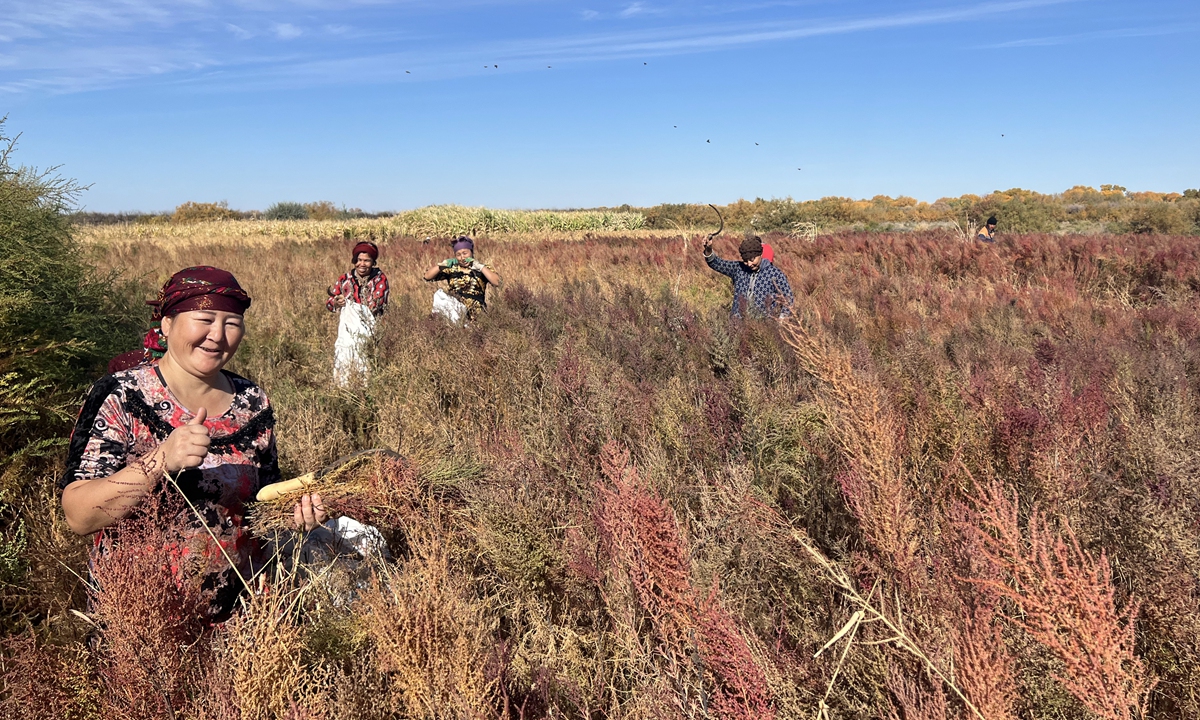
Uzbek residents harvest crops in a botanical garden jointly built by China and Uzbekistan in the Aral Sea region. Photo: Courtesy of the Xinjiang Institute of Ecology and Geography, CAS
GT: Looking at China's extensive experience, what do you think are the most important lessons other countries can draw on to promote sustainable development? What further expectations and suggestions do you have for China-Central Asia ecological cooperation and global green development cooperation?
Bakhitjan: One of the most important experiences China can share is its holistic approach to sustainable development, which integrates ecological restoration, economic development, technological innovation and strong government coordination. China has shown that even severely degraded environments can be restored with consistent effort and long-term planning.
Looking ahead, I look forward to deeper China-Central Asia cooperation in ecological technologies and research, expansion of pilot projects into larger-scale implementation, and more joint training programs for local specialists and farmers.
Increased international participation, including European and global partners, is also needed. Global ecological challenges require shared responsibility and shared solutions. Strengthening cooperation will benefit not only Central Asia but the entire world.
New levels of cooperation
RELATED ARTICLES