China’s cosmetics trade tops 170b yuan as country becomes world’s largest consumer market
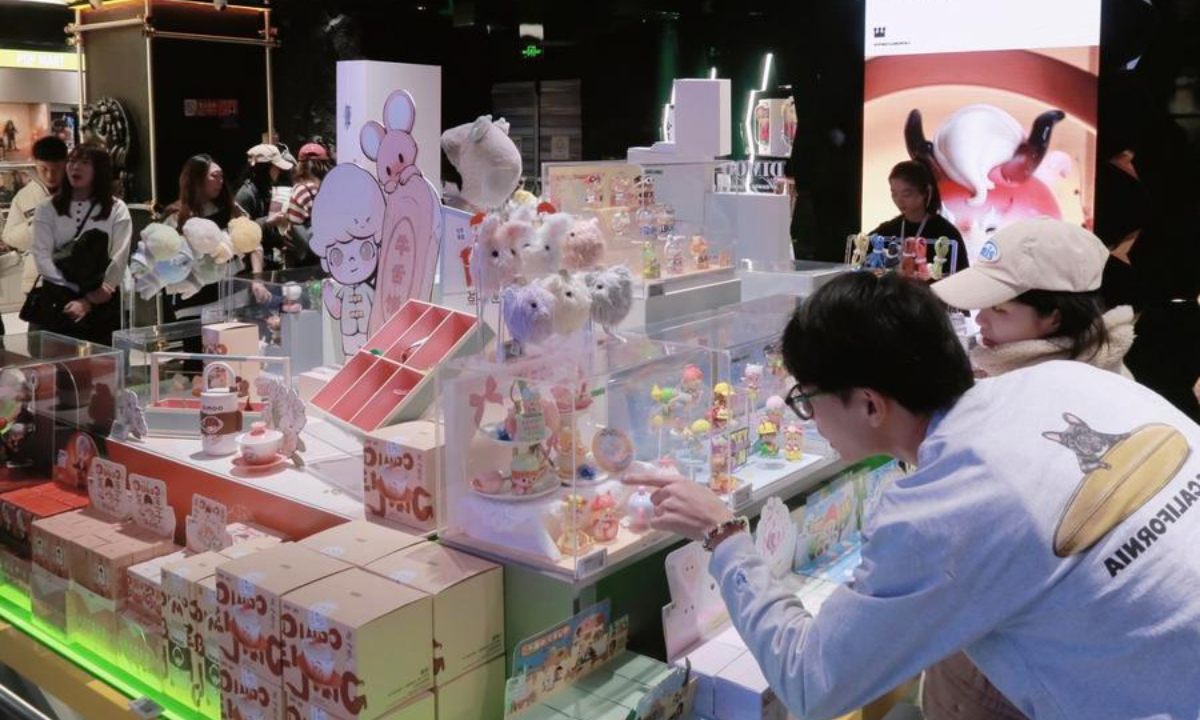
Consumers select blind boxes at a Pop Mart store in Xidan Joy City, a shopping mall in Beijing, capital of China, Dec. 28, 2024. (Xinhua/Shi Yifei)
China's cosmetics imports and exports exceeded 170 billion yuan ($24.8 billion) in 2025, with the country becoming the world's largest cosmetics consumer market, the Global Times learned from customs authorities on Monday.
As part of efforts to advance the nation's reforms to delegate power, streamline administration and optimize the business environment at ports and promote consumption upgrading, the General Administration of Customs (GAC) on Monday launched a pilot program for electronic labeling of imported cosmetics in Shanghai.
An industry observer noted that this type of institutional opening-up and process facilitation is of great significance for expanding imports of high-quality consumer goods and strengthening domestic supply capacity. The step will also have a profound impact on China's consumer market by both stimulating market vitality and enhancing its attractiveness to global players.
Meanwhile, the country's newly revised measures for the supervision and administration of inspection and quarantine of imported and exported cosmetics will take effect on December 1, the customs authorities noted in a Monday press conference.
The revised measures further improve trade facilitation for enterprises engaged in cosmetics imports and exports.
The newly revised measures will not only facilitate the development of imported cosmetics regulations, but also provide strong support for the overseas expansion of Chinese beauty brands that have gained popularity abroad.
During the revision process, authorities also focused on supporting the global expansion of Chinese beauty brands while balancing development and safety, optimizing inspection and supervision requirements for exported cosmetics, Kong Xiaobang, a spokesperson for the GAC, said at the press conference.
The scope of imported cosmetic samples exempted from inspection has also been expanded, supporting innovation in testing and research and development-related business models, and helping China move from a "major cosmetics producer" to a "strong cosmetics producer," according to the customs, China Media Group reported on Monday.
By reducing customs clearance costs and accelerating the circulation of goods through steps such as removing filing requirements and adjusting inspection locations the policy significantly lowers both time and financial burdens for importers, enabling high-quality overseas consumer products to enter the Chinese market more quickly and helping to fill gaps in domestic high-end supply, Wang Peng, an associate research fellow at the Beijing Academy of Social Sciences, told the Global Times on Monday.
He added that the move also sends a clear signal of further market opening and reflects China's determination to align with international rules. It is expected to strengthen global companies' confidence in the Chinese market and attract more international brands to expand their presence in China.
Industry data show that in 2025, China's cosmetics sector recorded more than 1.1 trillion yuan in total omnichannel transactions, marking the third consecutive year that the market size exceeded the threshold of 1 trillion yuan, according to the People's Daily. Of this total, 57.37 percent came from domestic Chinese brands.
In addition, exports of domestically produced cosmetics have shown a steady upward trend, with demand continuing to grow gradually. In 2025, China's total cosmetics exports reached $7.82 billion, up 9.2 percent year-on-year, maintaining strong growth momentum for several consecutive years.
RELATED ARTICLES