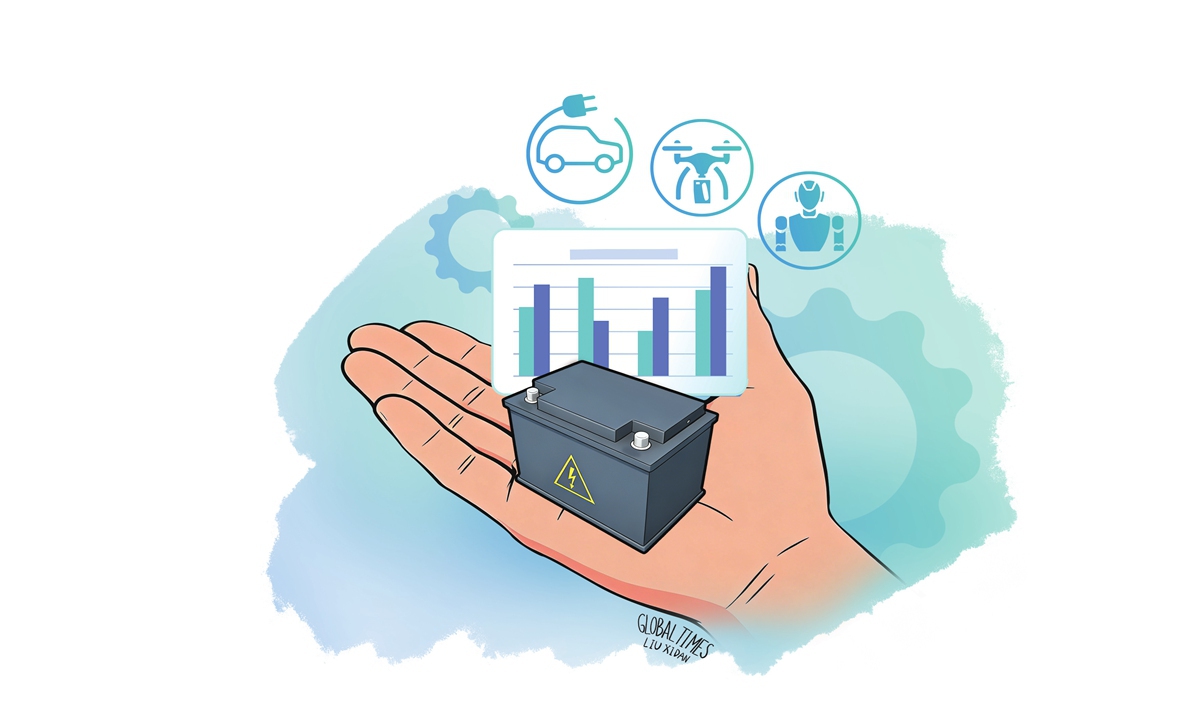
Illustration: Liu Xidan/GT
The Korea Trade-Investment Promotion Agency (KOTRA) will host a secondary battery export business meeting - featuring one-on-one B2B discussions among 13 South Korean companies and 20 Chinese battery-makers - during the 18th China International Battery Fair (CIBF) in Shenzhen, South China's Guangdong Province, from Wednesday to Friday, as well as more than one month of online video consultations after the CIBF, the Yonhap News Agency reported on Sunday. The move aims to support South Korean battery materials, parts, and equipment companies in expanding into overseas markets, Yonhap noted.Though it may seem to be a routine trade promotion event on the surface, a closer look at the underlying motives sends a clear signal: China's battery industry is not only rapidly gaining global influence, but is also boosting win-win cooperation.
As the core component of new-energy vehicles (NEVs), energy storage power stations and the new-energy industry, secondary batteries have become a critical part of the global energy transition. South Korea has built deep expertise in high-end battery materials, precision core components, and specialized manufacturing equipment, yet its domestic demand remains relatively limited. Some media reports even claimed that China has surpassed South Korea in this critical sector. However, viewed correctly, China's booming secondary battery industry actually offers South Korean companies an excellent window of opportunity for cooperation.
China's battery industry is in an upcycle of rapid expansion and global deployment. Leading Chinese battery-makers are accelerating their entry into Europe, Southeast Asia, the Middle East, and other overseas markets, with constant expansion in production capacity. As overseas orders grow and domestic markets for energy storage and NEVs increase, Chinese battery companies have rising demand for high-end raw materials, critical components, and smart production equipment. This has created a huge and stable market.
For South Korean companies with upstream advantages, this represents business opportunities. Actively integrating into China's industrial chain and sharing in its development dividends has become a practical choice for them. And the KOTRA's efforts show that the South Korean industry is actively seeking to boost cooperation with Chinese firms.
Notably, Shenzhen is not only a major hub of China's battery industry but also a frontline for global battery technology exchange. The 18th CIBF, to be held in Shenzhen, enables South Korean companies to conduct one-on-one business discussions, while observing the latest technological trends and distribution of production capacity in China's battery sector. This "exhibition-plus-matchmaking" model reflects South Korean companies' intention to deeply understand and cooperate with China's battery industry.
This kind of cooperation is not without its challenges. China and South Korea are both partners and competitors in the battery sector. Major South Korean battery-makers such as LG Energy Solution, Samsung SDI, and SK On are accelerating their global expansion. Nevertheless, despite the natural competitive dynamics, there remains considerable room for complementary collaboration across the upstream and downstream segments of the industrial chain. Forging such complementary relationships is a pragmatic response to the rising tide of protectionism.
From a broader perspective, the KOTRA's latest efforts are just a microcosm of a growing number of foreign companies seeking cooperation in China these days, which reveals an important trend: China is evolving from the "world factory" of global manufacturing to a "global hub" of critical industrial and supply chains. Now, more and more companies are coming for the overall efficiency of China's industrial ecosystem - the speed from research and development to mass production, the integration from raw materials to finished products, and the channel networks from domestic to overseas markets.
Moreover, China has always maintained a high level of openness to the outside world, continuously opening its door wider to cooperation for companies from around the world. This allows foreign partners to become deeply embedded in China's industrial ecosystem and share in the industry's growth dividends. The active integration of numerous foreign partners into China's industrial chain stands as the strongest testament to the country's comprehensive strength, vast market potential, robust industrial ecosystem, and the immense opportunities it offers. It is wise for companies from South Korea and other countries to seize these opportunities.
RELATED ARTICLES