Rifts in Japanese govt reportedly emerge over how to define China in security documents revision; hyping ‘China threat’ would meet backlash: Chinese expert
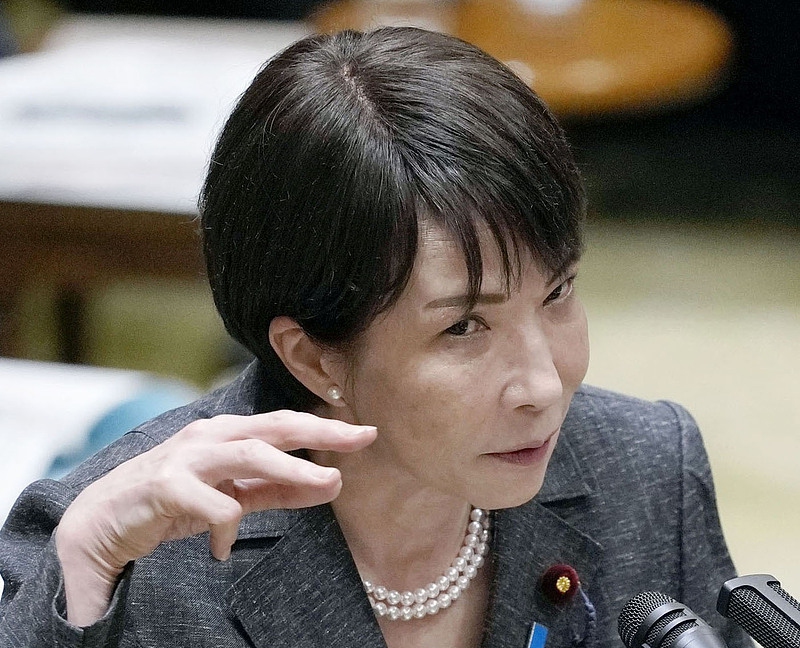
Japanese Prime Minister Sanae Takaichi attends a House of Councillors committee session in Tokyo on May 11, 2026. Photo:VCG
As the Japanese government plans to revise its three security-related documents within the year, Japanese media reported that assessments and perceptions of China have become one of the major points of contention among various parties.
Japan's government and ruling coalition differed over whether to explicitly label China as a "threat" in the upcoming revision of its three security-related documents by year-end, as views on China have become one of the major points of contention, according to a Jiji Press report on Sunday.
According to Jiji Press, amid cooling China-Japan relations following Japanese Prime Minister Sanae Takaichi's remarks on the Taiwan question, using stronger wording such as "threat" than that used in the current documents would inevitably spark backlash. While hardliners within the ruling coalition favor tougher language, others believe Japan should take relations with China into account and adopt more restrained wording.
At the same time, a former Japanese foreign minister expressed caution, saying that explicitly writing the word "threat" would only provoke dissatisfaction from China and should therefore be handled carefully. Japan's official position remains one of promoting a "mutually beneficial relationship based on common strategic interests" and building a "constructive and stable relationship" with China, per Japan Times.
The report also noted that when Japan's Liberal Democratic Party (LDP) submitted recommendations to the government during the previous revision in late 2022, it called for China's military activities to be defined as a "grave security threat." However, its then coalition partner Komeito opposed the proposal on grounds that it would intensify confrontation. As a result, the final wording in Japan's National Security Strategy referred to China as "an unprecedented and the greatest strategic challenge" and a "serious concern."
Japan itself has internal contradictions on this issue, and disputes already emerged during the previous revision process, Xiang Haoyu, a distinguished research fellow at the China Institute of International Studies, told the Global Times on Monday.
"Experienced Japanese diplomatic figures are aware that such wording could trigger responses from China. Meanwhile, Japan has consistently used media leaks to test public opinion and gauge China's reaction," Xiang said.
Xiang noted that under the Takaichi administration, a series of moves, including loosening restrictions on exports of lethal weapons, revising the Three Principles on Transfer of Defense Equipment and Technology and their implementation guidelines, have increasingly been used to provoke China and advance Japan's domestic political agenda.
The Japanese media report also noted that China has expressed "serious concern" over the abovementioned moves, with frictions between the two sides continuing to intensify.
At a regular press briefing on April 24, in response to a reporter's question regarding the growing signs of neo-militarism in Japan, Chinese Foreign Ministry spokesperson Guo Jiakun said that countries in the region, including China, must stay on high alert and jointly defend the outcomes of the victory of World War II.
"We must not allow Japanese militarism to be revived. We must not allow the tragedies of history to be repeated. We must not allow anyone or any force to undermine peace and sow disaster in our region," Guo said.
Earlier, on January 6, when asked about Japan's push to revise its "three security documents" within the year, Chinese Foreign Ministry spokesperson Mao Ning said that it reflects the dangerous trend of Japan "remilitarizing" itself faster, which is bound to undermine regional peace and stability.
China and all peace-loving countries and people in the world should never allow Japanese right-wing forces to turn back the wheel of history or allow the revival of militarism, Mao said.
RELATED ARTICLES