Cruise departs Dalian as S.Korea adds China-bound routes, signaling deeper two-way exchanges
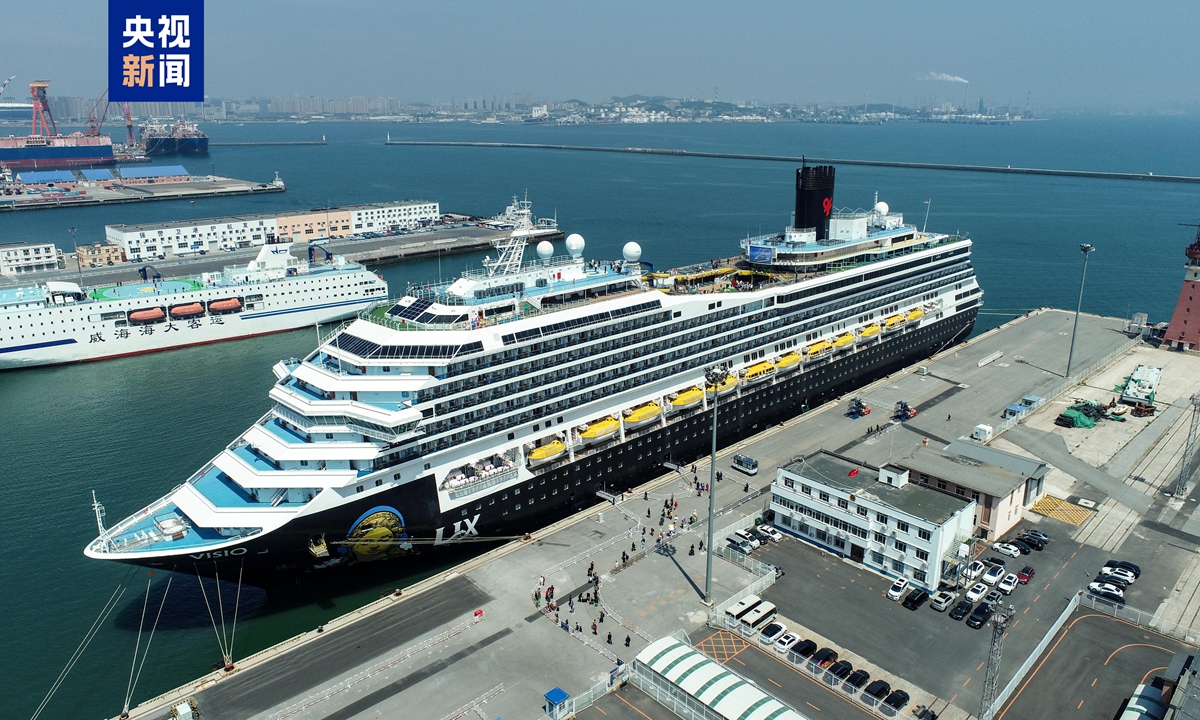
A 105,000-ton international cruise ship carrying 3,389 Chinese and foreign passengers departs from Dalian, Northeast China's Liaoning Province, on May 12, 2026. Photo: CCTV News
A 105,000-ton international cruise ship set sail from Dalian, Northeast China's Liaoning Province, on Tuesday carrying 3,389 Chinese and foreign passengers, according to China Media Group (CMG). Notably, the vessel's maiden voyage from Dalian opened a new "Dalian-Incheon-Jeju" route, offering travelers more diversified outbound travel options.
The launch of the route comes as two-way tourism exchanges between China and South Korea continue to gain momentum.
The Global Times learned that flights from South Korea to China have been steadily increasing in recent months, while South Korean media outlets have reported the addition of multiple new China-bound routes. Industry insiders said that the trend reflects continuously deepening people-to-people exchanges between the two countries and is expected to generate positive economic momentum for both sides.
From April 12 to May 11, 2026, the number of flights on routes between the Chinese mainland and South Korea reached 9,985, up 494 flights, or about 5.2 percent, from the previous 10-day period's 9,491 flights, and up 851 flights, or roughly 9.3 percent year-on-year from the same period of 2025, according to a statement provided to the Global Times by leading aviation data intelligence agency VariFlight.
VariFlight said that China-South Korea flight volumes have recently shown a trend of continued recovery and moderate expansion, noting that the latest figures exceeded both the previous period and the same period last year, indicating improvements in market demand, airline capacity deployment, and tourism and business exchanges.
According to an April 24 report by The Korea Economic Daily, South Korea's Ministry of Land, Infrastructure and Transport reviewed presentations by airlines the previous day over traffic rights for 35 international routes, with China routes drawing the fiercest competition.
The report said that some airlines hope to secure China routes as a breakthrough for an earnings recovery.
The report said that passenger traffic on China-South Korea routes rose more than 26 percent year-on-year in the first quarter to 4.39 million, surpassing the 4.14 million recorded in the first quarter of 2019. This stood in sharp contrast to declines on Southeast Asia routes, which fell 4.7 percent, and Middle East routes, which dropped 16 percent amid security concerns and geopolitical risks.

Tourists arriving from China disembark from a cruise ship in Incheon, South Korea, on February 6, 2026. Photo: VCG
According to booking data from major South Korean travel agency Hana Tour cited in the report, China accounted for about 30 percent of travel products departing during the early-May holiday period, ahead of Japan at 23 percent and Vietnam at 14 percent.Facing rapidly growing demand for travel to China, South Korean tourism companies have accelerated their expansion plans.
Another May 7 report by The Korea Economic Daily said that travel agency Kyowon Tour plans to expand tourism products linked to newly launched routes to Hangzhou, Chengdu, Guangzhou and Xiamen. Hana Tour has also rolled out summer travel packages to China to meet rising short-haul travel demand.
The Korea Economic Daily said that high oil prices and other factors have increased the cost of long-haul travel, making China, as a short-haul destination, more attractive in terms of cost performance. The report also noted that China's visa-free policy for South Korean travelers, introduced in November 2024, has further stimulated demand for travel to China.
Growing people-to-people exchanges between China and South Korea, particularly rising travel demand among younger generations, are expected to further boost consumption and inject fresh momentum into regional economic activity, said Lü Chao, a professor at the Liaoning Academy of Social Sciences.
Analysts said that rising travel demand serves as a tangible indicator of deepening economic and people-to-people ties between China and South Korea, while the continued expansion of outbound tourism to South Korea also reflects the growing spillover of Chinese consumer vitality overseas.
RELATED ARTICLES