Chinese president meets leaders from Tajikistan, Brunei, UNESCO as China’s diplomatic calendar shifts to high gear
By Published: May 13, 2026 12:43 AM

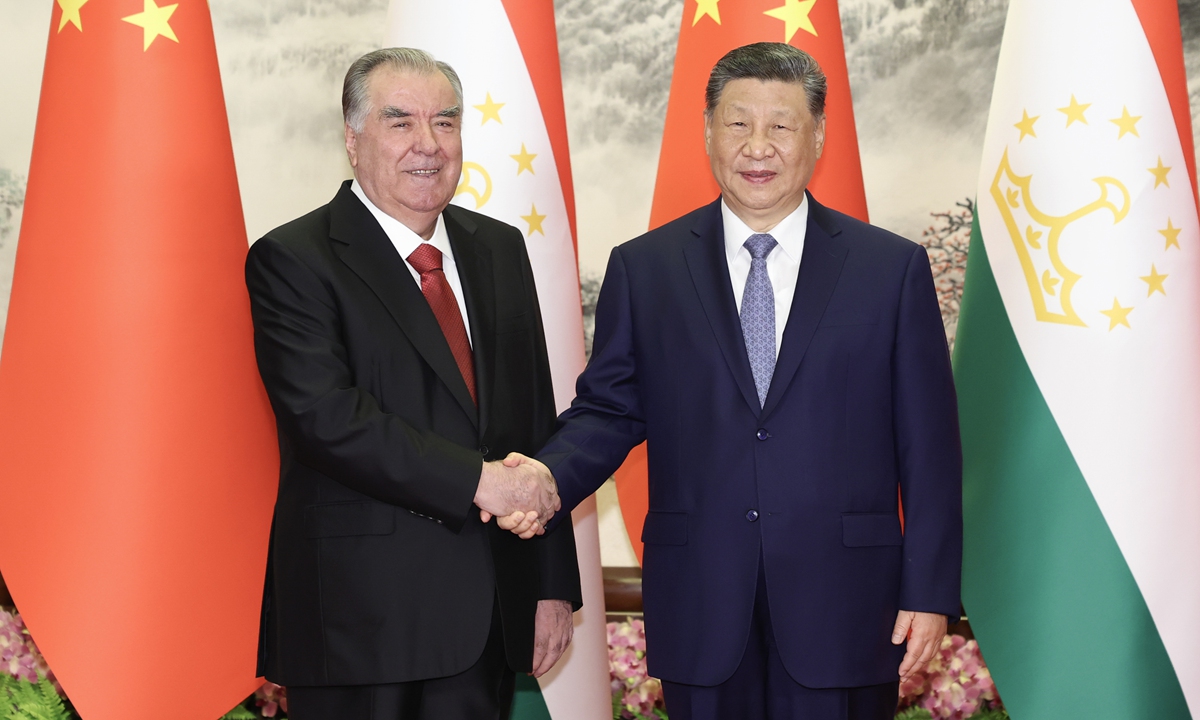
Chinese President Xi Jinping holds talks with Tajikistan's President Emomali Rahmon, who is on a state visit to China, at the Great Hall of the People in Beijing on May 12, 2026. Photo: Xinhua
China's diplomatic calendar is shifting to high gear.
Chinese President Xi Jinping on Tuesday met separately with Tajikistan's President Emomali Rahmon, Crown Prince and Senior Minister at the Prime Minister's Office of Brunei Darussalam Haji Al-Muhtadee Billah, and director-general of the United Nations Educational, Scientific and Cultural Organization (UNESCO) Khaled El-Enany, according to the Xinhua News Agency.
As US President Donald Trump is also scheduled to visit China from Wednesday to Friday, the flurry of high-level engagements on Tuesday—bringing together leaders from Central Asia, Southeast Asia and a key UN agency in a single day—underscored the breadth and intensity of China's diplomatic outreach. Chinese experts said the pace and scope of these exchanges reflect both the multidimensional nature of China's diplomacy and its growing global resonance.
They added that the active "home-ground diplomacy" highlights increasing international recognition of China's diplomatic approach. Through a focus on openness and cooperation, China is offering countries and international organizations a sense of stability and opportunity in an increasingly uncertain world, experts noted.
Neighborhood diplomacy in focus
In his meeting with Tajikistan's president, the Chinese leader said regardless of how the external environment may change, China and Tajikistan will always be good neighbors that help each other, good friends who trust each other, and good partners who work together for development, according to Xinhua.
By signing the China-Tajikistan treaty of permanent good-neighborliness and friendly cooperation, the two sides will fully showcase their strong political mutual trust and provide a solid guarantee for the enduring friendship between the two nations, he said, per Xinhua.
He called on both sides to focus on high-quality Belt and Road cooperation, thoroughly align their development strategies, and work together to advance their respective development goals, Xinhua said.
The two leaders also jointly attended a signing ceremony of cooperation documents in Beijing on Tuesday, Xinhua reported.
Some Tajik media shed light on the visit. The Tajik news website TajikPress reviewed the diplomatic history between Tajikistan and China from a historical perspective, noting that Rahmon has previously made multiple official, state and working visits to China, with his first official visit dating back to March 1993.
The report pointed out that China and Tajikistan have signed more than 250 bilateral documents to date, covering political, economic, social and cultural fields.
Another Tajik media Asia Plus News reported on Tuesday that as part of Rahmon's visit, he visited the Asian Infrastructure Investment Bank and signed a long-term investment plan, and met with representatives of Chinese companies on the same day.
In an interview with Xinhua on Saturday, Rahmon said Tajikistan and China have steadily expanded cooperation across various fields in recent years, with bilateral relations scaling new historical heights.
China is not only a close neighbor of Tajikistan, but also a strategic partner, Rahmon said, noting that over the more than 30 years since the establishment of diplomatic ties, the two countries have built a relationship of profound friendship and mutual trust, per Xinhua.
The two sides have consistently strengthened mutual political trust and mutually beneficial cooperation in order to effectively respond to challenges and threats facing regional security and sustainable development, he added, according to Xinhua.
In his meeting with Haji Al-Muhtadee Billah, the Crown Prince and Senior Minister at the Prime Minister's Office of Brunei Darussalam, Xi called for strengthening strategic communication and deepening practical cooperation.
This year marks the 35th anniversary of bilateral ties, the Chinese leader said, adding that faced with a turbulent and changing international landscape, the two sides should take the building of a China-Brunei community with a shared future as the guideline, to strengthen strategic communication, deepen practical cooperation, and inject more positive energy into regional peace and stability.
The Chinese leader also called on both sides to be partners in global governance and work with ASEAN countries to build a closer China-ASEAN community with a shared future, turning the region into a benchmark of peace, stability, development, and prosperity amidst profound changes unseen in a century, per Xinhua.
According to Brunei media Borneo Bulletin, Haji Al-Muhtadee Billah, the Crown Prince and Senior Minister at the Prime Minister's Office of Brunei Darussalam also visited the General Administration for Sports of China in Beijing on Tuesday.
He welcomed the mutual commitment of both countries to establish Brunei-China wushu training camps under the Bilateral Cooperation Plan of the Belt and Road Initiative signed in 2025, according to the Borneo Bulletin.
China and Brunei share highly consistent views and broad consensus on regional and international affairs. In particular, as both countries are located around the South China Sea, they have consistently maintained a positive and pragmatic approach toward issues related to the South China Sea. Over the years, Brunei has played an important role in maintaining peace and stability in the region, Ge Hongliang, deputy director of the College of ASEAN Studies at Guangxi University for Nationalities, told the Global Times on Tuesday.
From Tajikistan to Brunei, China's interactions with its neighboring countries fully demonstrate the significant progress made in building a community with a shared future in the region, a Chinese expert said.
"China's relevant concepts have gained broad recognition among its neighbors, and the defining features of its neighborhood diplomacy - inclusiveness and mutually beneficial cooperation - have been clearly highlighted and widely accepted by all parties," Zhu Yongbiao, executive director of the Research Center for the Belt and Road at Lanzhou University, told the Global Times on Tuesday.
Support multilateralism
In his meeting with UNESCO's Khaled El-Enany, Xi emphasized that UNESCO has made important contributions to greater understanding and trust among peoples and exchanges and mutual learning among civilizations, and played a proactive role in reforming and improving global governance on education, science and culture.
China actively supports the work of UNESCO, and the two sides have done many things for safeguarding world peace and promoting global development, he said, expressing China's readiness to deepen strategic cooperation with UNESCO to better benefit people of all countries, according to Xinhua.
The Chinese leader said global governance has come to a new fork in the road, underlining that China is committed to practicing true multilateralism, supports and upholds the authority of the United Nations, and supports UNESCO in playing an important role in global governance.
China's long-standing commitment to improving itself while contributing to global progress is gradually being understood, accepted and widely disseminated. As a major global power, China's stance of openness and cooperation has also helped elevate the international status and influence of countries around the world, particularly those in the Global South, emerging economies, and developing nations, Li Haidong, a professor at the China Foreign Affairs University, told the Global Times on Tuesday.
China's diplomatic practice demonstrates a spirit of openness and cooperation, encouraging countries to move toward one another and contributing to a more balanced, stable, and sustainable international order, Li said.
In a world marked by complexity and turbulence, China, through its diplomatic philosophy and practice of openness and cooperation, has brought greater balance, hope, and stability to global affairs. The growing role and influence of China have also contributed to enhancing the status and strength of emerging economies, developing countries, and the Global South, making global development more balanced and full of promise, the expert said.
RELATED ARTICLES