China’s BCI innovation enters fast track, with initial breakthroughs expected in assistive therapy, rehabilitation, and related fields
By and Chen Zishuai Published: May 13, 2026 07:56 PM

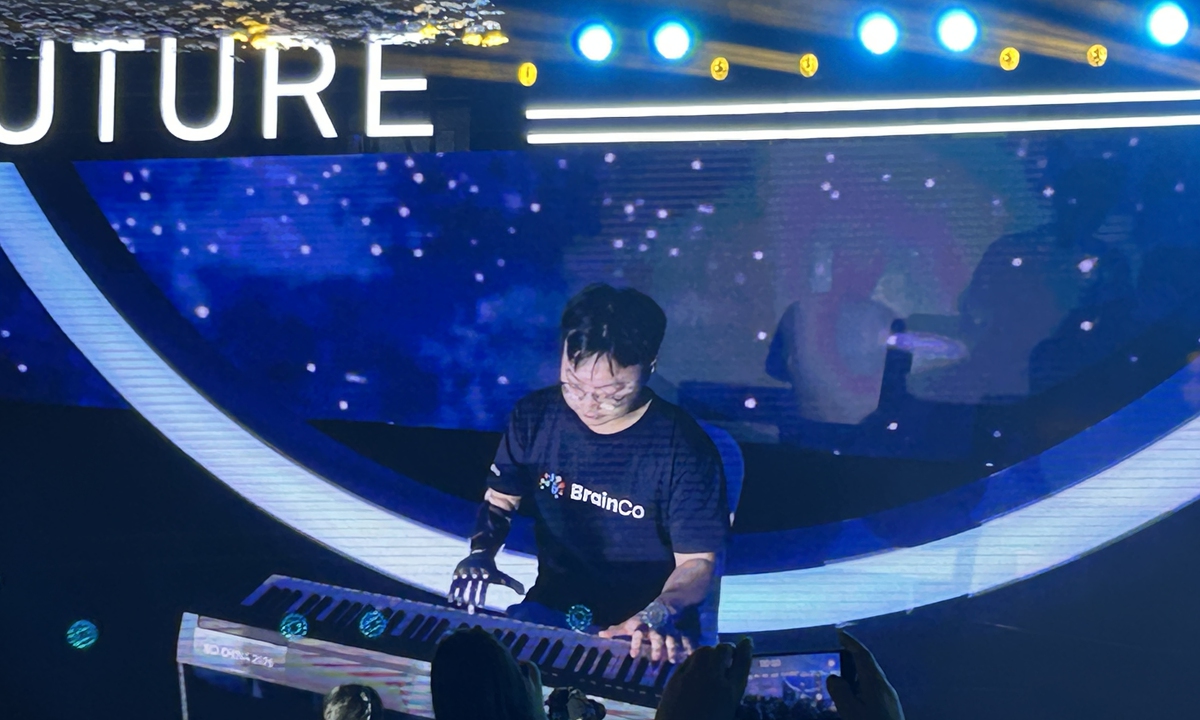
Zhou Jian, who lost his right arm in an accident at the age of 12, plays the piano with an intelligent bionic hand in Nanjing, East China's Jiangsu Province, on May 11, 2026. Photo: Chen Zishuai/GT
Zhou Jian, a boy who accidentally lost his right arm at the age of 12, is now wearing an intelligent bionic hand, gracefully playing the Chinese folk song Jasmine Flower.
This touching scene, reminiscent of Major Motoko Kusanagi embracing the world through her cybernetic body in Ghost in the Shell, came to life at the opening ceremony of a recent brain-computer interface (BCI) industry forum, leaving the audience in awe.
Zhou began wearing the intelligent bionic hand in September 2022. Now, he has fully adapted to the device, with his every finger able to respond to his thoughts, Zhou told the Global Times.
Across China, this cutting-edge industry is redefining the frontier between humans and machines after three decades of development, from empowering people with disabilities to control bionic limbs with their minds, restoring fine motor skills and daily independence, to industrial control, rehabilitation, entertainment, and human capability enhancement.
China's 15th Five-Year Plan (2026-30) noted that forward-looking plans should be put in place for industries of the future, and BCI, among other industries, is listed in the catalogue.
Scientists and entrepreneurs told the Global Times that they expect the industry, now at a critical juncture of technology implementation and commercial exploration, will "take off like rockets soaring into the sky" in the next few years, particularly applications involving medical care, consumer electronics, and high-end manufacturing. These advancements will inject new dynamics into China's high-quality economic development.
The development of the industry will also advance alongside continuous improvement of supporting policies and top-level design, including medical insurance pricing, industry standards, and clinical trials, they said, while highlighting the country's globally leading role in relevant technology breakthroughs and real-world applications.
'Mind control'
When Global Times reporters walked through the booths at the 2026 National Technology and Industry Integration Innovation Conference in Nanjing, East China's Jiangsu Province, a slogan reading "Let some blind people see first" immediately caught the reporters' attention.
A staff member of Shenzhen CAS-Envision Medical Technology Co, a BCI start-up based in Shenzhen, South China's Guangdong Province, demonstrated the device by placing a pair of camera-equipped glasses on a human head model. The Global Times observed that when a piece of white paper with the letter "A" was held in front of the glasses, the connected digital screen displayed a 60-pixel version of the letter "A". This means that a blind person wearing the glasses could "see" the letter A.
The staff member told the Global Times that this is an implantable BCI device, which requires electrodes to be surgically implanted under the dura mater of the brain so that the chip can convert image information into electrical stimulation signals that stimulate the visual nerve cells, allowing blind people to "see" objects.
According to the staff member, the latest animal experiments have achieved a resolution of 1,500 pixels, "which means we can now distinguish the outlines of people, buildings, and objects."
The Global Times also noticed that a variety of BCI devices, including invasive, semi-invasive and non-invasive, designed for mental illness screening and sleep assistance were also showcased at the exhibition. Non-invasive BCIs do not require surgery, while both semi-invasive and invasive approaches involve surgical implantation.
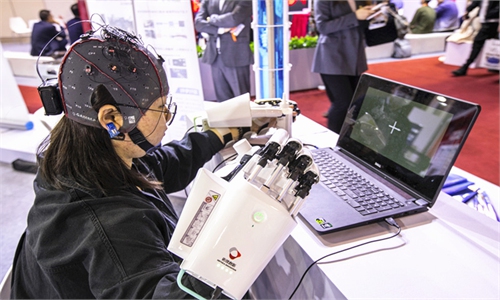
A Global Times reporter experienced "mind-controlled walking" at the exhibition site. After donning a brainwave cap (called EEG headset) and a robotic exoskeleton on the lower limbs, the reporter closed his eyes and imagined walking. Remarkably, the mechanical legs began to move on their own, successfully achieving thought-controlled locomotion - a scene straight out of science fiction.
A staff member from the developer told the Global Times that the product combines BCI technology with a robotic exoskeleton, enabling the EEG cap to collect brain signals via electrodes and transmit instructions to the robot in real time. The product is intended to aid rehabilitation for patients suffering from hemiplegia and spinal cord injuries.
'Everyone having their own BCIs'
Chinese scientists believe that BCIs, like artificial intelligence (AI), rely on rapid technological iteration to drive development, and that China is set to take a leading role in the highly competitive global landscape.
"We cannot wait until everything is perfectly ready before using it. Instead, we must continuously refine and improve it through real-world applications," Liang Dong, vice president of the Shenzhen Institute of Advanced Technology, a national research institution affiliated with the Chinese Academy of Sciences, told the Global Times.
He noted that China's technical bottlenecks involving BCI are now being broken through one by one, with initial breakthroughs expected in assistive therapy, rehabilitation, and related fields.
In March, China's National Medical Products Administration approved the registration application for an implantable BCI for Hand Motor Augmentation, developed by Neuracle Technology (Shanghai) Co, marking the world's first market launch of an invasive BCI medical device.
Hong Bo, a professor at Tsinghua University and chief scientist at the Lin Gang Laboratory, told the Global Times that the launch also marks the beginning of a new chapter for more advanced BCI systems specifically designed for patients with severe disabilities, and it is expected that more BCI medical devices will enter the stages of research, development, and market approval this year.
Tao Hu, founder and chief scientist of Chinese BCI start-up NeuroXess, told the Global Times that he believes that BCI will act as a vital communication channel between the human brain and the outside world, thereby "serving as a core technology for fusing AI with human intelligence."
Last year, Tao's team, in collaboration with Shanghai Huashan Hospital, implanted a fully implantable, fully wireless, and fully functional BCI product into a patient with high-level quadriplegia. After nearly six months of training, the patient is now able to control a wheelchair, a computer, a robotic arm, and other external devices using only his thoughts.
With the rollout of more policy support and regulatory frameworks, industry insiders are painting a rosy picture of the future application scenarios for BCIs. For example, in the field of virtual reality, users will be able to control objects in virtual environments through thought alone. In industrial settings, BCI can be used to monitor the mental state of workers in high-risk operations. And in education, it can also be applied to analyze students' learning conditions.
"Looking toward the future, we hope that everyone will one day own their own BCIs, just as they own a smartphone today," Hong said. "Although we still have some way to go, just as landing on Mars requires launching a rocket first, we are now entering an era in which BCIs are poised to take off like rockets soaring into the sky."
RELATED ARTICLES