Illustration: Chen Xia/GT
The results of a recent survey released earlier this month showed that most Cambodian people felt positively about China. Conducted by the Asian Vision Institute, an independent think tank based in Phnom Penh, the survey on Cambodia-China relations was participated in by a total of 2,612 respondents in Cambodia from December 2025 to March 2026. The survey results provide a valuable "think tank perspective" for understanding how different sectors of Cambodian society perceive China and China-Cambodia relations, while also offering insights into the effectiveness of China's neighborhood diplomacy concepts and practices.Overall, the poll highlights China's favorable image in Cambodia and the strength of bilateral relations, providing an important reference for refining China's neighborhood diplomacy in the new era.
Since the 18th National Congress of the Communist Party of China (CPC), neighborhood diplomacy has gained greater strategic importance in the major-country diplomacy with Chinese characteristics in the new era. In 2025, China and Cambodia vowed to forge an all-weather community with shared future in the new era. This upgrade not only reinforces the traditional "ironclad friendship" but also signals that the two sides will stand together through thick and thin, regardless of international changes. The survey paints a very positive picture: 97.4 percent of the respondents are optimistic about Cambodia's relations with China. This reflects deep trust in China as a reliable neighbor and demonstrates the solid public foundation of the "ironclad friendship" between the two countries. The survey reflects strong Cambodian support for this new positioning.
The principle of amity, sincerity, mutual benefit and inclusiveness has played a key role in building a favorable regional environment. About 96.1 percent of all respondents express positive feelings about China. And the highly positive views in the poll vividly demonstrate how the principle has taken root in Cambodia.
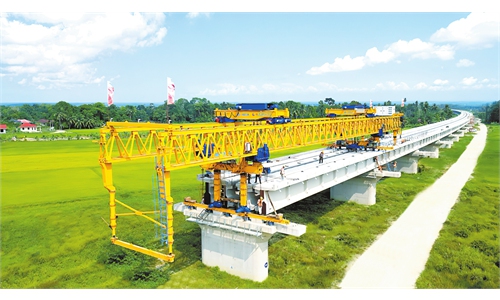
The China-proposed Belt and Road Initiative (BRI) serves as a major platform for China's neighborhood diplomacy, with infrastructure connectivity as a priority. The Phnom Penh-Sihanoukville Port Expressway Project is a key project of high-quality cooperation between China and Cambodia under the framework of BRI. The project connects Phnom Penh, the capital of Cambodia, and the Sihanoukville Port. It commenced operations in 2022 and serves as the first expressway in Cambodia.
Built to Chinese standards, it cuts travel time from over five hours to under two, boosting economic links, tourism, logistics and industry. Nearly half of respondents named it the most beneficial project for Cambodia, showing how BRI delivers tangible gains and improves local livelihoods.
China's neighborhood diplomacy is driven by both development and security. Most neighboring countries prioritize development while facing complex security challenges. China supports this dual approach - promoting security through development and ensuring development through security.
In 2025, China-Cambodia trade reached $19.73 billion, up 29.9 percent year-on-year. China has remained Cambodia's largest trading partner for 13 consecutive years. In July 2025, the first batch of fresh Cambodian durians was officially exported directly to China. Prior to this, Cambodian agricultural products such as bananas, mangoes, longans, and coconuts had already been successively approved for export to the Chinese market.
At the same time, security issues are also a major concern for the Cambodian public. In particular, the 2025 Cambodia-Thailand conflict displaced hundreds of thousands of Cambodians from their homes, led to the closure of border crossings between the two countries, and caused significant disruptions to Cambodia's economy and people's livelihoods. China, as a friendly neighbor to both Cambodia and Thailand, upheld the Asian way of handling disputes by actively promoting peace talks and de-escalating tensions through various channels, including foreign ministers' dialogues, trilateral senior officials' consultations, and the dispatch of special envoys for mediation.
It can be seen from the survey that China's role in promoting peace and stability along the Cambodia-Thailand border also received attention, along with its humanitarian assistance to Cambodian refugees.
Against the backdrop of global uncertainty and intensifying geopolitical competition, China's neighborhood diplomacy faces both opportunities and challenges. As China's strength and international influence grow, its image as a responsible major country is widely recognized. In terms of development assistance, 77.11 percent of respondents identified China as the country that has helped Cambodia the most.
While celebrating achievements, challenges must also be addressed. For instance, one of the concerns cited were online and non-online fraud as well as illegal activities. Going forward, China and Cambodia need to strengthen cooperation on cross-border crime and corporate compliance to deepen the all-weather community with shared future in new era.
The author is director of the Center for Southeast Asian Studies at the Chinese Academy of Social Sciences. opinion@globaltimes.com.cn
RELATED ARTICLES