IN-DEPTH / IN-DEPTH
‘Class super leagues’ grow popular among Chinese campuses, help bridge the ‘last mile’ of youth sports
Enjoy the Game
By and Leng Shumei Published: May 13, 2026 09:34 PM

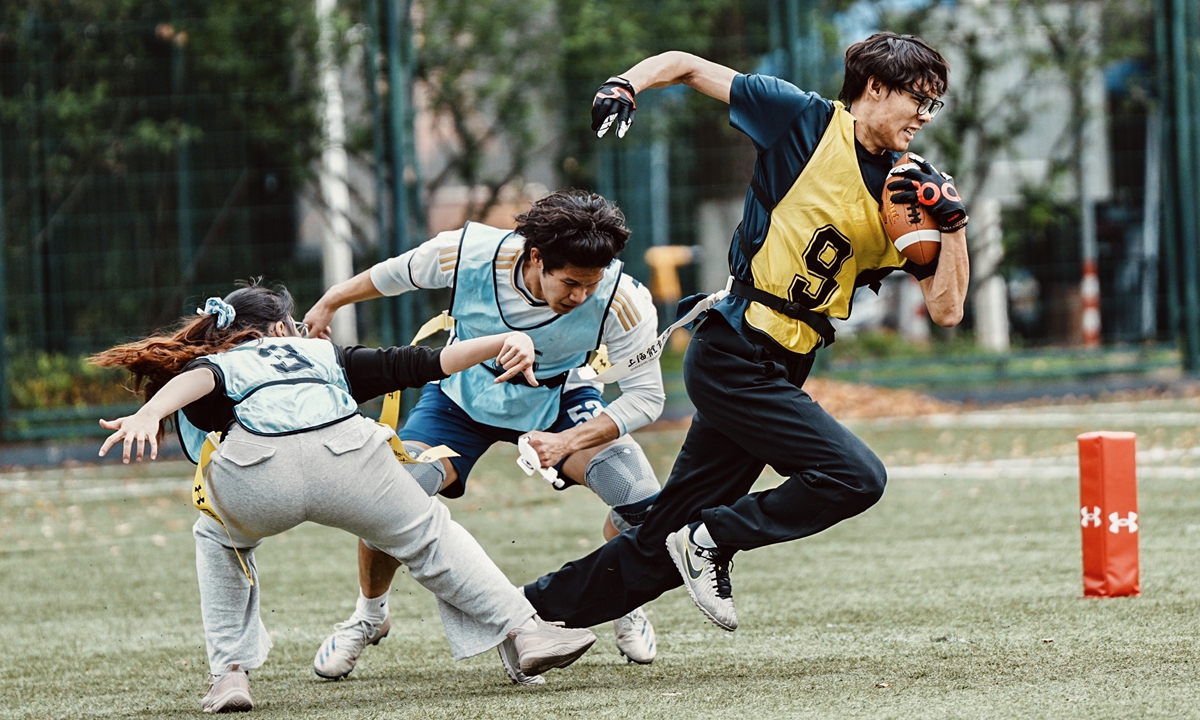
Students compete in a flag football "class super league" match at Shanghai University of Sport (SUS) on April 16, 2026. Photo: Courtesy of SUS
Spring sunlight spilled across the green pitch at Shanghai University of Sport (SUS), where colorful flag belts fluttered in the breeze. Wei Yundi, 19, ran his route with precision, caught the ball, and sprinted forward, carrying the ball into the end zone to the roar of the crowd. In that adrenaline-charged moment, Wei clenched his fist and embraced his teammates tightly.
The first-year student had only formally encountered flag football a few days earlier. Before that, his impression of the sport - still relatively niche in China - was limited to, as he put it, "a retired NBA player I liked happened to play it."
The event that had so many beginners buzzing with excitement was SUS' "class super league," or "ban chao" in Chinese, which, according to the university, is the first campus-wide, class-based league of its kind at a Chinese higher education institution.
A total of 100 class teams across the university signed up enthusiastically, with participation approaching half of the student body, as sports majors and non-sports majors compete side by side.
China's 2026 Report on the Work of the Government calls to "fully implement the Healthy Schools Initiative, strengthen physical, aesthetic, labor skills and mental health education, and improve the school-family-society collaboration mechanism to ensure that students are physically and mentally healthy and realize well-rounded development." As the country's "village super leagues" has gradually gained popularity, the wave of mass sports has flowed into campuses in a younger, more nuanced form, seeking to bridge the "last mile" of youth sports.
At SUS, the starting point of that "mile" is flag football, a sport mainly popular in the West but still relatively obscure in China. The reason for choosing such an unfamiliar event is, as Liu Jiayu, secretary of the Communist Youth League Committee of SUS and a main organizer of the event, explained, quite simple.
"Most people don't know how to play the game, which means everyone is in the same boat," Liu told the Global Times with a smile.
Stand on the field
The story of the university's "class super league" in flag football began in late 2025.
At the time, Liu was chatting with colleagues when a shared observation emerged: at institutions such as SUS, students at sports universities generally tend to have fewer psychological problems, in part because sport plays a clear role in relieving depressive moods. Yet even on this campus, where roughly half of the students are majoring in sports, traditional sports competitions often see championship titles claimed by a small group of elite performers.
If the goal was to get as many students as possible moving through the "class super league" event, then the organizers needed to find the "greatest common denominator" for all. After several rounds of brainstorming, an unexpected sport emerged: flag football.
Why flag football? Liu explained that, while many traditional popular sports, such as football, basketball and table tennis, enjoy broad participation, they often fail to expand beyond their existing player base. Flag football, by contrast, is lesser-known, but particularly well suited to young people, let alone it will be added to the 2028 Los Angeles Games. "There's no intense physical collision, the rules are simple and it's a lot of fun," Liu told the Global Times.
In early March this year, notice of the school's flag football "class super league" spread across campus. Liu had initially worried that the niche sport might not draw much interest, but within the 10-day registration period, all 100 team slots were quickly filled, covering nearly half of the classes on campus.
Wei and his classmates, first-year students in rehabilitation studies, who, in their daily lives, rarely exercised, let alone took part in team sports, signed up straight away. Joining the "class super league," Wei said, was a chance to work out more and interact with classmates outside of the classroom.
From the registration deadline there was only about one week until the first match. The university invited members of the Shanghai Flag Football Association and players from the school's flag football team to train the participants. Throughout that week, the large lawn in the dormitory area was dotted with students practicing.
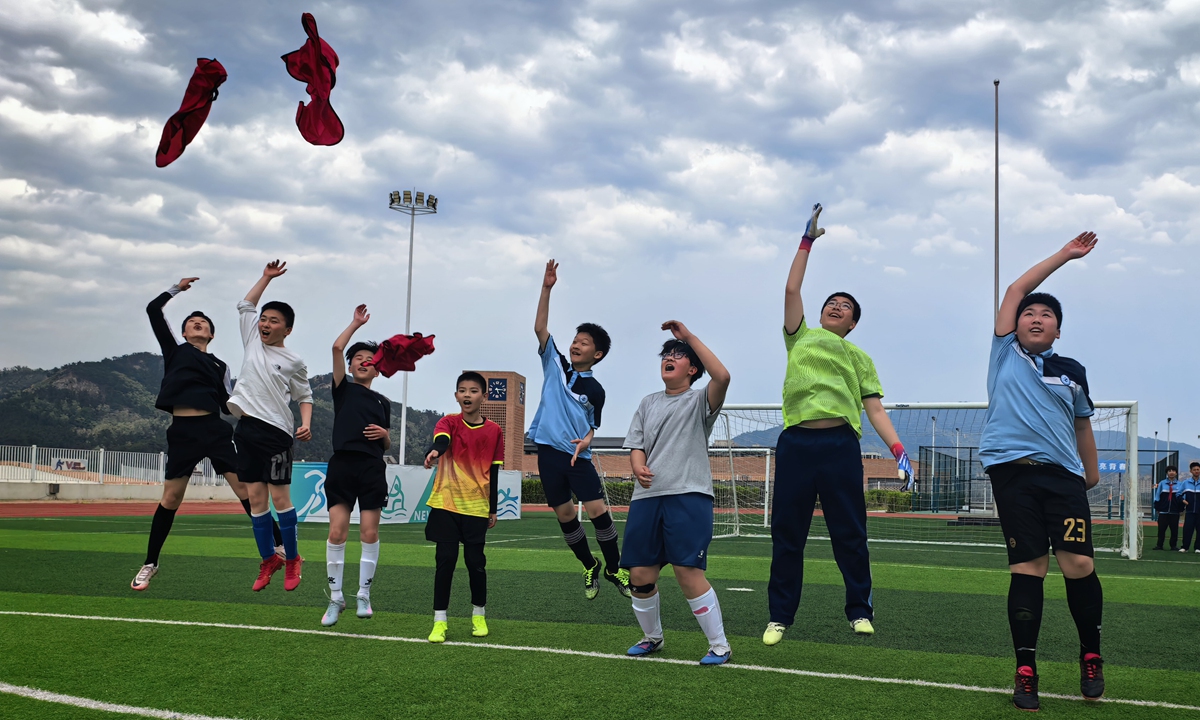
Students of Grade 7 from The Experimental School Affiliated to the Ocean University of China cheer for victory after a competition of the school's campus football tournament on May 11, 2026. Photo: Courtesy of Zhang Nianyi
According to Liu, students like Wei - non-athletes admitted through gaokao (the national college entrance examinations) - make up about 50 percent of the student body at SUS. Zhang Xixuan, a sophomore majoring in broadcasting and hosting, is one of them. Her program is designed to train sports event commentators, yet many of her classmates rarely play any sport.
Still, despite their unfamiliarity with and initial hesitation toward flag football, they were ultimately inspired by the "class super league" to sign up. Of all the 39 students majoring in broadcasting and hosting in the year, nearly 20 formed two teams to compete. With some experience in flag football, Zhang became a team captain, leading her classmates from learning the rules and practicing tactics to stepping onto the field. They were involved every step of the way, and fully experienced the joy of sport and the power of collective activity.
"For us, just being able to stand on the field means we've already won," Zhang told the Global Times.
From trend to culture
If the university-level "class super league" is still a relatively new trend, then in the broader world of basic education, where there are fewer classes and students within each class tend to be more closely connected, the "class super league" has reportedly already taken root in many primary and secondary schools across China, becoming a popular part of campus culture, the Global Times found.
On May 9, an intense football match unfolded on the soccer field of the middle school section of The Experimental School Affiliated to the Ocean University of China in Qingdao, East China's Shandong Province. Student from Grade 7 of the school were competing enthusiastically against each other. Early May in Qingdao is relatively cool, yet the students are filled with extraordinary passion for the game.
Li Shengzhe (pseudonym), a Grade 7 student who had just been taken off the field, sat on the sidelines, anxiously watching his teammates. Despite a clear strength gap with the opposite side and a high chance of defeat, Li told the Global Times that he and his teammates responded actively, stuck to tactical arrangements, cooperated closely and did their best to withstand wave after wave of attacks.
"I tell myself that sometimes we don't have to care too much about the result. What matters is to step onto the field and give it our all. In this football match, though our class lags behind the other two in football skills, I value far more the experience of our classmates uniting as one and striving relentlessly," Li said.
Zhang Nianyi, a Grade 7 teacher at the school, told the Global Times that the school had been holding football tournament for three consecutive years.
The original purpose of holding the campus football tournament is not only to spark students' interest in football through matches, but also foster a love for the game and sports in general. Education through sports helps students build physical fitness, develop mental acuity, establish a sound awareness of rules and a healthy mindset toward competition, and achieve all-round development, according to a report the school released in July 2024.
The tournament is more than just a match. It is an educational process involving everyone, according to Zhang.
Over the past three years, each tournament lasts only a short week. Nevertheless, there are diverse roles for everyone: team flag designers and coaches before the matches, athletes, cheerleaders and spectators during the games, as well as staff providing logistical support and psychological counseling. Even those who do not play, cannot play or have no interest in football can find their own place in the league. Students, parents and teachers all devote themselves wholeheartedly, giving full play to their strengths and showing their love for sports, she said.
Zheng Jiakun, a professor at School of Economics and Management of SUS, has long focused on the development of mass sports and youth sports in China. He believes that low-threshold competitions such as "class super league" help young people overcome psychological barriers to sports participation.
"We often say that the biggest challenge in youth sports, is not finding a place for those who already love sports, but getting people to try sport for the first time," Zheng told the Global Times.
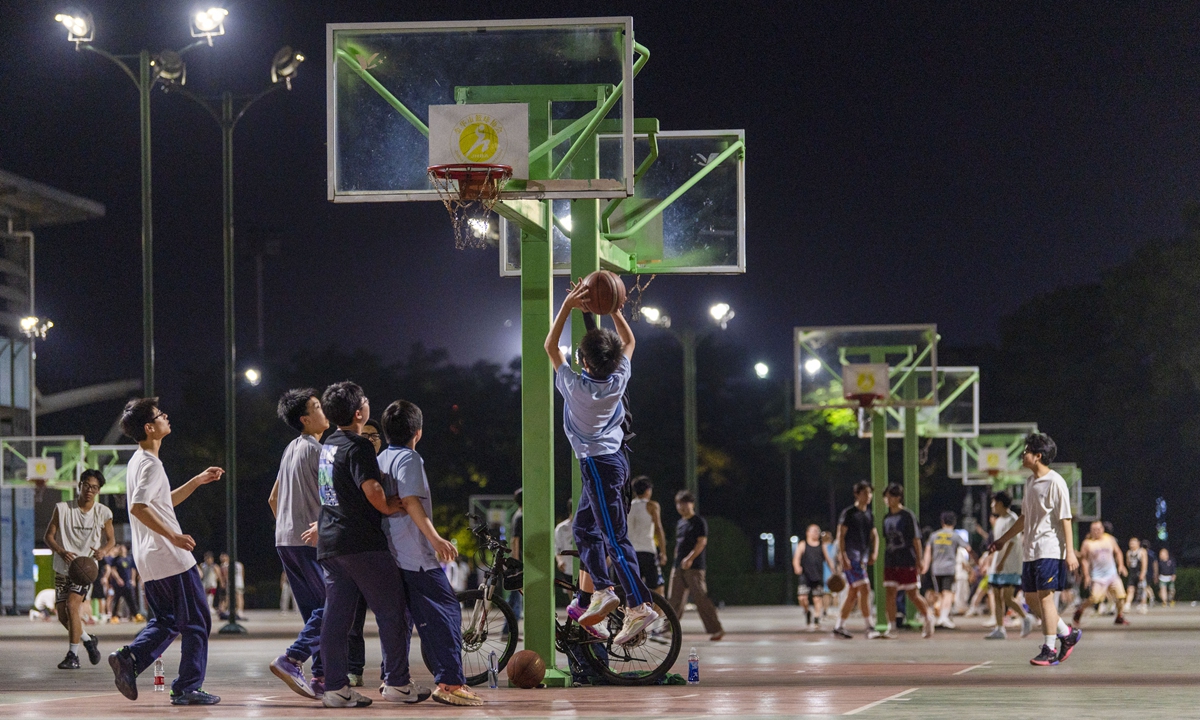
Teenagers play basketball at a national fitness center in Jinhua, East China's Zhejiang Province, on May 9, 2026. Photo: VCG
A symbol of youth sports
In recent years, the "class super league" craze has swept across campuses nationwide, emerging as a symbol of youth sports development.
This year, for instance, Beijing will host 400,000 primary and secondary school "class super league" matches, with more than 10 million students participating, reported CCTV News on March 18. In Rongjiang County of Southwest China's Guizhou Province, local organizers have held more than 4,800 campus football "class super league" matches, involving more than 48,300 people in total, according to the Rongjiang government website on February 10.
Behind this wave of enthusiasm lies strong policy guidance and strategic support from the country. In November 2025, five government departments, including the Ministry of Education, jointly issued a document, calling for promoting the high-quality development of school sports. The Recommendations of the Central Committee of the Communist Party of China for Formulating the 15th Five-Year (2026-2030) Plan for National Economic and Social Development also stresses that, recreational and competitive sports should be developed through a coordinated approach to see that we make faster progress in building China into a country strong in sports.
Zheng said the "class super league" model, with its low barrier to entry and high level of participation, holds great value in improving the physical and mental health of young people. "It turns exercise into a process in which a group of people strive together toward a shared goal, and through passing the balls, running and teamwork, it builds genuine, warm social connections," the expert said.
RELATED ARTICLES