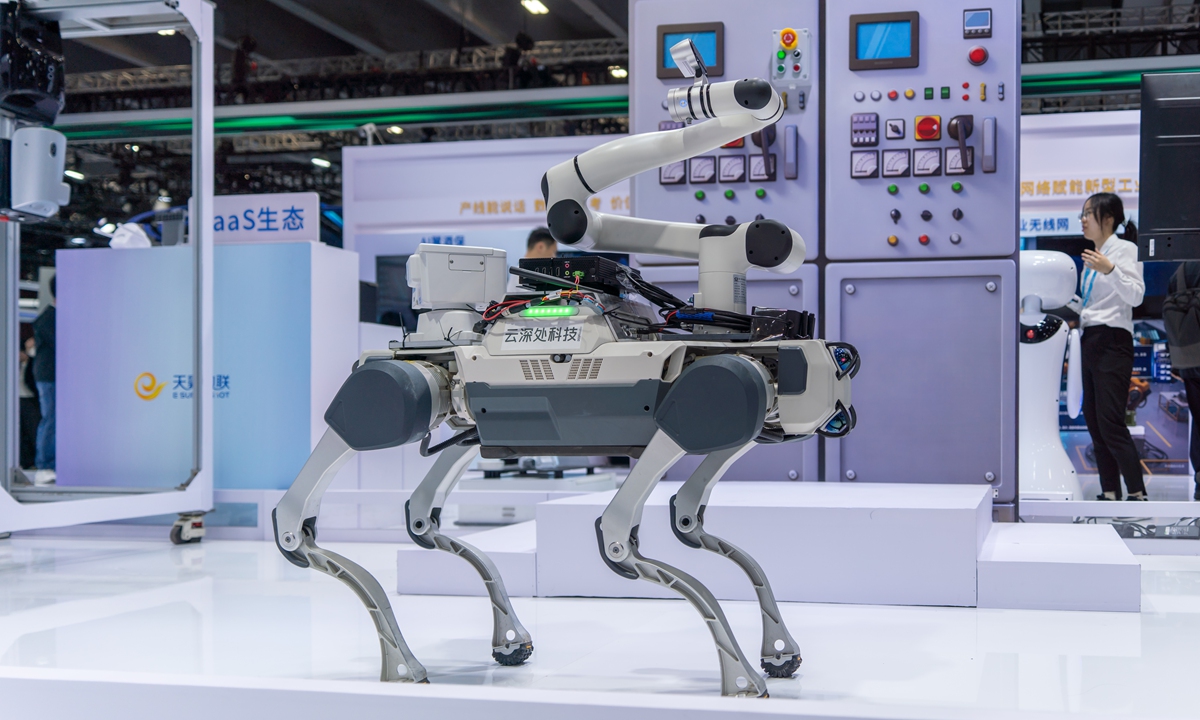
Quadruped robots developed by DEEP Robotics Photo: VCG
A delegation from the Japan-China Economic Association visited Hangzhou‑based DEEP Robotics on Wednesday as part of its five‑day tour of Shanghai and Hangzhou in East China's Zhejiang Province, a move that Chinese experts said signals the Japanese business community's willingness to pursue pragmatic cooperation with China as bilateral relations face serious strain from Japanese Prime Minister Sanae Takaichi's erroneous remarks on China's Taiwan region.
DEEP Robotics told the Global Times on Wednesday that the Japan-China Economic Association visited its facility to view a range of intelligent robot models and attend on-site functional demonstrations.
"During the visit, some Japanese delegates voiced strong interest in introducing quadruped robots into airport and power industry scenarios. They were impressed by the rapid progress of China's robotics industry as a whole," a representative of DEEP Robotics told the Global Times.
According to Japanese media outlet Nikkei, the Japan-China Economic Association sent a delegation to Shanghai and Hangzhou for a five-day visit that started on Monday. With a focus on robotics industry developments, approximately 30 representatives of Japanese manufacturers and trading firms are scheduled to tour robotics exhibitions and industrial chain enterprises, and hold face-to-face talks with local business leaders.
The visit shows that Japan's business community is eager to resume pragmatic exchanges with China even as bilateral relations face severe difficulties rooted in Takaichi's erroneous remarks on China's Taiwan region, Lü Chao, an expert at the Liaoning Academy of Social Sciences, told the Global Times on Wednesday.
Boasting massive economic scale and huge consumer demand, China has registered rapid progress in robotics, artificial intelligence (AI) and other cutting-edge sectors, emerging as an indispensable cooperation destination for Japanese enterprises, Lü said.
As a core growth engine of the global robotics industry, China's industrial strength continues to rise. Data from China's General Administration of Customs shows the country's industrial robot exports rose 48.7 percent in 2025, surpassing imports for the first time and making China a net exporter of industrial robots.
DEEP Robotics told the Global Times that it has already engaged in technological and business exchanges with leading Japanese enterprises and institutions. For example, its quadruped robots have been deployed in Japanese automotive manufacturing plants for intelligent patrol inspection and material handling, helping boost operational efficiency and automation in complex industrial scenarios.
Beyond the May visit, the Japan-China Economic Association has planned a July trip to Hefei, East China's Anhui Province, which is accelerating industrial upgrading toward AI and semiconductors, according to Nikkei.
Sasaki Nobuhiko, director-general of the Japan-China Economic Association, said that China's advanced technologies have made remarkable strides within a year, and learning from China's industrial competitiveness has become a key task for Japanese businesses, according to Nikkei.
A survey released in February by the Japanese Chamber of Commerce and Industry in China showed that 59 percent of respondents planned to expand or maintain their investment scale in China under their 2026 investment plans, up three percentage points from the previous survey. Those opting to boost investment cited the aim of securing competitiveness and developing new products and services.
China, as the world's second-largest economy with massive economic scale, has long maintained solid supply-demand ties and a mature industrial supply chain with Japan, laying a very sound foundation for bilateral economic and trade cooperation. However, erroneous remarks made by Takaichi have undermined bilateral relations, causing a severe negative impact on China-Japan economic and trade exchanges and cooperation. Such developments run counter to the interests of Japan's business community, Lü said.
"China-Japan relations are currently facing serious difficulties, and the root cause lies in Japanese Prime Minister Sanae Takaichi's erroneous remarks related to the Taiwan question. The responsibility lies entirely with the Japanese side," Chinese Foreign Ministry spokesperson Lin Jian said on Thursday, when responding to a Japanese media inquiry about whether China hopes to restore people-to-people exchanges between the two countries amid increasingly reduced exchanges between Japan and China.
Lin said that if the Japanese side truly wants to improve China-Japan relations, it should abide by the four political documents between China and Japan and its own commitments, retract the erroneous remarks, take concrete actions to safeguard the political foundation of bilateral relations, and create the necessary conditions for normal exchanges and interactions between the two countries.
RELATED ARTICLES