Italy-based Chinese artist shares cross-cultural art journey in Beijing
Italy-based Chinese artist shares cross-cultural art journey
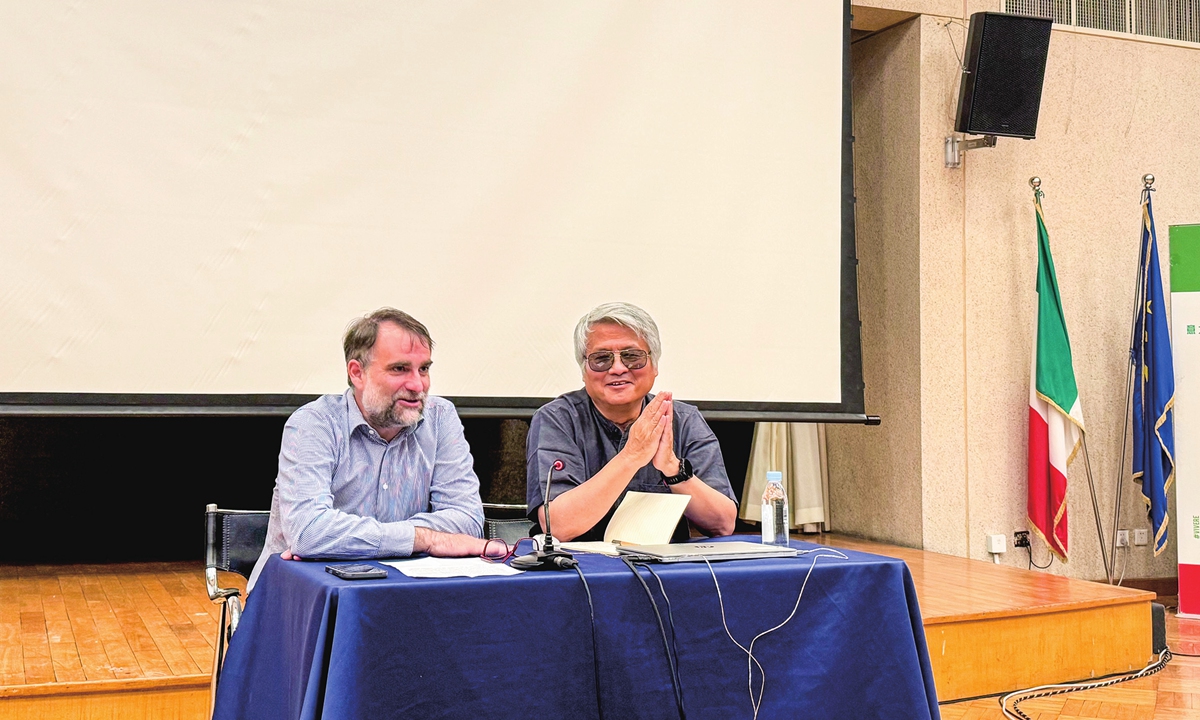
Federico Antonelli, cultural counselor of the Italian Embassy in China (left), and Zhou Zhiwei, a Chinese painter based in Italy, at a lecture in Beijing on May 12, 2026. Photo: Dong Feng/GT
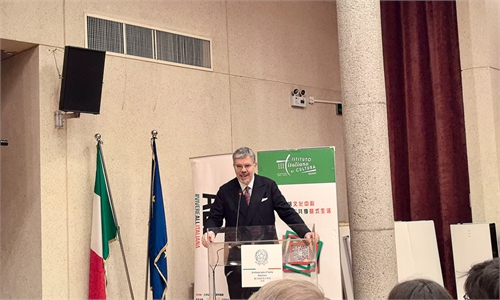
The Italian Cultural Institute in Beijing hosted a lecture on Tuesday, inviting Zhou Zhiwei, a Chinese painter based in Italy, to share his journey pursuing his art dream and becoming a renowned artist over the past four decades. Zhou recounted his creative journey and his reflections on the encounter between cultures, taking the audience on an artistic contact between the East and the Mediterranean.Federico Antonelli, cultural counselor of the Italian Embassy in China, chaired the lecture. Antonelli recalled Zhou's first art exhibition staged at the Italian Cultural Institute in Beijing, in 1984.
Antonelli said that Zhou's journey is unique, "as it is not just the convergence of Eastern and Western cultures, but also a dialogue between history and reality, tradition and contemporary art."
Born in Shanghai in 1954, Zhou studied painting since he was a boy, apprenticing under renowned oil painter Yu Yunjie and Liu Kemin, a professor at the Central Academy of Fine Arts and Tongji University, thus establishing a solid foundation in artistic creation.
Zhou is one of the young artists who emerged in Shanghai in the 1970s, and along with Chen Danqing, Chen Jifei, Wei Jingshan, and other well-known artists, he is a prominent representative of the Shanghai art scene during that period.
Zhou shared his creative journey and cross-cultural artistic reflections, focusing on his solo exhibition Notes along the Way.
From China to Italy, Zhou's artistic journey has been marked by constant intercultural exploration and profound introspection. In 1980, he entered the Academy of Fine Arts in Venice, becoming part of an internationally renowned artistic education system. There, he met masters of contemporary art such as Bruno Saetti and Emilio Vedova, from whom he drew significant inspiration.
Zhou said that for a Chinese painter, it is not so easy to get acknowledged among Italian artists. "One has to get into their circle and learn their techniques," he added.
His experience in Florence with the master Pietro Annigoni (1910-1988) and his learning of fresco and tempera grassa techniques laid a solid foundation for his subsequent work. His encounter with the master Riccardo Tommasi Ferroni (1934-2000) further transformed Zhou's artistic language, allowing him to find, within tradition, a personal and original means of expression.
His training in Italy was not only a study of Western art techniques, but also a journey into his own inner self. Zhou's works have always been grounded in a refined mastery of classical Italian painting, yet they observe and interpret the world through an Eastern lens.
The exhibition summarizes and presents his journey through the many intersections of cultures. The Mediterranean, an ancient and captivating sea, holds a long history and extraordinary cultural diversity.
Zhou told the Global Times that his exhibition presents not only his artistic practice but also his inner journey. These works testify to his spirit of continuous innovation within the framework of tradition and, at the same time, his exploration of the theme of cultural encounter and the profound connection between art and interiority.
The exhibition revolves around the Mediterranean. Each work, through the medium of his brush, recounts a stage in Zhou's personal journey. Both in the figurative representations and in the sometimes more abstract forms, a reflection on the meaning of existence and memory emerges, demonstrating how an artist can integrate thought and emotion into the creative process.
Traversing this cultural bridge spanning time and space, Zhou connects the spiritual world of Chinese tradition with the forms of Italian classicism, sparking an intense and fruitful exchange, said Antonelli.
RELATED ARTICLES